Why Hormuz diplomacy is stuck on who moves first
Iran hardened its Hormuz conditions this week as US-Iranian messages passed through mediators around the UN General Assembly.
US and Iranian officials exchanged proposals through mediators in New York, but the contacts clarified positions rather than becoming formal negotiations.[1] Tehran insists Washington must remove the blockade and meet Iranian conditions first, while Washington wants Iran to demonstrate sufficient g…
US and Iranian officials exchanged proposals through mediators in New York, but the contacts clarified positions rather than becoming formal negotiations.[1] Tehran insists Washington must remove the blockade and meet Iranian conditions first, while Washington wants Iran to demonstrate sufficient goodwill before receiving concessions.[1] Britain separately urged de-escalation and reopening Hormuz, while the Russian and Iranian foreign ministers said diplomacy was the only solution to the conflict.[3][4]
Why it matters: The Strait of Hormuz normally handles a fifth of global oil and gas shipments, making its closure a global economic and security problem rather than solely a US-Iran dispute.[3] The impasse is also driving discussion of a Western-backed UN Security Council initiative supporting an international mission to protect navigation, which Iran opposes.[1]
Key insights: Iran says it has sent seven conditions to the US through Pakistan and Qatar and will neither reopen Hormuz nor negotiate until they are met.[1] | About 80 countries backed a UN statement demanding the waterway’s urgent reopening and condemning attacks on regional states and international shipping.[1] | Europe and Washington are discussing a separately drafted Security Council initiative designed to have a better chance of attracting Chinese and Russian support.[1] | The UK meeting also covered alleged Iranian-linked threats on British soil and the detention of British couple Lindsay and Craig Foreman.[3]
Cheatsheet facts: What changed: Tehran moved from mediated message exchanges to an explicit demand that Washington act first on seven conditions before negotiations or reopening Hormuz.[1] | Why now: Economic pressure from the blockade, high oil prices and US political concern over fuel costs are increasing the incentive for action.[1] | Watch next: Watch for a US response to Iran’s conditions and for the Western-backed Security Council text on a maritime protection mission to be formally advanced.[1]
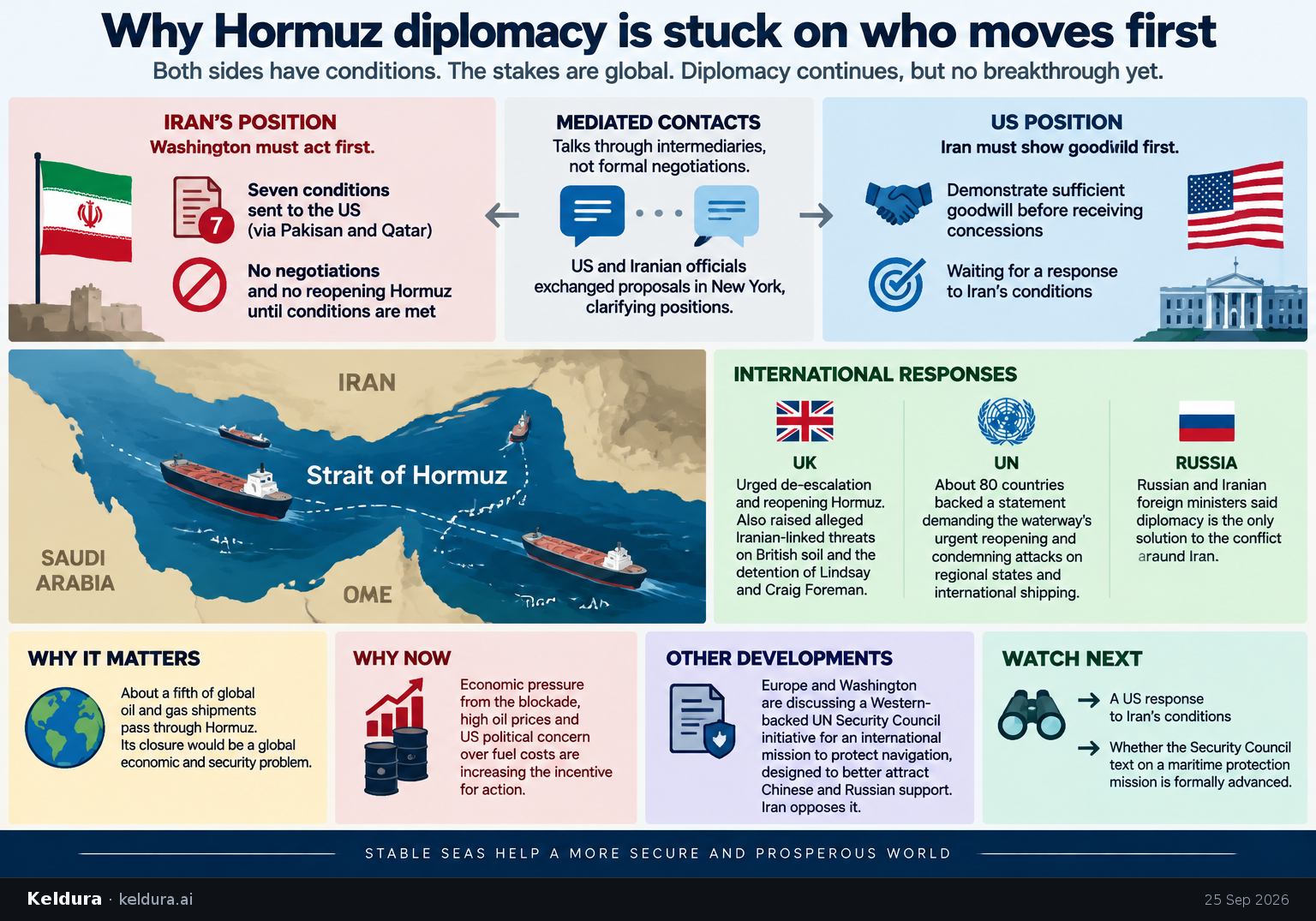
US and Iranian officials exchanged proposals through mediators in New York, but the contacts clarified positions rather than becoming formal negotiations.[1] Tehran insists Washington must remove the blockade and meet Iranian conditions first, while Washington wants Iran to demonstrate sufficient goodwill before receiving concessions.[1] Britain separately urged de-escalation and reopening Hormuz, while the Russian and Iranian foreign ministers said diplomacy was the only solution to the conflict.[3][4]
Why it matters: The Strait of Hormuz normally handles a fifth of global oil and gas shipments, making its closure a global economic and security problem rather than solely a US-Iran dispute.[3] The impasse is also driving discussion of a Western-backed UN Security Council initiative supporting an international mission to protect navigation, which Iran opposes.[1]
Key insights: Iran says it has sent seven conditions to the US through Pakistan and Qatar and will neither reopen Hormuz nor negotiate until they are met.[1] | About 80 countries backed a UN statement demanding the waterway’s urgent reopening and condemning attacks on regional states and international shipping.[1] | Europe and Washington are discussing a separately drafted Security Council initiative designed to have a better chance of attracting Chinese and Russian support.[1] | The UK meeting also covered alleged Iranian-linked threats on British soil and the detention of British couple Lindsay and Craig Foreman.[3]
Cheatsheet facts: What changed: Tehran moved from mediated message exchanges to an explicit demand that Washington act first on seven conditions before negotiations or reopening Hormuz.[1] | Why now: Economic pressure from the blockade, high oil prices and US political concern over fuel costs are increasing the incentive for action.[1] | Watch next: Watch for a US response to Iran’s conditions and for the Western-backed Security Council text on a maritime protection mission to be formally advanced.[1]
X copy pack
[1] Iran hardens Hormuz stance as New York diplomacy struggles for breakthrough | The National — thenationalnews.com[3] Miliband tells Iran minister UK will not tolerate 'hostile activity' on British soil — BBC World[4] Russian, Iranian foreign ministers say only diplomatic solution to conflict around Iran | Reuters — reuters.comRead in BriefingsPost to X