How strikes on Ukraine are testing NATO’s escalation controls
Nato aircraft deployed over Poland and Romania as Russia launched another wave of missiles and drones against Ukraine; Poland scrambled.
Nato aircraft deployed over Poland and Romania as Russia launched another wave of missiles and drones against Ukraine; Poland scrambled fighters, while Romania sent two F-16s toward a detected target near the border.[1] Ukraine said Russia launched 161 drones, including 82 jet-powered models, as st…
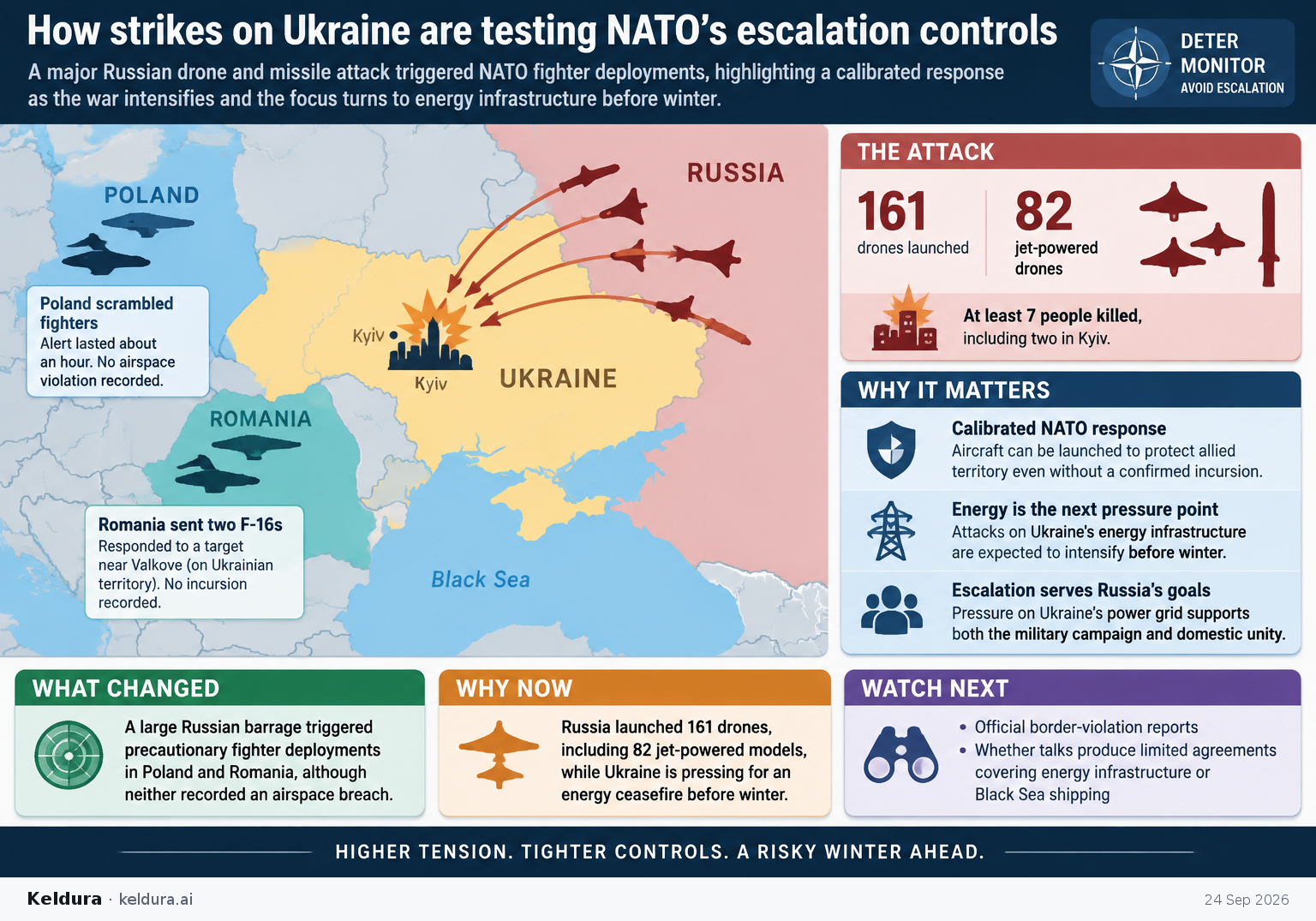
Nato aircraft deployed over Poland and Romania as Russia launched another wave of missiles and drones against Ukraine; Poland scrambled fighters, while Romania sent two F-16s toward a detected target near the border.[1] Ukraine said Russia launched 161 drones, including 82 jet-powered models, as strikes killed at least seven people, including two in Kyiv.[1] At the UN, Volodymyr Zelensky called for an energy ceasefire and continued pressure on Russian revenues before winter.[1]
Why it matters: The deployments demonstrate a calibrated NATO response: aircraft can be launched to protect allied territory even when authorities find no confirmed airspace incursion.[1] The next escalation pressure point is energy infrastructure, with Ukraine and its allies seeking limited arrangements before winter as Moscow intensifies attacks and Kyiv threatens retaliation.[1][2]
Key insights: Poland’s alert lasted about an hour and ended without any recorded airspace violation.[1] | Romania’s two F-16s responded to a target manoeuvring near Valkove on Ukrainian territory; Romanian authorities also reported no incursion.[1] | Foreign Affairs describes escalation as serving both Russia’s military campaign and the Kremlin’s domestic demand for unity, with further pressure on Ukraine’s power grid expected during winter.[2] | Zelensky urged governments to target Russia’s revenues and warned that Ukraine would make winter painful for Russia if attacks on energy systems continued.[1]
Cheatsheet facts: What changed: A large Russian barrage triggered precautionary fighter deployments in two NATO countries, although neither Poland nor Romania recorded an airspace breach.[1] | Why now: Russia launched 161 drones, including 82 jet-powered drones, while Kyiv is pressing for an energy ceasefire before winter.[1] | Watch next: Watch official border-violation reports and whether talks produce limited agreements covering energy infrastructure or Black Sea shipping.[1]
Nato aircraft deployed over Poland and Romania as Russia launched another wave of missiles and drones against Ukraine; Poland scrambled fighters, while Romania sent two F-16s toward a detected target near the border.[1] Ukraine said Russia launched 161 drones, including 82 jet-powered models, as strikes killed at least seven people, including two in Kyiv.[1] At the UN, Volodymyr Zelensky called for an energy ceasefire and continued pressure on Russian revenues before winter.[1]
Why it matters: The deployments demonstrate a calibrated NATO response: aircraft can be launched to protect allied territory even when authorities find no confirmed airspace incursion.[1] The next escalation pressure point is energy infrastructure, with Ukraine and its allies seeking limited arrangements before winter as Moscow intensifies attacks and Kyiv threatens retaliation.[1][2]
Key insights: Poland’s alert lasted about an hour and ended without any recorded airspace violation.[1] | Romania’s two F-16s responded to a target manoeuvring near Valkove on Ukrainian territory; Romanian authorities also reported no incursion.[1] | Foreign Affairs describes escalation as serving both Russia’s military campaign and the Kremlin’s domestic demand for unity, with further pressure on Ukraine’s power grid expected during winter.[2] | Zelensky urged governments to target Russia’s revenues and warned that Ukraine would make winter painful for Russia if attacks on energy systems continued.[1]
Cheatsheet facts: What changed: A large Russian barrage triggered precautionary fighter deployments in two NATO countries, although neither Poland nor Romania recorded an airspace breach.[1] | Why now: Russia launched 161 drones, including 82 jet-powered drones, while Kyiv is pressing for an energy ceasefire before winter.[1] | Watch next: Watch official border-violation reports and whether talks produce limited agreements covering energy infrastructure or Black Sea shipping.[1]