Why Hormuz and the Red Sea are becoming one diplomatic crisis
Diplomats gathered in New York are trying to reopen Gulf shipping, restrain Houthi attacks and create a path back to US-Iran negotiations.
Qatar says mediators have spent nearly two weeks exchanging proposals intended to secure a short-term US-Iran agreement, while Gulf states discuss broader regional security arrangements.[6] At the same time, the G7 has demanded that Iran end its support for Yemen’s Houthis, whose attacks and territ…
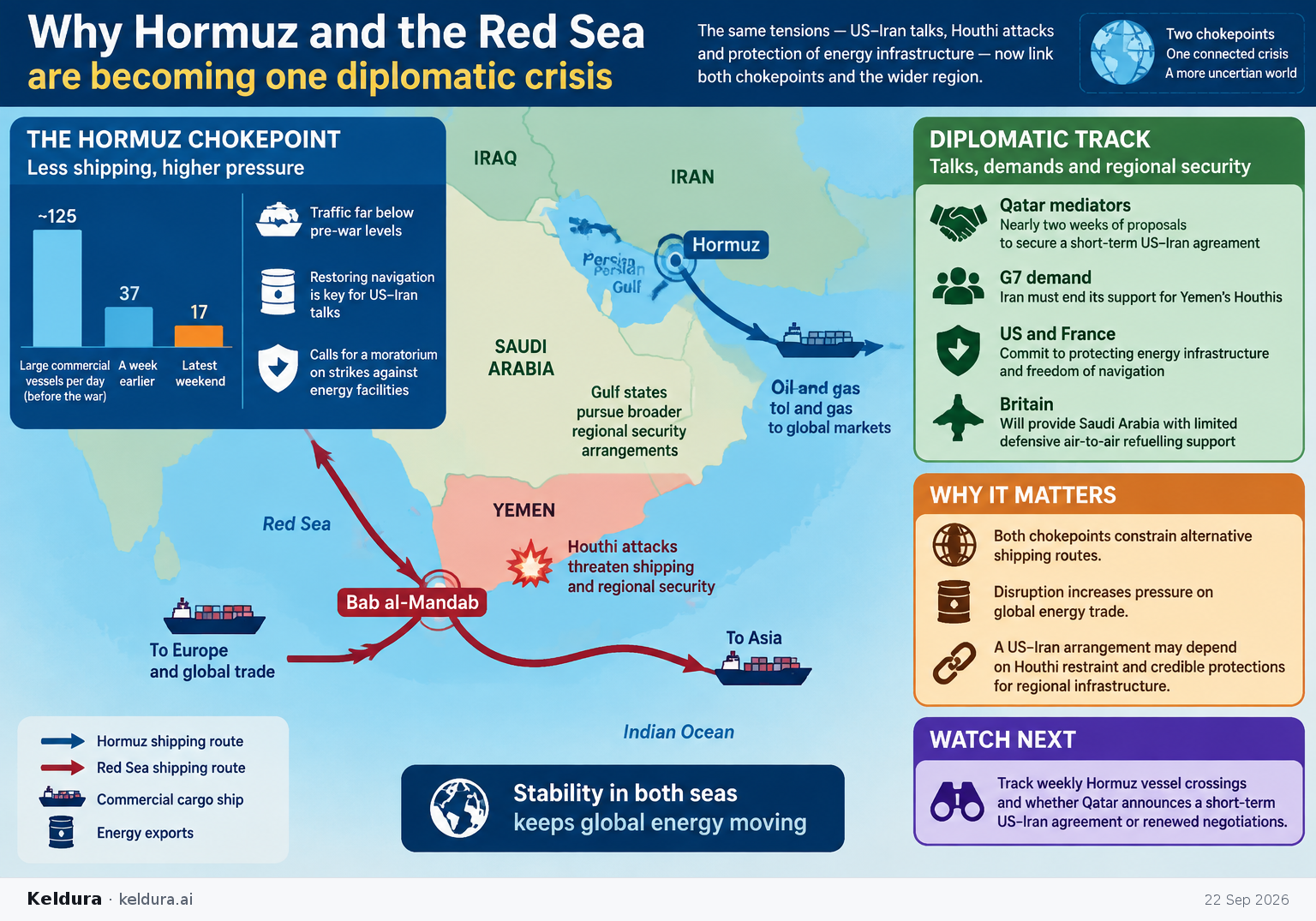
Qatar says mediators have spent nearly two weeks exchanging proposals intended to secure a short-term US-Iran agreement, while Gulf states discuss broader regional security arrangements.[6] At the same time, the G7 has demanded that Iran end its support for Yemen’s Houthis, whose attacks and territorial advances threaten Saudi Arabia, civilian shipping and the Bab al-Mandab trade route.[2][6] Shipping through Hormuz remains far below pre-war levels, linking diplomacy directly to energy infrastructure and freedom of navigation.[6]
Why it matters: Hormuz and Bab al-Mandab sit on separate sides of the Arabian Peninsula, but disruption at both constrains alternative shipping routes and increases pressure on global energy trade.[2][6][8] The overlapping crises also mean that a narrow US-Iran arrangement may depend on Houthi restraint and credible protections for regional infrastructure.[2][6]
Key insights: Only 17 commodity vessels crossed Hormuz over the latest weekend, compared with 37 a week earlier and about 125 large commercial vessels per day before the war.[6] | Qatar says restoring navigation through Hormuz and removing the threat of military action are necessary for meaningful US-Iran talks.[6] | France and the United States said they would work to protect critical energy infrastructure and freedom of navigation while seeking a moratorium on strikes against energy facilities.[6] | Britain agreed to provide Saudi Arabia with limited defensive air-to-air refuelling support as Houthi attacks intensified.[2][6]
Cheatsheet facts: What changed: UN diplomacy now links US-Iran talks, Hormuz access, Houthi attacks and protection of regional energy infrastructure.[2][6] | Why now: Hormuz traffic remains sharply depressed, while Houthi activity is making the Red Sea route near Bab al-Mandab more dangerous.[2][6][8] | Watch next: Track weekly Hormuz vessel crossings and whether Qatar announces a short-term US-Iran agreement or renewed negotiations.[6]
Qatar says mediators have spent nearly two weeks exchanging proposals intended to secure a short-term US-Iran agreement, while Gulf states discuss broader regional security arrangements.[6] At the same time, the G7 has demanded that Iran end its support for Yemen’s Houthis, whose attacks and territorial advances threaten Saudi Arabia, civilian shipping and the Bab al-Mandab trade route.[2][6] Shipping through Hormuz remains far below pre-war levels, linking diplomacy directly to energy infrastructure and freedom of navigation.[6]
Why it matters: Hormuz and Bab al-Mandab sit on separate sides of the Arabian Peninsula, but disruption at both constrains alternative shipping routes and increases pressure on global energy trade.[2][6][8] The overlapping crises also mean that a narrow US-Iran arrangement may depend on Houthi restraint and credible protections for regional infrastructure.[2][6]
Key insights: Only 17 commodity vessels crossed Hormuz over the latest weekend, compared with 37 a week earlier and about 125 large commercial vessels per day before the war.[6] | Qatar says restoring navigation through Hormuz and removing the threat of military action are necessary for meaningful US-Iran talks.[6] | France and the United States said they would work to protect critical energy infrastructure and freedom of navigation while seeking a moratorium on strikes against energy facilities.[6] | Britain agreed to provide Saudi Arabia with limited defensive air-to-air refuelling support as Houthi attacks intensified.[2][6]
Cheatsheet facts: What changed: UN diplomacy now links US-Iran talks, Hormuz access, Houthi attacks and protection of regional energy infrastructure.[2][6] | Why now: Hormuz traffic remains sharply depressed, while Houthi activity is making the Red Sea route near Bab al-Mandab more dangerous.[2][6][8] | Watch next: Track weekly Hormuz vessel crossings and whether Qatar announces a short-term US-Iran agreement or renewed negotiations.[6]
X copy pack
[6] Iran diplomacy intensifies at UN as Hormuz crisis keeps pressure on region | Iran International — iranintl.com[2] Iran must stop arming Houthis in Yemen, G7 says ahead of UN General Assembly — BBC World[8] Trump returns to UN at a moment of anxiety about Iran, AI and the future of world body itself – WTOP News — wtop.comRead in BriefingsPost to X