How pressure in the Strait of Hormuz is becoming an international coalition test
Hundreds of thousands attended a government-orchestrated rally in Tehran, while the Revolutionary Guard said it had struck another tanker.
Hundreds of thousands attended a government-orchestrated rally in Tehran, while the Revolutionary Guard said it had struck another tanker amid a US naval blockade and new sanctions.[7] South Korean Foreign Minister reaffirmed to Rubio that Seoul intended to contribute substantively to restoring fre…
Hundreds of thousands attended a government-orchestrated rally in Tehran, while the Revolutionary Guard said it had struck another tanker amid a US naval blockade and new sanctions.[7] South Korean Foreign Minister reaffirmed to Rubio that Seoul intended to contribute substantively to restoring free passage through the Strait of Hormuz, according to South Korea’s foreign ministry.[1]
Why it matters: The combination of tanker attacks, a naval blockade and outside governments considering contributions turns control of Hormuz into both an energy-security problem and a test of how broadly the conflict draws in US partners.[1][7]
Key insights: The Tehran rally presented a mass show of defiance in which participants vowed to take up arms as the war with the United States and Israel continued.[7] | Iran’s Janfaday-e Iran campaign is adding civilian trainees alongside Revolutionary Guard and Basij forces, raising concerns that the mobilization could also reinforce the state’s capacity to suppress future protests.[7] | The Revolutionary Guard’s claimed tanker strike would further restrict energy flows through a maritime chokepoint already under pressure from blockade and sanctions.[7] | Seoul’s message to Rubio indicates that efforts to restore navigation could involve partners beyond the immediate combatants, although the cited statement did not specify South Korea’s contribution.[1]
Cheatsheet facts: What changed: Iran coupled domestic wartime mobilization with a claimed new tanker strike, while South Korea publicly expressed willingness to contribute to restoring free passage through Hormuz.[1][7] | Why now: A US naval blockade, new sanctions and attacks on tankers are increasing pressure on Iran while constricting global energy flows through the strait.[7] | Watch next: Watch for Seoul to specify what its “substantive” contribution will involve and for verified reports of further tanker attacks or restored passage through Hormuz.[1][7]
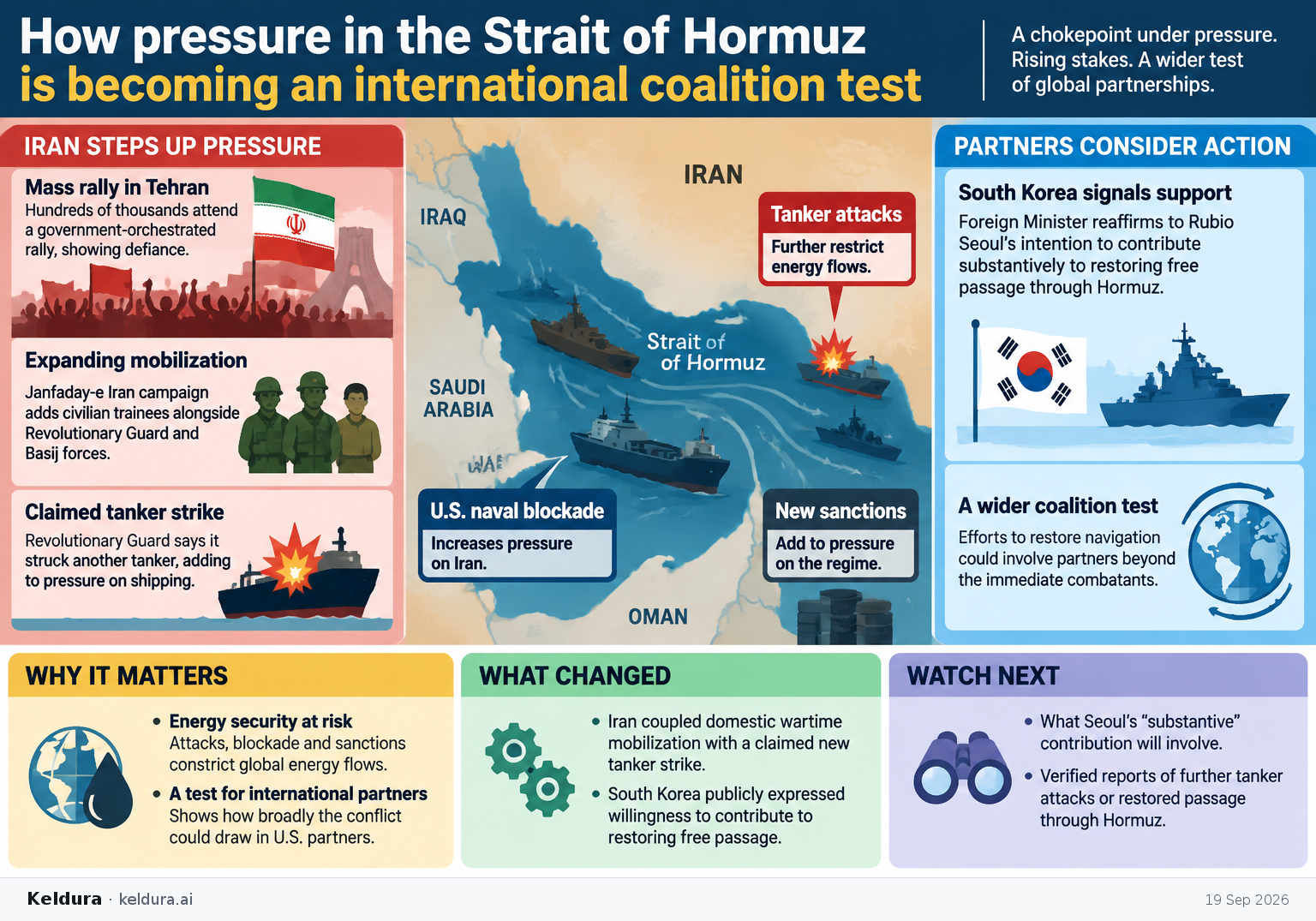
Hundreds of thousands attended a government-orchestrated rally in Tehran, while the Revolutionary Guard said it had struck another tanker amid a US naval blockade and new sanctions.[7] South Korean Foreign Minister reaffirmed to Rubio that Seoul intended to contribute substantively to restoring free passage through the Strait of Hormuz, according to South Korea’s foreign ministry.[1]
Why it matters: The combination of tanker attacks, a naval blockade and outside governments considering contributions turns control of Hormuz into both an energy-security problem and a test of how broadly the conflict draws in US partners.[1][7]
Key insights: The Tehran rally presented a mass show of defiance in which participants vowed to take up arms as the war with the United States and Israel continued.[7] | Iran’s Janfaday-e Iran campaign is adding civilian trainees alongside Revolutionary Guard and Basij forces, raising concerns that the mobilization could also reinforce the state’s capacity to suppress future protests.[7] | The Revolutionary Guard’s claimed tanker strike would further restrict energy flows through a maritime chokepoint already under pressure from blockade and sanctions.[7] | Seoul’s message to Rubio indicates that efforts to restore navigation could involve partners beyond the immediate combatants, although the cited statement did not specify South Korea’s contribution.[1]
Cheatsheet facts: What changed: Iran coupled domestic wartime mobilization with a claimed new tanker strike, while South Korea publicly expressed willingness to contribute to restoring free passage through Hormuz.[1][7] | Why now: A US naval blockade, new sanctions and attacks on tankers are increasing pressure on Iran while constricting global energy flows through the strait.[7] | Watch next: Watch for Seoul to specify what its “substantive” contribution will involve and for verified reports of further tanker attacks or restored passage through Hormuz.[1][7]
X copy pack
[7] Iranians rally by the hundreds of thousands in biggest show of defiance since war began - Los Angeles Times — latimes.com[1] (URGENT) S. Korean FM reaffirms to Rubio Seoul's will to contribute substantively to restoring free passage through Hormuz Strait: foreign ministry | Yonhap News Agency — en.yna.co.krRead in BriefingsPost to X