How Houthi gains are squeezing Saudi Arabia’s alternative oil corridor
Yemen’s Iran-aligned Houthis launched a new wave of attacks against Saudi Arabia and consolidated positions along Yemen’s western coast.
Yemen’s Iran-aligned Houthis launched a new wave of attacks against Saudi Arabia and consolidated positions along Yemen’s western coast as Gulf states postponed talks over reopening the Strait of Hormuz.[3] Separately, regional officials said the Saudi East-West Pipeline could remain largely unavai…
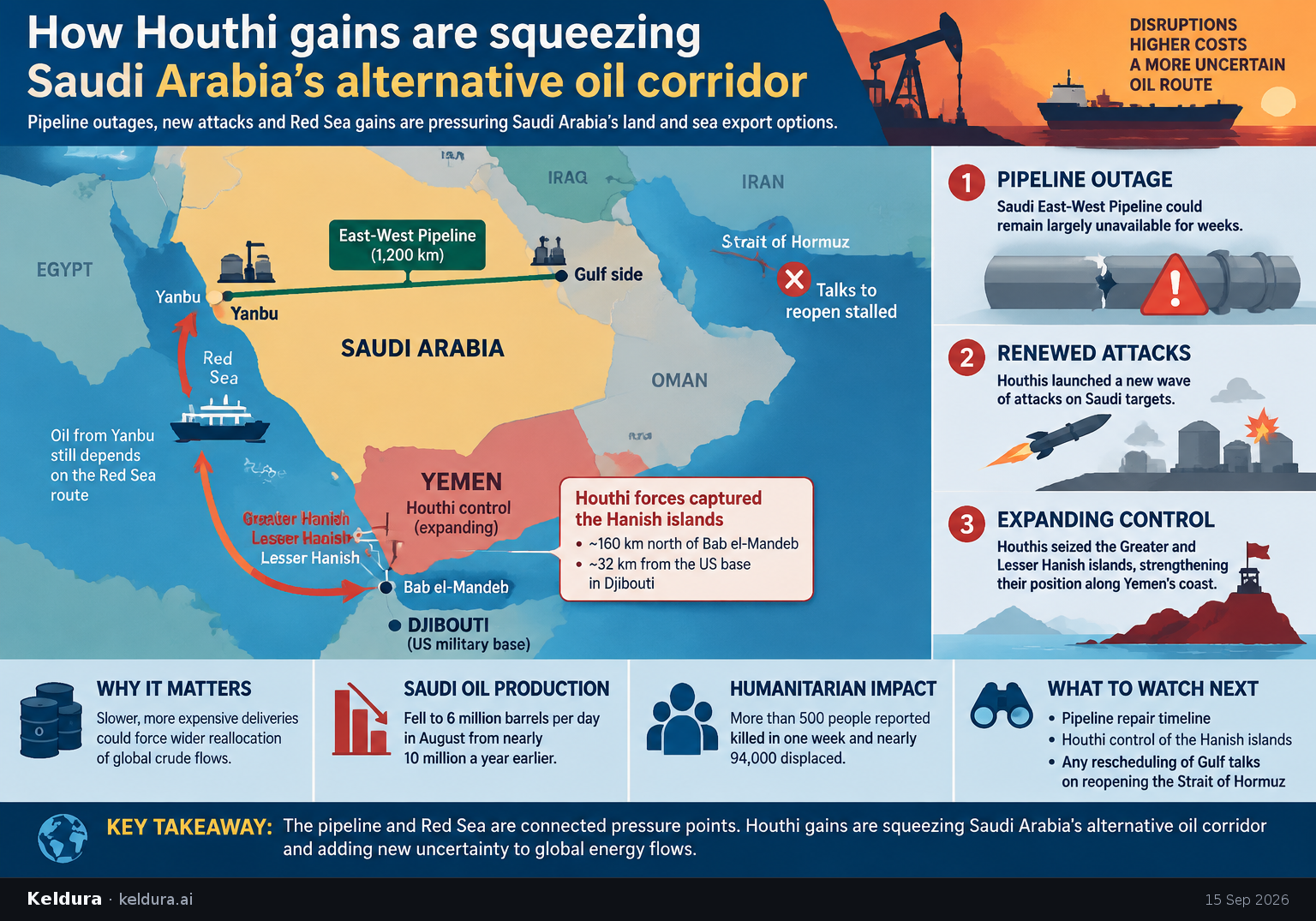
Yemen’s Iran-aligned Houthis launched a new wave of attacks against Saudi Arabia and consolidated positions along Yemen’s western coast as Gulf states postponed talks over reopening the Strait of Hormuz.[3] Separately, regional officials said the Saudi East-West Pipeline could remain largely unavailable for weeks, while Houthi forces captured the Greater and Lesser Hanish islands near the Bab el-Mandeb shipping corridor.[6]
Why it matters: Saudi Arabia had relied heavily on the 1,200-kilometre pipeline to move crude from the Gulf side to Yanbu after disruption in the Strait of Hormuz; a prolonged outage and insecurity along the Red Sea route could make deliveries slower and more expensive and force wider reallocation of global crude flows.[6]
Key insights: The pipeline and Red Sea are connected pressure points: the line moves oil to Yanbu, but tankers leaving there still depend on contested maritime routes.[6] | The Hanish islands sit about 160 kilometres north of Bab el-Mandeb and bring Houthi positions within roughly 32 kilometres of the US military base in Djibouti.[6] | Saudi oil production fell to 6 million barrels per day in August from nearly 10 million a year earlier, according to the International Energy Agency figures cited in the report.[6] | The renewed conflict is also worsening Yemen’s humanitarian emergency: more than 500 people were reported killed in one week and nearly 94,000 displaced.[6]
Cheatsheet facts: What changed: A pipeline outage, renewed strikes and Houthi island gains are simultaneously pressuring Saudi Arabia’s land and Red Sea export options.[3][6] | Why now: Hormuz disruption had already redirected Saudi exports toward the East-West Pipeline and Yanbu, increasing dependence on the route now under pressure.[6] | Watch next: Watch the pipeline’s repair timeline, Houthi control of the Hanish islands and any rescheduling of Gulf talks on reopening the Strait of Hormuz.[3][6]
Yemen’s Iran-aligned Houthis launched a new wave of attacks against Saudi Arabia and consolidated positions along Yemen’s western coast as Gulf states postponed talks over reopening the Strait of Hormuz.[3] Separately, regional officials said the Saudi East-West Pipeline could remain largely unavailable for weeks, while Houthi forces captured the Greater and Lesser Hanish islands near the Bab el-Mandeb shipping corridor.[6]
Why it matters: Saudi Arabia had relied heavily on the 1,200-kilometre pipeline to move crude from the Gulf side to Yanbu after disruption in the Strait of Hormuz; a prolonged outage and insecurity along the Red Sea route could make deliveries slower and more expensive and force wider reallocation of global crude flows.[6]
Key insights: The pipeline and Red Sea are connected pressure points: the line moves oil to Yanbu, but tankers leaving there still depend on contested maritime routes.[6] | The Hanish islands sit about 160 kilometres north of Bab el-Mandeb and bring Houthi positions within roughly 32 kilometres of the US military base in Djibouti.[6] | Saudi oil production fell to 6 million barrels per day in August from nearly 10 million a year earlier, according to the International Energy Agency figures cited in the report.[6] | The renewed conflict is also worsening Yemen’s humanitarian emergency: more than 500 people were reported killed in one week and nearly 94,000 displaced.[6]
Cheatsheet facts: What changed: A pipeline outage, renewed strikes and Houthi island gains are simultaneously pressuring Saudi Arabia’s land and Red Sea export options.[3][6] | Why now: Hormuz disruption had already redirected Saudi exports toward the East-West Pipeline and Yanbu, increasing dependence on the route now under pressure.[6] | Watch next: Watch the pipeline’s repair timeline, Houthi control of the Hanish islands and any rescheduling of Gulf talks on reopening the Strait of Hormuz.[3][6]