How Russia’s gray-zone pressure is testing Europe’s defensive perimeter
Macron said France had been targeted by Russian hybrid attacks in recent weeks and ordered preparations to protect critical infrastructure.
Macron said France had been targeted by Russian hybrid attacks in recent weeks and ordered preparations to protect critical infrastructure and sensitive defence and technology sites from drone and cyberattacks.[3] Separately, Russian drones were reported near Ukrainian crossings with Poland and Mol…
Macron said France had been targeted by Russian hybrid attacks in recent weeks and ordered preparations to protect critical infrastructure and sensitive defence and technology sites from drone and cyberattacks.[3] Separately, Russian drones were reported near Ukrainian crossings with Poland and Moldova, including a September 13 strike on a locomotive carrying European officials toward Warsaw after a conference in Kyiv.[6]
Why it matters: Pressure on infrastructure and cross-border transport can disrupt support for Ukraine and expose European officials without requiring a conventional attack deep inside NATO territory; Macron said the intent was to intimidate European governments and weaken their support for Kyiv.[3][6]
Key insights: France’s planned response focuses on critical infrastructure, defence-industry facilities and sensitive technology sites vulnerable to drone and cyber operations.[3] | The September 13 locomotive strike occurred about 5km from Poland while Boris Johnson and European political and security officials were aboard the train.[6] | A Russian drone entered Moldovan airspace on September 8 as Volodymyr Zelenskyy prepared to leave Chisinau, delaying his flight; Moldova did not confirm Norway’s claim that it nearly struck the aircraft.[6] | Kremlin Ambassador-at-large Rodion Miroshnik defended strikes on Ukrainian logistics sites as an effort to stop Western military aid from reaching Kyiv.[6]
Cheatsheet facts: What changed: Reported Russian activity has increasingly reached border crossings, transport links and infrastructure associated with Ukraine’s European connections, while France says attacks against Europe have intensified.[3][6] | Why now: Macron linked the pressure to Russia’s effort to intimidate European governments and break their support for Ukraine, while a Kremlin representative described logistics routes as military targets.[3][6] | Watch next: Watch for France’s critical-infrastructure protection plan and the announced G7 meeting on energy cooperation and gas stocks.[3]
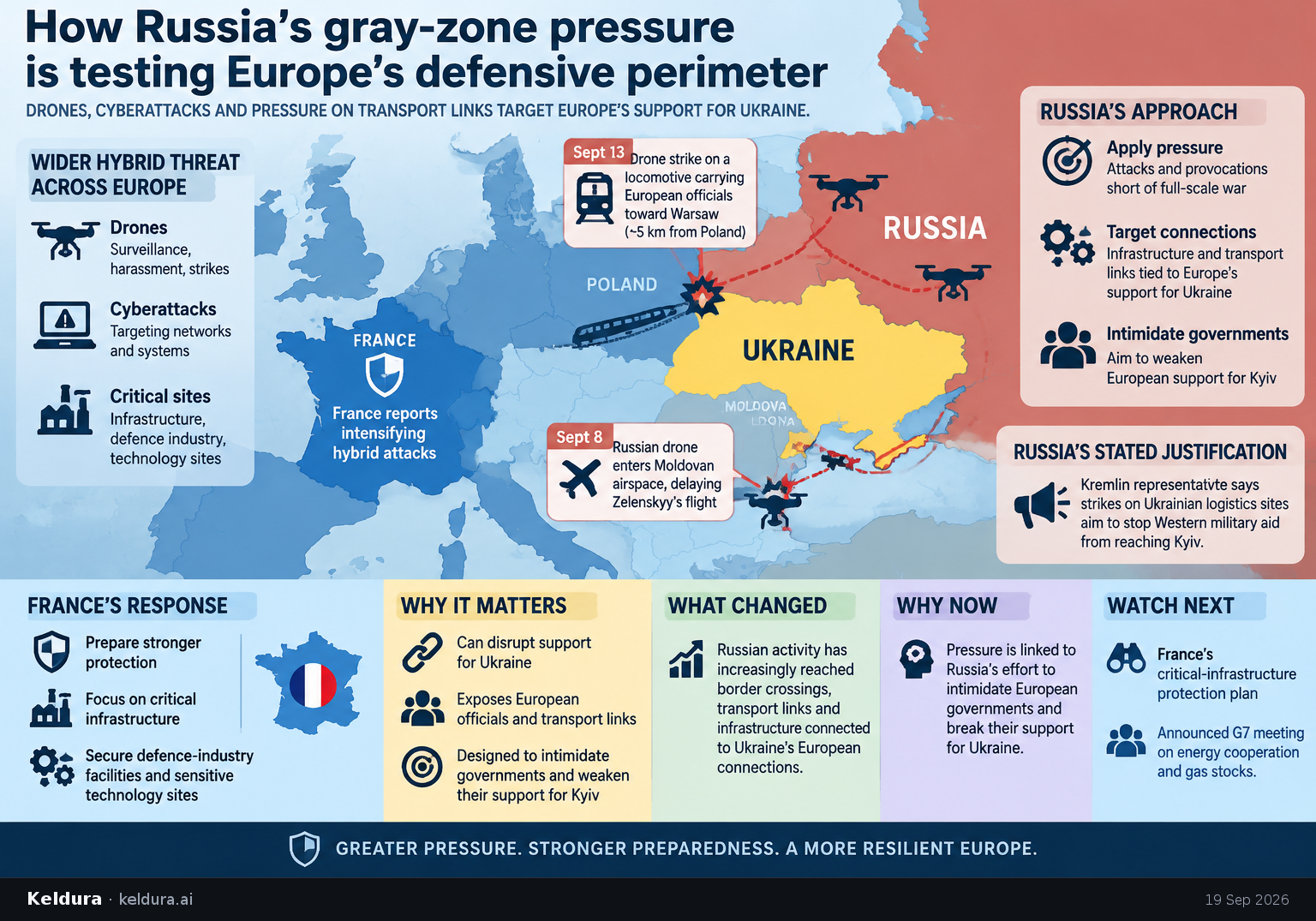
Macron said France had been targeted by Russian hybrid attacks in recent weeks and ordered preparations to protect critical infrastructure and sensitive defence and technology sites from drone and cyberattacks.[3] Separately, Russian drones were reported near Ukrainian crossings with Poland and Moldova, including a September 13 strike on a locomotive carrying European officials toward Warsaw after a conference in Kyiv.[6]
Why it matters: Pressure on infrastructure and cross-border transport can disrupt support for Ukraine and expose European officials without requiring a conventional attack deep inside NATO territory; Macron said the intent was to intimidate European governments and weaken their support for Kyiv.[3][6]
Key insights: France’s planned response focuses on critical infrastructure, defence-industry facilities and sensitive technology sites vulnerable to drone and cyber operations.[3] | The September 13 locomotive strike occurred about 5km from Poland while Boris Johnson and European political and security officials were aboard the train.[6] | A Russian drone entered Moldovan airspace on September 8 as Volodymyr Zelenskyy prepared to leave Chisinau, delaying his flight; Moldova did not confirm Norway’s claim that it nearly struck the aircraft.[6] | Kremlin Ambassador-at-large Rodion Miroshnik defended strikes on Ukrainian logistics sites as an effort to stop Western military aid from reaching Kyiv.[6]
Cheatsheet facts: What changed: Reported Russian activity has increasingly reached border crossings, transport links and infrastructure associated with Ukraine’s European connections, while France says attacks against Europe have intensified.[3][6] | Why now: Macron linked the pressure to Russia’s effort to intimidate European governments and break their support for Ukraine, while a Kremlin representative described logistics routes as military targets.[3][6] | Watch next: Watch for France’s critical-infrastructure protection plan and the announced G7 meeting on energy cooperation and gas stocks.[3]