Can Black Sea talks create a narrow opening in the Ukraine war?
German and Russian foreign ministers held rare talks on Saturday as Russian strikes continued across Ukraine.
Johann Wadephul and Sergey Lavrov met during the UN General Assembly in the first such German-Russian talks since Russia’s 2022 invasion, discussing Ukraine, bilateral relations and safe Black Sea navigation.[3] The meeting produced no reported breakthrough, while Ukrainian officials said Russian s…
Johann Wadephul and Sergey Lavrov met during the UN General Assembly in the first such German-Russian talks since Russia’s 2022 invasion, discussing Ukraine, bilateral relations and safe Black Sea navigation.[3] The meeting produced no reported breakthrough, while Ukrainian officials said Russian strikes had killed at least 10 people over two days and called for stronger sanctions and additional missile interceptors.[1]
Why it matters: A limited arrangement covering grain shipments, energy infrastructure or safe navigation could test whether practical agreements remain possible even when the parties are far apart on a comprehensive ceasefire. Russia has discussed navigation proposals with India, Egypt and Turkiye, while Ukraine and its partners continue to demand a full ceasefire and meaningful negotiations.[1][3]
Key insights: Germany initiated the ministerial meeting despite bilateral relations having remained frozen since the invasion, indicating that European governments are preserving selective channels to Moscow.[3] | Wadephul focused partly on grain exports and energy infrastructure, narrowing the immediate diplomatic objective below a settlement of the wider war.[3] | Lavrov said he heard nothing new from Germany and argued that separate discussions with Ukraine would require demands rather than requests, illustrating the gap between contact and compromise.[3] | Ukraine is pairing its diplomatic case with requests for missile interceptors, tougher sanctions and pressure on actors enabling Russian attacks.[1]
Cheatsheet facts: What changed: Germany and Russia resumed foreign-minister-level contact for the first time since the 2022 invasion, with Black Sea grain and energy security on the agenda.[3] | Why now: Attacks on vessels, ports, civilians and energy infrastructure are restricting exports and intensifying calls for both a ceasefire and stronger pressure on Moscow.[1][3] | Watch next: Watch for a concrete safe-navigation arrangement, a grain-and-energy ceasefire, additional missile interceptors or newly imposed sanctions.[1][3]
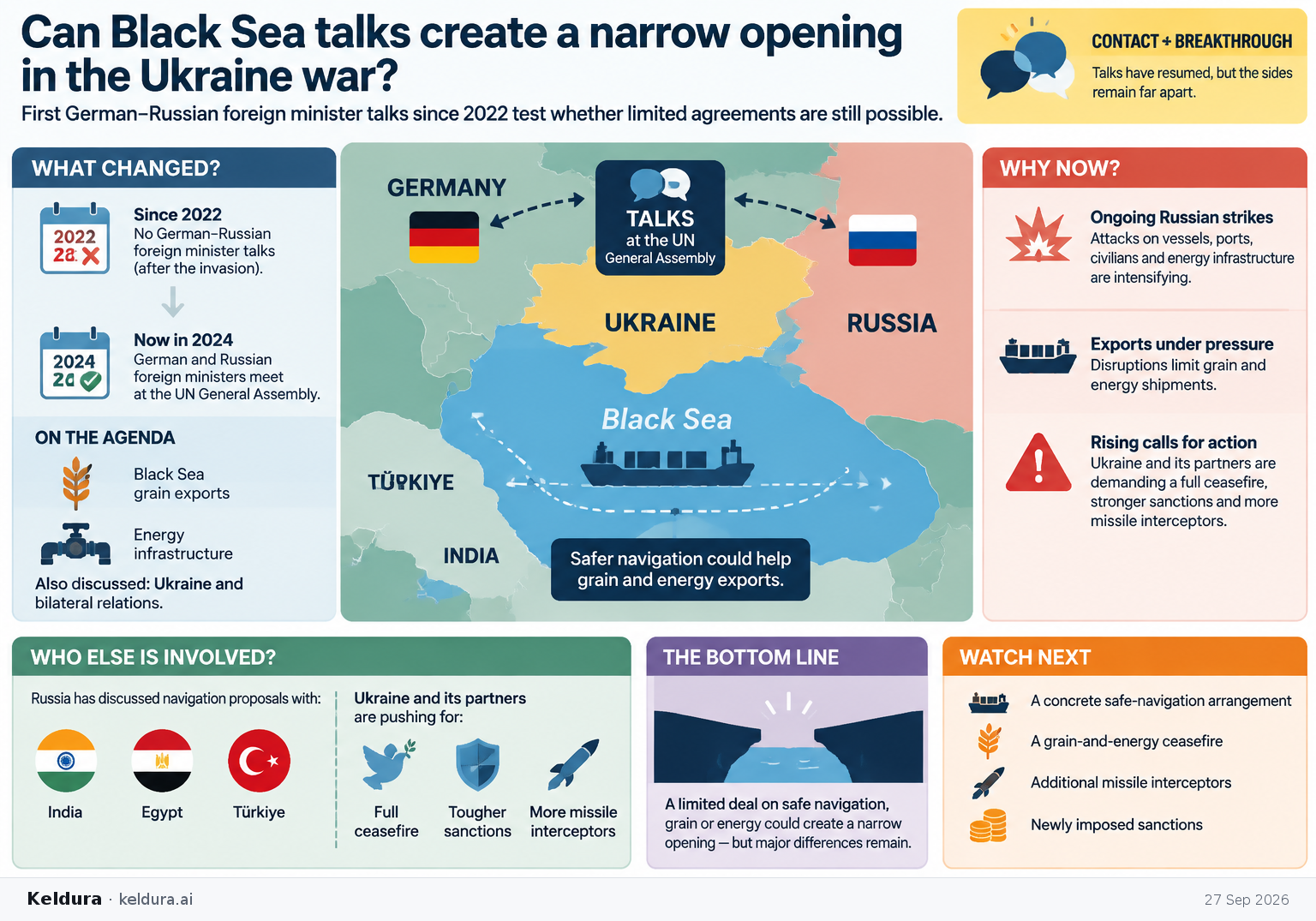
Johann Wadephul and Sergey Lavrov met during the UN General Assembly in the first such German-Russian talks since Russia’s 2022 invasion, discussing Ukraine, bilateral relations and safe Black Sea navigation.[3] The meeting produced no reported breakthrough, while Ukrainian officials said Russian strikes had killed at least 10 people over two days and called for stronger sanctions and additional missile interceptors.[1]
Why it matters: A limited arrangement covering grain shipments, energy infrastructure or safe navigation could test whether practical agreements remain possible even when the parties are far apart on a comprehensive ceasefire. Russia has discussed navigation proposals with India, Egypt and Turkiye, while Ukraine and its partners continue to demand a full ceasefire and meaningful negotiations.[1][3]
Key insights: Germany initiated the ministerial meeting despite bilateral relations having remained frozen since the invasion, indicating that European governments are preserving selective channels to Moscow.[3] | Wadephul focused partly on grain exports and energy infrastructure, narrowing the immediate diplomatic objective below a settlement of the wider war.[3] | Lavrov said he heard nothing new from Germany and argued that separate discussions with Ukraine would require demands rather than requests, illustrating the gap between contact and compromise.[3] | Ukraine is pairing its diplomatic case with requests for missile interceptors, tougher sanctions and pressure on actors enabling Russian attacks.[1]
Cheatsheet facts: What changed: Germany and Russia resumed foreign-minister-level contact for the first time since the 2022 invasion, with Black Sea grain and energy security on the agenda.[3] | Why now: Attacks on vessels, ports, civilians and energy infrastructure are restricting exports and intensifying calls for both a ceasefire and stronger pressure on Moscow.[1][3] | Watch next: Watch for a concrete safe-navigation arrangement, a grain-and-energy ceasefire, additional missile interceptors or newly imposed sanctions.[1][3]