How emerging economies are redrawing the map of carbon pricing
Carbon-pricing systems now cover roughly 30% of global emissions, twice their 2020 reach, as countries including India and Vietnam begin.
Carbon-pricing systems now cover roughly 30% of global emissions, twice their 2020 reach, as countries including India and Vietnam begin applying limits to heavy-emitting sectors such as steel and cement.[2] Separately, a coalition co-chaired by China, Brazil and the European Union approved a work…
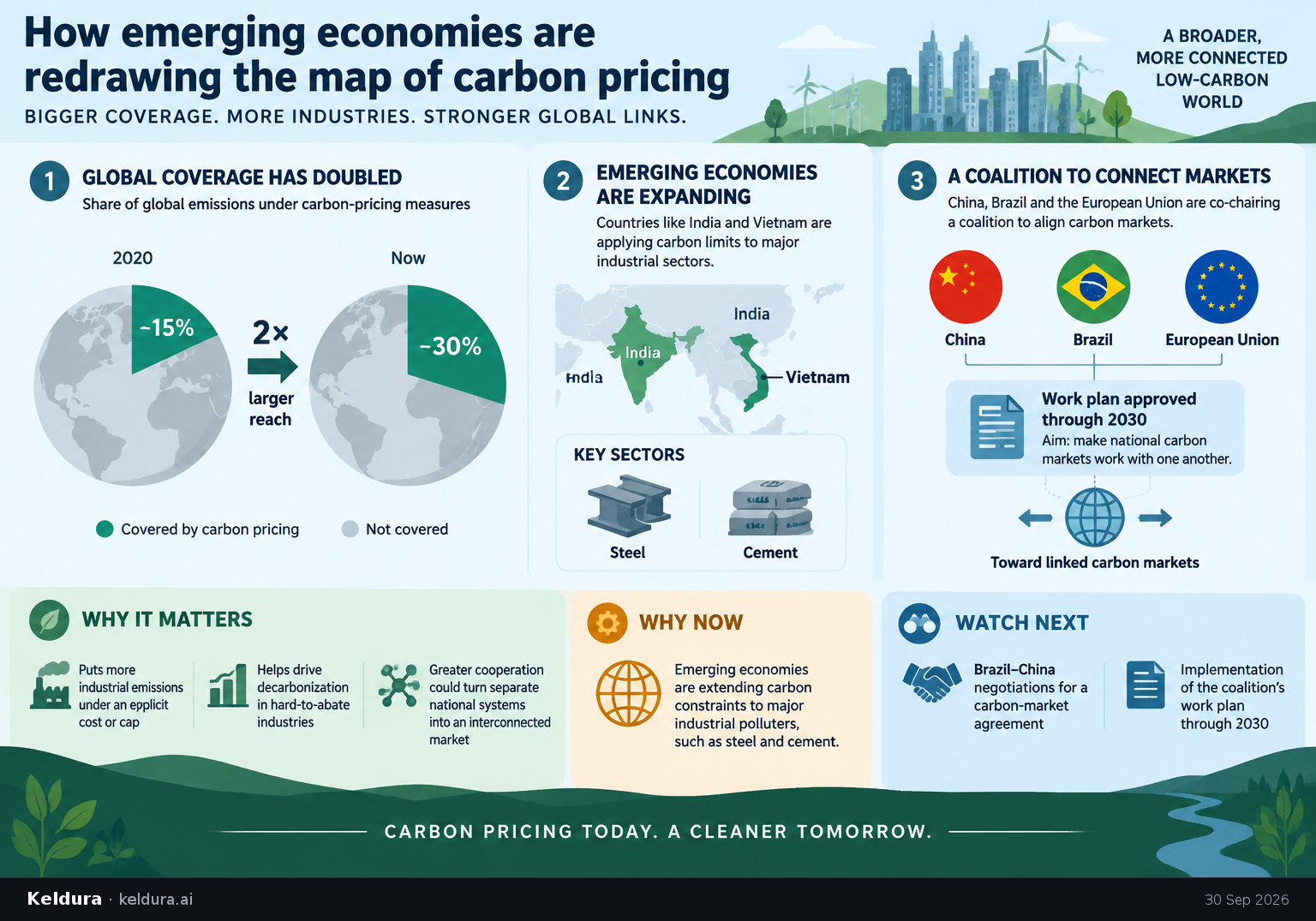
Carbon-pricing systems now cover roughly 30% of global emissions, twice their 2020 reach, as countries including India and Vietnam begin applying limits to heavy-emitting sectors such as steel and cement.[2] Separately, a coalition co-chaired by China, Brazil and the European Union approved a work plan through 2030 aimed at making national carbon markets work with one another.[3]
Why it matters: Broader coverage puts more industrial emissions under an explicit cost or cap, while cooperation between markets could determine whether national systems can interact rather than remain isolated.[2][3]
Key insights: The global emissions share covered by carbon-pricing measures has doubled from about 15% in 2020 to roughly 30%.[2] | The emerging-market expansion reaches difficult-to-decarbonize industries, including steel and cement.[2] | The coalition approved its 2030 work plan at its second meeting in Wuhan, and Brasília is negotiating a carbon-market agreement with Beijing.[3]
Cheatsheet facts: What changed: Carbon-pricing coverage reached roughly 30% of global emissions, while the China-Brazil-EU coalition adopted a work plan for linking national markets.[2][3] | Why now: India, Vietnam and other emerging economies are extending carbon constraints to major industrial polluters.[2] | Watch next: Watch the Brazil-China negotiations for a carbon-market agreement and the coalition’s implementation of its work plan through 2030.[3]
Carbon-pricing systems now cover roughly 30% of global emissions, twice their 2020 reach, as countries including India and Vietnam begin applying limits to heavy-emitting sectors such as steel and cement.[2] Separately, a coalition co-chaired by China, Brazil and the European Union approved a work plan through 2030 aimed at making national carbon markets work with one another.[3]
Why it matters: Broader coverage puts more industrial emissions under an explicit cost or cap, while cooperation between markets could determine whether national systems can interact rather than remain isolated.[2][3]
Key insights: The global emissions share covered by carbon-pricing measures has doubled from about 15% in 2020 to roughly 30%.[2] | The emerging-market expansion reaches difficult-to-decarbonize industries, including steel and cement.[2] | The coalition approved its 2030 work plan at its second meeting in Wuhan, and Brasília is negotiating a carbon-market agreement with Beijing.[3]
Cheatsheet facts: What changed: Carbon-pricing coverage reached roughly 30% of global emissions, while the China-Brazil-EU coalition adopted a work plan for linking national markets.[2][3] | Why now: India, Vietnam and other emerging economies are extending carbon constraints to major industrial polluters.[2] | Watch next: Watch the Brazil-China negotiations for a carbon-market agreement and the coalition’s implementation of its work plan through 2030.[3]