Why depleted groundwater makes Texas cotton drought harder to survive
On October 8, NASA documented severe Texas High Plains drought as farmers reported dead cotton and failing wells.
NASA's October 8 account shows drought persisting across much of the Texas High Plains despite recent rain, with September satellite imagery revealing parched fields compared with the previous year. [5] Lubbock County farmer Lacy Cotter-Vardeman reported that roughly 90 percent of her dryland cotto…
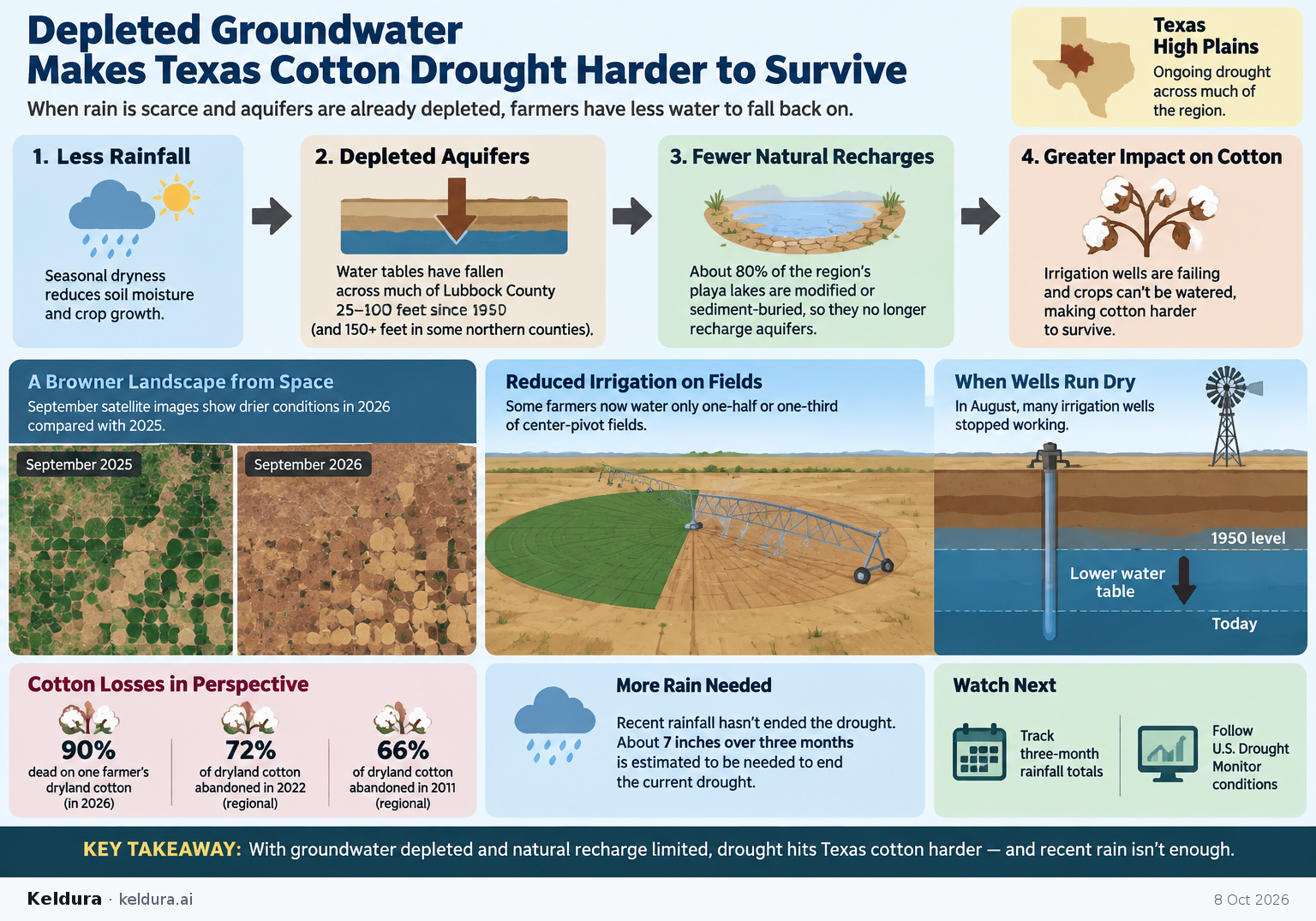
NASA's October 8 account shows drought persisting across much of the Texas High Plains despite recent rain, with September satellite imagery revealing parched fields compared with the previous year. [5] Lubbock County farmer Lacy Cotter-Vardeman reported that roughly 90 percent of her dryland cotton was dead and that many irrigation wells stopped working in August. [5] The immediate drought is colliding with decades of groundwater decline: across much of Lubbock County, the water table has fallen 25–100 feet since 1950. [5]
Why it matters: Groundwater is becoming a less reliable fallback when rain fails, leaving farmers exposed to both seasonal drought and long-term aquifer depletion. Recharge is also constrained: NASA reports that about 80 percent of the region's playa lakes are modified or sediment-buried enough that they no longer perform their rainfall-collection and aquifer-recharge function. [5]
Key insights: Satellite imagery makes reduced irrigation visible: some farmers now water only one-half or one-third of center-pivot fields, creating partial green circles amid dry land. [5] | The regional drought has historical comparisons—farmers abandoned 72 percent of dryland cotton in 2022 and 66 percent in 2011—but the reported 90 percent mortality applies to one farmer's crop, not the whole region. [5] | Aquifer losses vary geographically: declines of 150 feet or more have occurred in counties north of Lubbock, including Parmer, Castro, Swisher, and Briscoe. [5] | Recent rainfall has not ended the drought; a NASA meteorologist contributing to the U.S. Drought Monitor estimated that about seven inches over three months would be needed. [5]
Cheatsheet facts: What changed: The 2026 drought coincided with failing irrigation wells and severe cotton losses; satellite images show a browner landscape than in September 2025. [5] | Why now: Seasonal dryness is hitting an already depleted aquifer, while many playa lakes no longer provide their natural recharge function. [5] | Watch next: Track three-month rainfall totals and U.S. Drought Monitor conditions against the cited estimate of roughly seven inches needed to end the current drought. [5]