Can reef rescue tactics keep pace with a stronger El Niño?
Underwater speakers are broadcasting sounds from healthy reefs to attract coral larvae, while other teams are moving corals into cooler.
Underwater speakers are broadcasting sounds from healthy reefs to attract coral larvae, while other teams are moving corals into cooler water and applying potentially protective microorganisms.[2] These efforts coincide with a potentially historic El Niño forecast to peak between October and Decemb…
Underwater speakers are broadcasting sounds from healthy reefs to attract coral larvae, while other teams are moving corals into cooler water and applying potentially protective microorganisms.[2] These efforts coincide with a potentially historic El Niño forecast to peak between October and December 2026, although the extent to which climate change alters El Niño intensity and frequency remains debated.[6]
Why it matters: Global hard-coral cover in 2020–2024 was 9.5% below the 1980–2009 level, and the 8.9% fall in 2024 was the largest recorded single-year decline.[2] Restoration can support individual reefs, but scientists say cutting greenhouse-gas emissions and reducing pollution and overfishing remain the primary protections against recurrent bleaching.[2]
Key insights: Coral larvae can detect sound and use it as a cue when choosing where to settle, creating a possible tool for repopulating damaged reefs.[2] | Bleaching occurs when heat-stressed corals expel the symbiotic algae on which they depend for nutrients, potentially killing the coral.[2] | Galapagos coral records suggest El Niño intensity increased 36.5% over the past 40 years, but those samples end in 2014 and cannot establish how long the trend will continue.[6] | Climate models disagree on the future trajectory of El Niño, although warming air can hold more moisture and intensify associated swings in rainfall and drought.[6]
Cheatsheet facts: What changed: Researchers are pairing acoustic attraction, coral relocation and microbial treatments with efforts to reduce local reef stresses.[2] | Why now: A strong El Niño is building after the previous global bleaching event ended in 2025, leaving reefs little recovery time.[2][6] | Watch next: Track NOAA Coral Reef Watch heat-risk areas and documented bleaching as El Niño approaches its expected October–December 2026 peak and continues into 2027.[2][6]
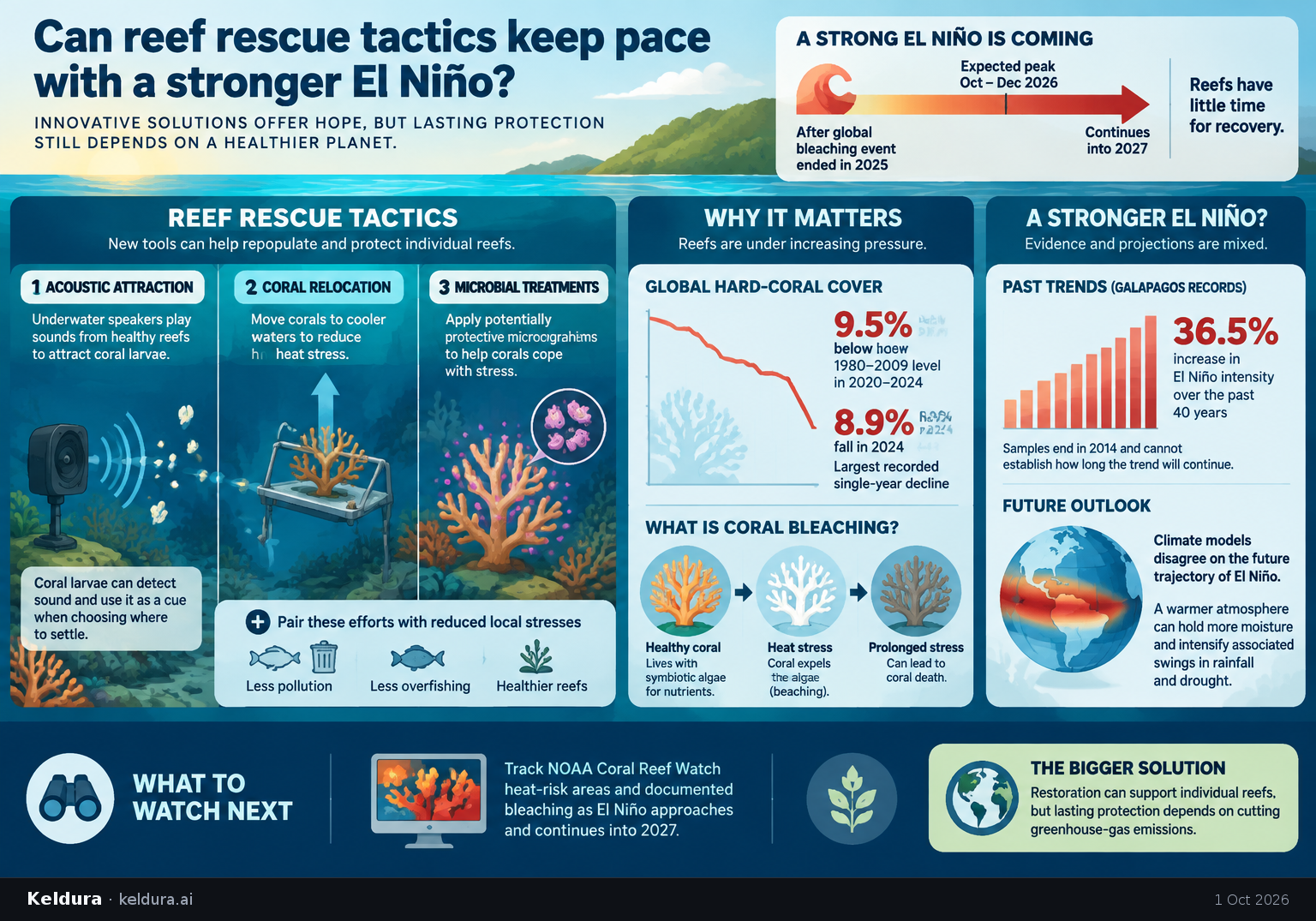
Underwater speakers are broadcasting sounds from healthy reefs to attract coral larvae, while other teams are moving corals into cooler water and applying potentially protective microorganisms.[2] These efforts coincide with a potentially historic El Niño forecast to peak between October and December 2026, although the extent to which climate change alters El Niño intensity and frequency remains debated.[6]
Why it matters: Global hard-coral cover in 2020–2024 was 9.5% below the 1980–2009 level, and the 8.9% fall in 2024 was the largest recorded single-year decline.[2] Restoration can support individual reefs, but scientists say cutting greenhouse-gas emissions and reducing pollution and overfishing remain the primary protections against recurrent bleaching.[2]
Key insights: Coral larvae can detect sound and use it as a cue when choosing where to settle, creating a possible tool for repopulating damaged reefs.[2] | Bleaching occurs when heat-stressed corals expel the symbiotic algae on which they depend for nutrients, potentially killing the coral.[2] | Galapagos coral records suggest El Niño intensity increased 36.5% over the past 40 years, but those samples end in 2014 and cannot establish how long the trend will continue.[6] | Climate models disagree on the future trajectory of El Niño, although warming air can hold more moisture and intensify associated swings in rainfall and drought.[6]
Cheatsheet facts: What changed: Researchers are pairing acoustic attraction, coral relocation and microbial treatments with efforts to reduce local reef stresses.[2] | Why now: A strong El Niño is building after the previous global bleaching event ended in 2025, leaving reefs little recovery time.[2][6] | Watch next: Track NOAA Coral Reef Watch heat-risk areas and documented bleaching as El Niño approaches its expected October–December 2026 peak and continues into 2027.[2][6]