Why Kaliningrad turns Baltic tension into a nuclear-risk problem
Russia has warned NATO that an attempt to isolate or attack Kaliningrad could trigger a nuclear response.
Kaliningrad is a heavily militarised Russian exclave between NATO members Poland and Lithuania, giving Moscow a base for air-defence, missile, and naval forces while leaving it dependent on vulnerable supply and reinforcement routes.[4] Russia’s warning accused NATO of risking direct conflict and r…
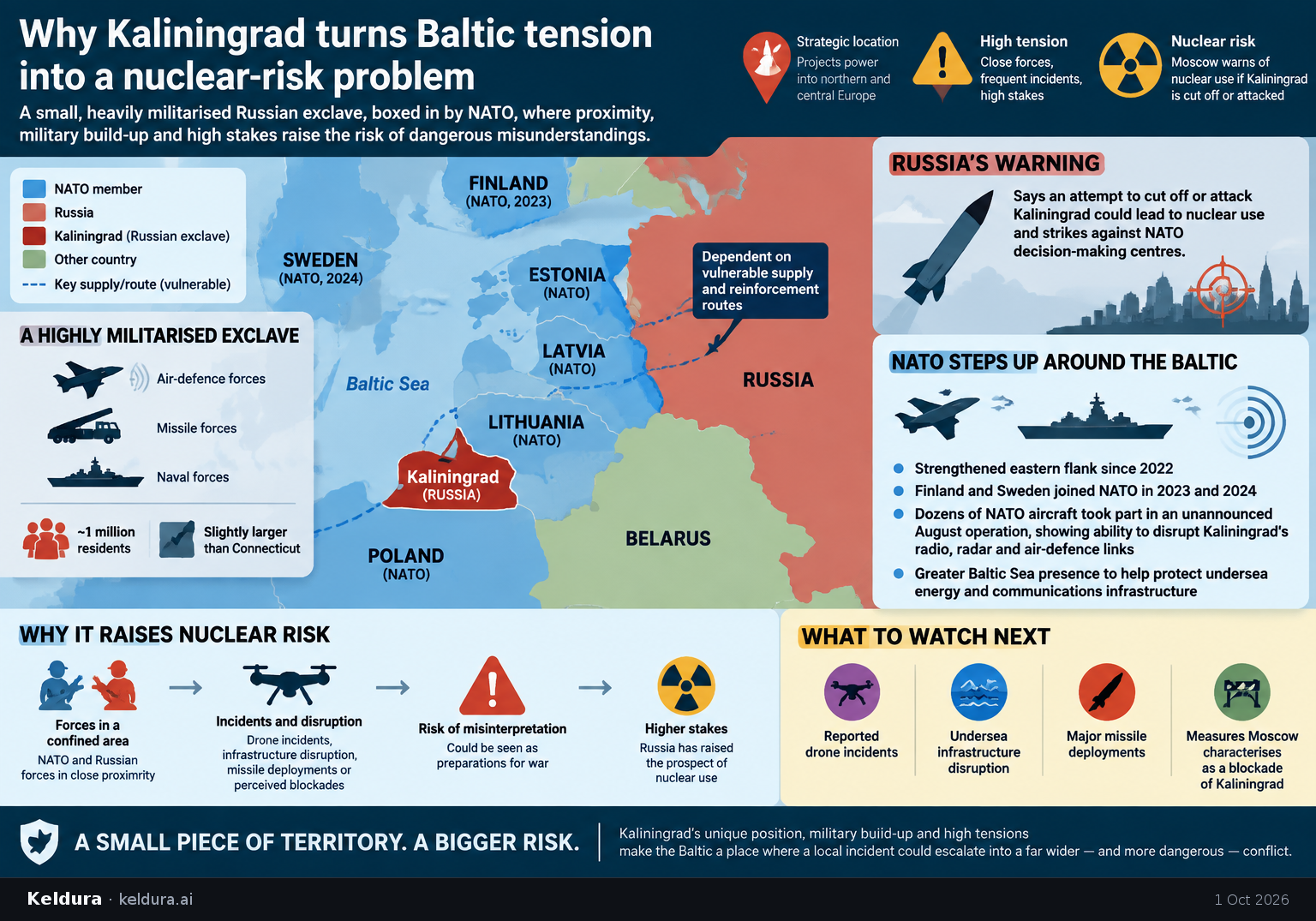
Kaliningrad is a heavily militarised Russian exclave between NATO members Poland and Lithuania, giving Moscow a base for air-defence, missile, and naval forces while leaving it dependent on vulnerable supply and reinforcement routes.[4] Russia’s warning accused NATO of risking direct conflict and raised the possibility of strikes against decision-making centres in alliance states from the outset.[5]
Why it matters: Kaliningrad compresses Russian and NATO forces into a confined area where drone incidents, infrastructure disruption, missile deployments, or perceived blockade measures could be interpreted as preparations for war.[4] NATO has strengthened its eastern flank since Russia’s 2022 invasion of Ukraine, while Finland and Sweden joined the alliance in 2023 and 2024 respectively.[4]
Key insights: Kaliningrad has about 1 million residents and is slightly larger than Connecticut, but its position allows Russian forces to project power into northern and central Europe.[4] | Dozens of NATO aircraft reportedly participated in an unannounced August operation around Kaliningrad that demonstrated an ability to disrupt the exclave’s radio, radar, and air-defence links.[4] | NATO says its increased Baltic Sea presence partly addresses threats to critical undersea energy and communications infrastructure.[4] | European governments are supporting Ukraine while trying to avoid direct participation in the war, making misinterpretation around Kaliningrad especially dangerous.[4]
Cheatsheet facts: What changed: Moscow explicitly warned that an attempt to cut off or attack Kaliningrad could lead to nuclear use and strikes against NATO decision-making centres.[4][5] | Why now: NATO has reinforced its eastern flank and Baltic presence, while Moscow has highlighted alliance exercises, military movements, and rhetoric about Kaliningrad as threats.[4] | Watch next: Watch for reported drone incidents, undersea infrastructure disruption, major missile deployments, or measures Moscow characterises as a blockade of Kaliningrad.[4]
Kaliningrad is a heavily militarised Russian exclave between NATO members Poland and Lithuania, giving Moscow a base for air-defence, missile, and naval forces while leaving it dependent on vulnerable supply and reinforcement routes.[4] Russia’s warning accused NATO of risking direct conflict and raised the possibility of strikes against decision-making centres in alliance states from the outset.[5]
Why it matters: Kaliningrad compresses Russian and NATO forces into a confined area where drone incidents, infrastructure disruption, missile deployments, or perceived blockade measures could be interpreted as preparations for war.[4] NATO has strengthened its eastern flank since Russia’s 2022 invasion of Ukraine, while Finland and Sweden joined the alliance in 2023 and 2024 respectively.[4]
Key insights: Kaliningrad has about 1 million residents and is slightly larger than Connecticut, but its position allows Russian forces to project power into northern and central Europe.[4] | Dozens of NATO aircraft reportedly participated in an unannounced August operation around Kaliningrad that demonstrated an ability to disrupt the exclave’s radio, radar, and air-defence links.[4] | NATO says its increased Baltic Sea presence partly addresses threats to critical undersea energy and communications infrastructure.[4] | European governments are supporting Ukraine while trying to avoid direct participation in the war, making misinterpretation around Kaliningrad especially dangerous.[4]
Cheatsheet facts: What changed: Moscow explicitly warned that an attempt to cut off or attack Kaliningrad could lead to nuclear use and strikes against NATO decision-making centres.[4][5] | Why now: NATO has reinforced its eastern flank and Baltic presence, while Moscow has highlighted alliance exercises, military movements, and rhetoric about Kaliningrad as threats.[4] | Watch next: Watch for reported drone incidents, undersea infrastructure disruption, major missile deployments, or measures Moscow characterises as a blockade of Kaliningrad.[4]