Why the order of concessions is blocking a US-Iran deal
Iran proposes that Washington release frozen funds, lift oil sanctions and end its blockade of Iranian ports within four or five days.
Iran proposes that Washington release frozen funds, lift oil sanctions and end its blockade of Iranian ports within four or five days, after which the strait could reopen and nuclear negotiations could begin by day seven.[1][2] The US calls the proposal unacceptable and insists that nuclear issues…
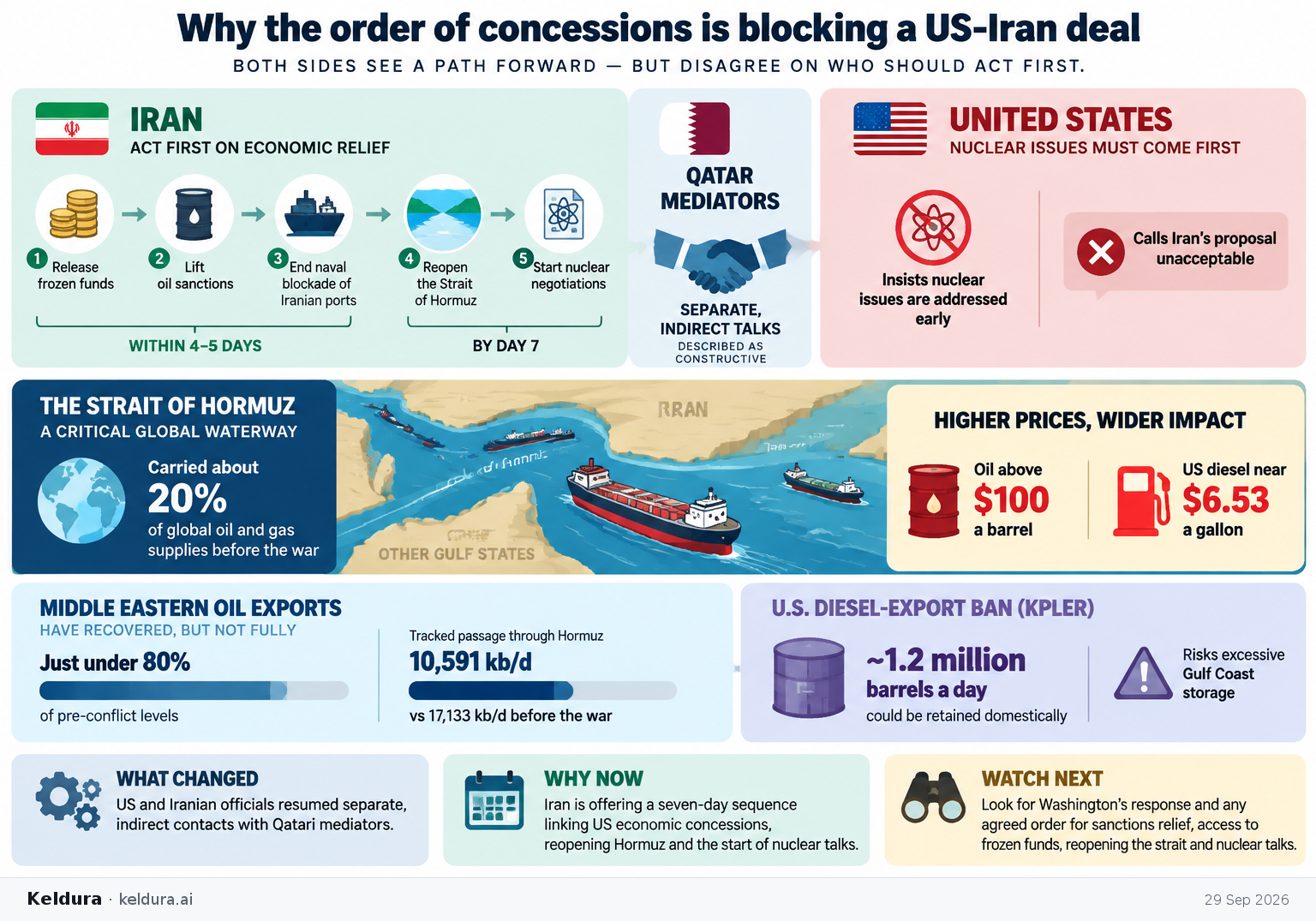
Iran proposes that Washington release frozen funds, lift oil sanctions and end its blockade of Iranian ports within four or five days, after which the strait could reopen and nuclear negotiations could begin by day seven.[1][2] The US calls the proposal unacceptable and insists that nuclear issues be addressed, leaving the sides divided over the timing and order of commitments despite describing indirect talks as constructive.[1]
Why it matters: The sequencing dispute links nuclear diplomacy to a waterway that carried roughly 20 percent of global oil and gas supplies before the war; restricted traffic has helped push oil above $100 a barrel and US diesel near a record $6.53 a gallon.[1][2]
Key insights: The main obstacle is not simply whether sanctions relief and nuclear concessions are possible, but which side must act first and how quickly.[1] | Tehran has made reopening the Strait of Hormuz conditional on sanctions relief, access to frozen funds and an end to the US naval blockade.[1][2] | Middle Eastern crude exports have recovered to just under 80 percent of pre-conflict levels, but tracked passage through Hormuz remained at 10,591 kilobarrels a day versus a prewar baseline of 17,133.[2] | A US diesel-export ban could retain about 1.2 million barrels a day domestically while risking excessive Gulf Coast storage, according to Kpler.[2]
Cheatsheet facts: What changed: US and Iranian officials resumed separate, indirect contacts with Qatari mediators while Tehran awaited a response to its revised ceasefire framework.[1][2] | Why now: Iran is offering a seven-day sequence connecting US economic concessions, reopening Hormuz and the start of nuclear negotiations.[1][2] | Watch next: Watch for Washington’s response and any agreed order for sanctions relief, access to frozen funds, reopening the strait and addressing Iran’s nuclear programme.[1][2]
Iran proposes that Washington release frozen funds, lift oil sanctions and end its blockade of Iranian ports within four or five days, after which the strait could reopen and nuclear negotiations could begin by day seven.[1][2] The US calls the proposal unacceptable and insists that nuclear issues be addressed, leaving the sides divided over the timing and order of commitments despite describing indirect talks as constructive.[1]
Why it matters: The sequencing dispute links nuclear diplomacy to a waterway that carried roughly 20 percent of global oil and gas supplies before the war; restricted traffic has helped push oil above $100 a barrel and US diesel near a record $6.53 a gallon.[1][2]
Key insights: The main obstacle is not simply whether sanctions relief and nuclear concessions are possible, but which side must act first and how quickly.[1] | Tehran has made reopening the Strait of Hormuz conditional on sanctions relief, access to frozen funds and an end to the US naval blockade.[1][2] | Middle Eastern crude exports have recovered to just under 80 percent of pre-conflict levels, but tracked passage through Hormuz remained at 10,591 kilobarrels a day versus a prewar baseline of 17,133.[2] | A US diesel-export ban could retain about 1.2 million barrels a day domestically while risking excessive Gulf Coast storage, according to Kpler.[2]
Cheatsheet facts: What changed: US and Iranian officials resumed separate, indirect contacts with Qatari mediators while Tehran awaited a response to its revised ceasefire framework.[1][2] | Why now: Iran is offering a seven-day sequence connecting US economic concessions, reopening Hormuz and the start of nuclear negotiations.[1][2] | Watch next: Watch for Washington’s response and any agreed order for sanctions relief, access to frozen funds, reopening the strait and addressing Iran’s nuclear programme.[1][2]