Why Google is restricting its most capable Gemini model
Google unveiled Gemini 4 Argon on September 30 but initially limited access to trusted cybersecurity defenders.
Google says Gemini 4 Argon can handle complex workflows spanning software engineering, enterprise knowledge work and cybersecurity, and the model is already supporting internal tasks such as large-scale codebase migrations.[8] Rather than offering broad access immediately, Google is working through…
Google says Gemini 4 Argon can handle complex workflows spanning software engineering, enterprise knowledge work and cybersecurity, and the model is already supporting internal tasks such as large-scale codebase migrations.[8] Rather than offering broad access immediately, Google is working through a voluntary U.S. government pre-release process while strengthening protections against misuse, prompt injection and misalignment.[8]
Why it matters: The staged launch tests a new distribution model for frontier AI: developers can demonstrate powerful capabilities without immediately exposing them to every user, while access decisions become part of the product’s safety architecture.[8]
Key insights: Gemini 4 Argon is initially available to a selected group of cyber defenders, not the general public.[8] | Google says the model can autonomously find, validate and patch critical software vulnerabilities, and trusted defenders will receive access without cyber guardrails.[1] | On the CWE-bench v1 security benchmark, Gemini 4 Argon scored 68 percent, tying GPT-6 Astra and Grok 4.7.[1] | Google announced introductory API pricing of $2 per million input tokens and $10 per million output tokens, with expected post-introductory rates of $4 and $20 respectively.[1]
Cheatsheet facts: What changed: Google introduced Gemini 4 Argon but confined its first release to trusted cyber defenders and internal workflows.[8] | Why now: Google says it must reinforce safeguards covering misuse, prompt injection, misalignment monitoring and sandbox security before expanding access.[1][8] | Watch next: Track whether Google broadens access beyond trusted defenders after completing the voluntary U.S. government pre-release process.[8]
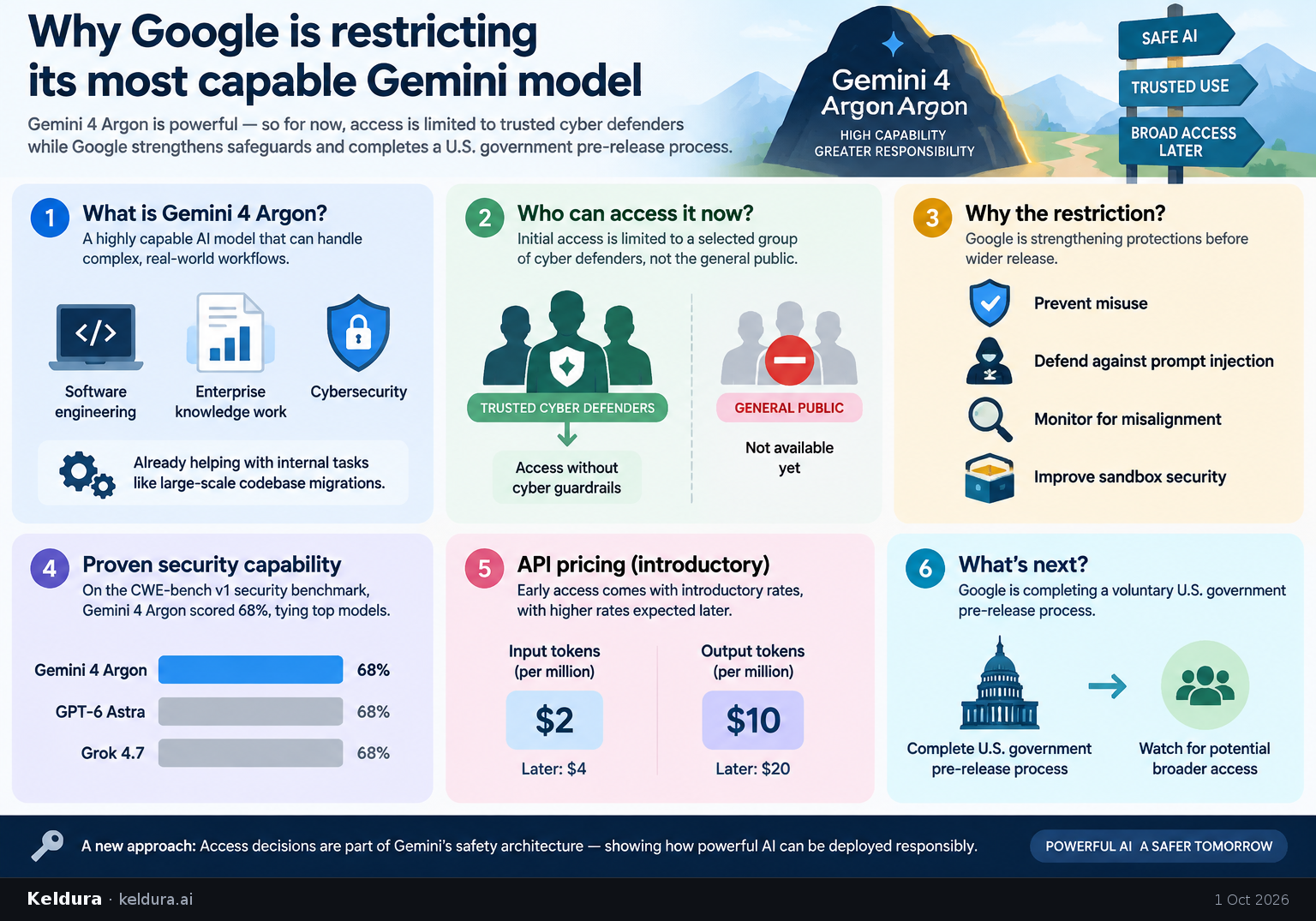
Google says Gemini 4 Argon can handle complex workflows spanning software engineering, enterprise knowledge work and cybersecurity, and the model is already supporting internal tasks such as large-scale codebase migrations.[8] Rather than offering broad access immediately, Google is working through a voluntary U.S. government pre-release process while strengthening protections against misuse, prompt injection and misalignment.[8]
Why it matters: The staged launch tests a new distribution model for frontier AI: developers can demonstrate powerful capabilities without immediately exposing them to every user, while access decisions become part of the product’s safety architecture.[8]
Key insights: Gemini 4 Argon is initially available to a selected group of cyber defenders, not the general public.[8] | Google says the model can autonomously find, validate and patch critical software vulnerabilities, and trusted defenders will receive access without cyber guardrails.[1] | On the CWE-bench v1 security benchmark, Gemini 4 Argon scored 68 percent, tying GPT-6 Astra and Grok 4.7.[1] | Google announced introductory API pricing of $2 per million input tokens and $10 per million output tokens, with expected post-introductory rates of $4 and $20 respectively.[1]
Cheatsheet facts: What changed: Google introduced Gemini 4 Argon but confined its first release to trusted cyber defenders and internal workflows.[8] | Why now: Google says it must reinforce safeguards covering misuse, prompt injection, misalignment monitoring and sandbox security before expanding access.[1][8] | Watch next: Track whether Google broadens access beyond trusted defenders after completing the voluntary U.S. government pre-release process.[8]