NASA selects 302 projects for up to $171 million
NASA is backing tools for the Moon and Mars, but which ideas are ready for a demonstration?
On November 20, NASA announced it had selected 302 small-business research projects for up to $171 million in early-stage funding.
NASA selected 302 projects for up to $171 million through its small-business research programs, including work on cold-tolerant batteries, rollable solar arrays, and reusable lunar landing pads. The selections span first-stage feasibility studies and 98 second-stage contracts that build on projects…
Open original · [5] New NASA Seed Funding Primes Small Businesses for Innovation - NASA — NASA News
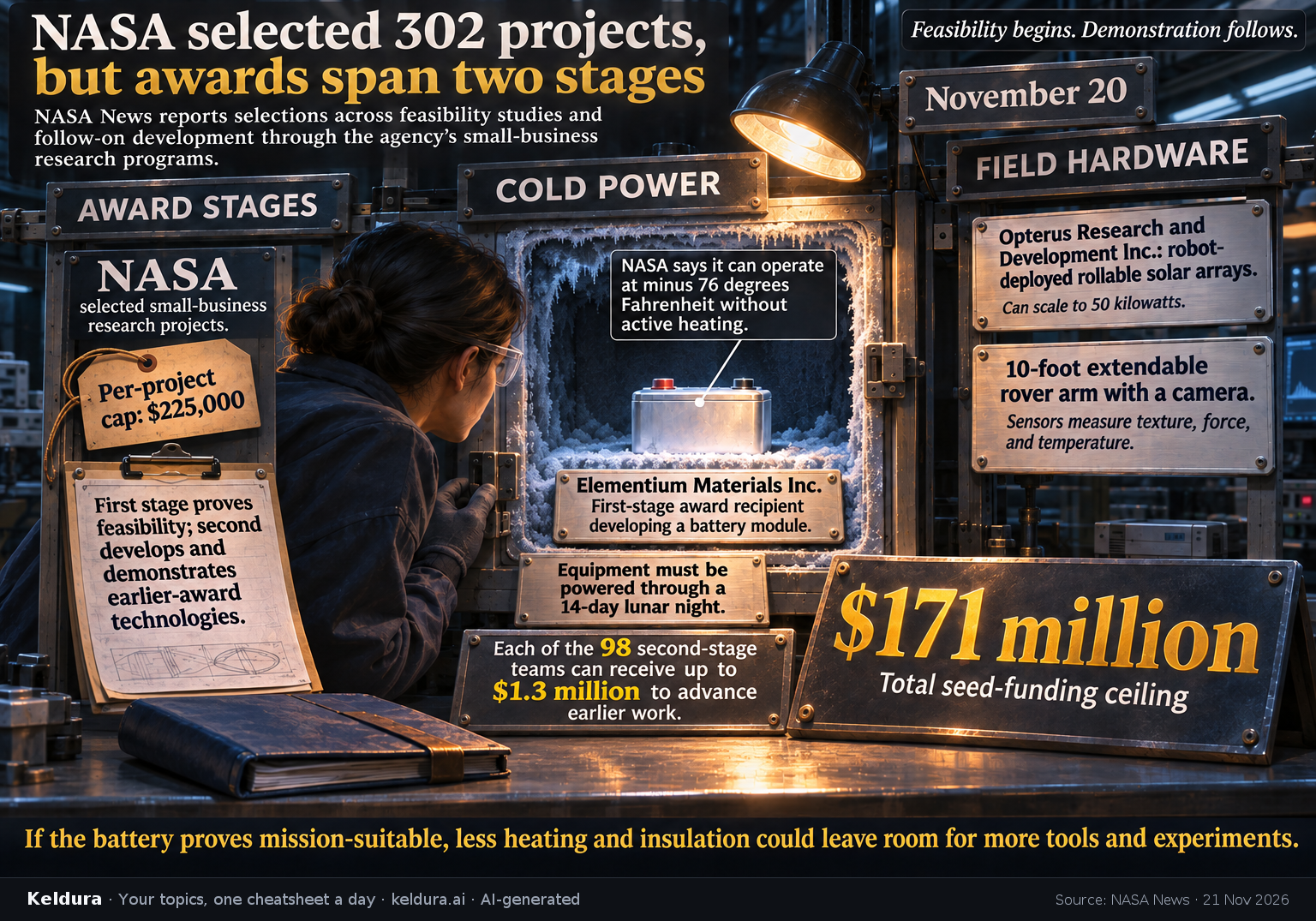
NASA selected 302 projects for up to $171 million through its small-business research programs, including work on cold-tolerant batteries, rollable solar arrays, and reusable lunar landing pads. The selections span first-stage feasibility studies and 98 second-stage contracts that build on projects selected in 2025. [5]
Why it matters: A battery selected for early-stage funding can operate at minus 76 degrees Fahrenheit without active heating, according to NASA. If it proves suitable for missions, using fewer heaters and less insulation could leave room to fly more tools and experiments. [5]
Key insights: Opterus Research and Development Inc. received a second-stage award for rollable solar arrays that robots could deploy and that could scale up to 50 kilowatts. [5] | Intelligent Fiber Optic Systems Corporation is working on a 10-foot extendable rover arm that combines a camera with sensors for texture, force, and temperature. [5] | Slate Geotechnical Consultants Inc. and the Colorado School of Mines will compare two ways to turn loose lunar surface material into landing pads that can withstand repeated use. [5]
Cheatsheet facts: What happened: NASA selected 302 small-business projects for up to $171 million in seed funding. [5] | Why: The research addresses problems such as powering equipment through a 14-day lunar night and keeping repeated landings from kicking debris toward spacecraft and nearby equipment. [5] | Who pays: NASA’s first-stage contracts are capped at $225,000 per project; each of the 98 second-stage contracts can be worth up to $1.3 million. [5] | The catch: First-stage contracts are for proving that an idea can work; second-stage contracts are for developing and demonstrating technologies started under earlier awards. [5]