BepiColombo reaches Mercury after eight years
BepiColombo has reached Mercury, but can it slow down enough to stay?
By November 20, 2026, the European-Japanese BepiColombo mission had reached Mercury after about eight years and roughly 10 billion kilometers.
BepiColombo reached Mercury after a route that took it past Earth once, Venus twice and Mercury six times to shed speed. [2][6] On November 21, flight controllers are due to fire its thrusters for about 11 minutes; if the burn works, BepiColombo will become only the second mission to orbit the plan…
Open original (2 sources):
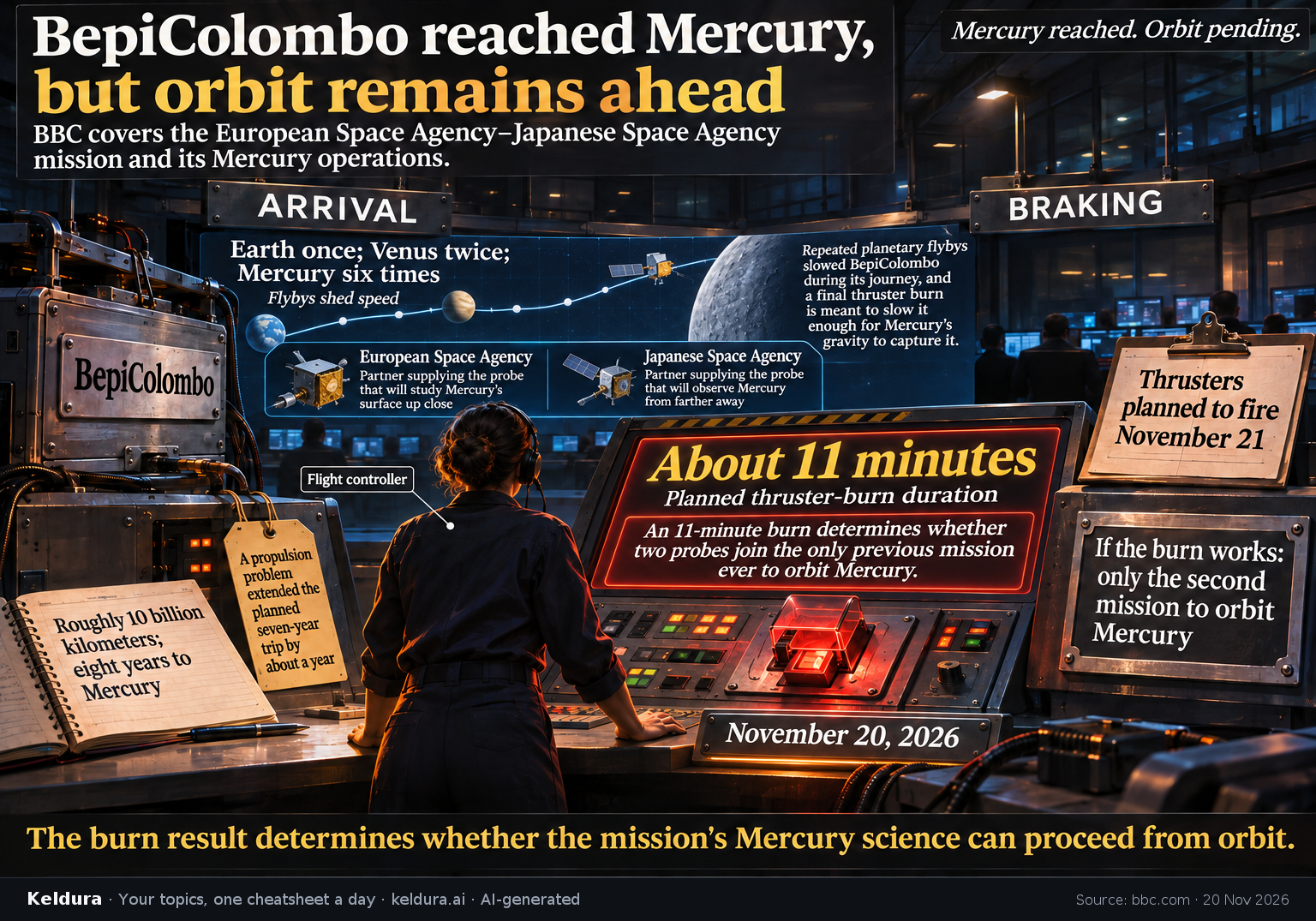
BepiColombo reached Mercury after a route that took it past Earth once, Venus twice and Mercury six times to shed speed. [2][6] On November 21, flight controllers are due to fire its thrusters for about 11 minutes; if the burn works, BepiColombo will become only the second mission to orbit the planet. [2][6]
Why it matters: A successful arrival in orbit would give researchers two vantage points on a planet only one previous mission has orbited, letting them examine ice in permanently shadowed craters and look for clues to how the smallest planet ended up with such a large metal core. [2][6]
Key insights: A propulsion problem extended the planned seven-year trip by about a year. [2] | The mission carries two spacecraft: the European Space Agency’s will study the surface up close, while the Japanese Space Agency’s will observe from farther away. [2] | Mercury has thousands of shallow, steep-sided hollows thought to be about 100,000 years old; researchers know they are not impact craters but do not yet know how they formed. [2]
Cheatsheet facts: What happened: BepiColombo reached Mercury after traveling roughly 10 billion kilometers. [2][6] | Why: The two probes will investigate Mercury’s polar ice, unusual surface hollows and oversized metal core. [2][6] | The catch: Reaching Mercury is not the same as entering orbit: if the braking burn goes wrong, the spacecraft could fly past the planet. [2] | What's next: Watch for the result of the roughly 11-minute orbit-entry burn planned for November 21. [2][6]