Voyager 1’s signal reaches Earth without data
Voyager 1’s radio signal still reaches Earth, but what can engineers learn from a transmission carrying no data?
On November 14, 2026, NASA detected Voyager 1’s radio signal from nearly a light-day away but received no science or engineering data.
A NASA antenna in Canberra, Australia, locked onto Voyager 1’s radio carrier on November 14 but received none of the science or engineering data it normally carries. NASA says the signal shows that the spacecraft is still pointed at Earth and that its broadcast equipment works; engineers suspect th…
Open original · [3] Voyager 1 Engineers Analyze Data Issue, Ready to Confirm Light-day - NASA Science — science.nasa.gov
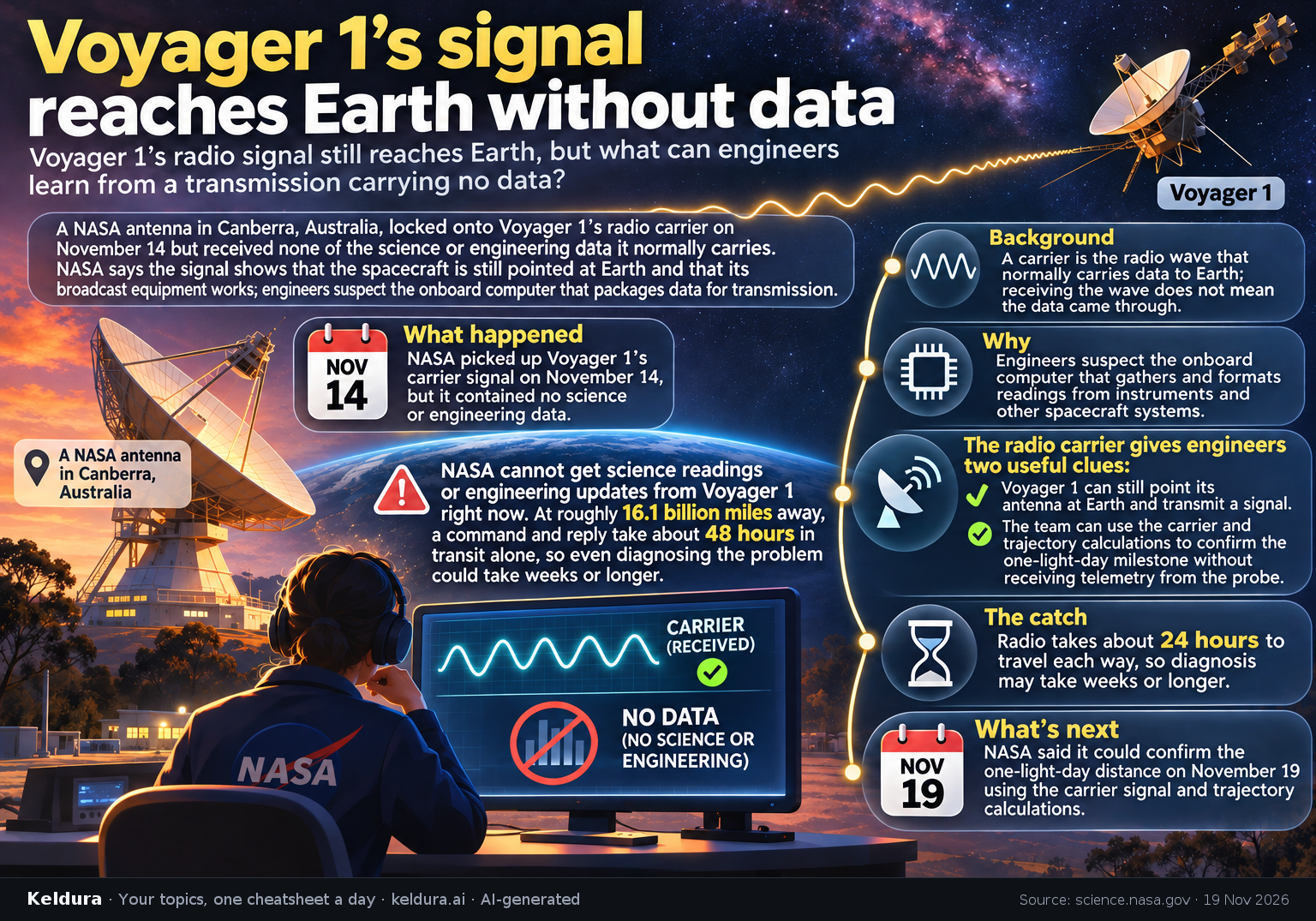
A NASA antenna in Canberra, Australia, locked onto Voyager 1’s radio carrier on November 14 but received none of the science or engineering data it normally carries. NASA says the signal shows that the spacecraft is still pointed at Earth and that its broadcast equipment works; engineers suspect the onboard computer that packages data for transmission. [3]
Why it matters: NASA cannot get science readings or engineering updates from Voyager 1 right now. At roughly a light-day away, a command and reply take about 48 hours in transit alone, so even diagnosing the problem could take weeks or longer. [3]
Key insights: The radio carrier gives engineers two useful clues: Voyager 1 can still point its antenna at Earth and transmit a signal. [3] | The team can use the carrier and trajectory calculations to confirm the one-light-day milestone without receiving telemetry from the probe. [3]
Cheatsheet facts: What happened: NASA picked up Voyager 1’s carrier signal on November 14, but it contained no science or engineering data. [3] | Background: A carrier is the radio wave that normally carries data to Earth; receiving the wave does not mean the data came through. [3] | Why: Engineers suspect the onboard computer that gathers and formats readings from instruments and other spacecraft systems. [3] | The catch: Radio takes about 24 hours to travel each way, so diagnosis may take weeks or longer. [3] | What's next: NASA said it could confirm the one-light-day distance on November 19 using the carrier signal and trajectory calculations. [3]