Voyager 1’s light-day milestone puts Earth 24 hours away
Voyager 1 is reaching a light-day from Earth, but how much longer can its dwindling power keep interstellar data coming?
NASA’s Voyager 1 was due to reach one light-day from Earth—25.9 billion kilometres—at 5:16 a.m. EST on November 18, after more than 49 years of flight.
Voyager 1 was due to become the first human-made object one light-day from Earth on November 18, making the one-way journey for a radio signal 24 hours. It continues collecting interstellar measurements despite dwindling power, while Voyager 2 is not expected to reach the same distance until about…
Open original (2 sources):
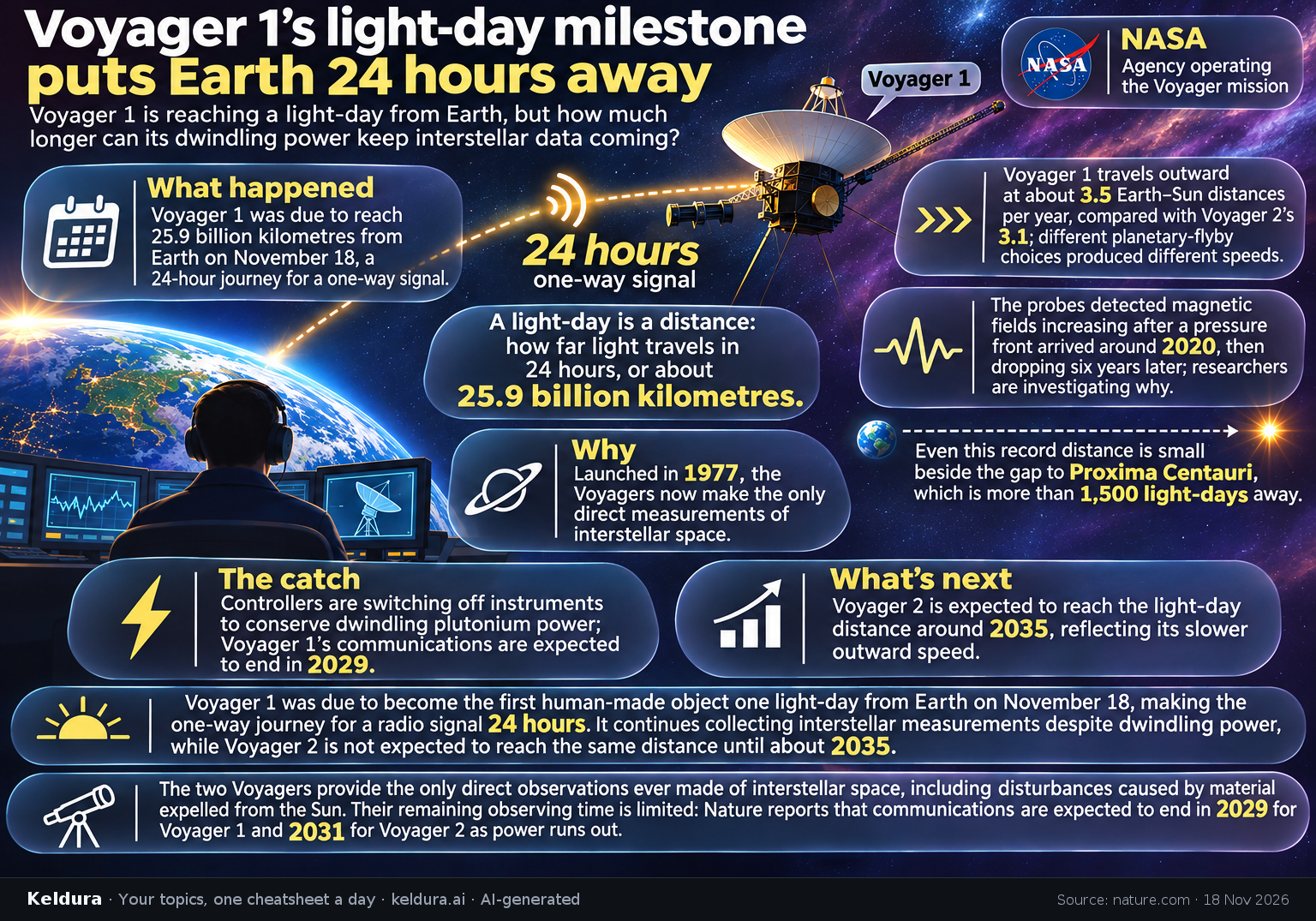
Voyager 1 was due to become the first human-made object one light-day from Earth on November 18, making the one-way journey for a radio signal 24 hours. It continues collecting interstellar measurements despite dwindling power, while Voyager 2 is not expected to reach the same distance until about 2035. [4][5]
Why it matters: The two Voyagers provide the only direct observations ever made of interstellar space, including disturbances caused by material expelled from the Sun. Their remaining observing time is limited: Nature reports that communications are expected to end in 2029 for Voyager 1 and 2031 for Voyager 2 as power runs out. [4]
Key insights: A light-day is a distance: how far light travels in 24 hours, or about 25.9 billion kilometres. [4] | Voyager 1 travels outward at about 3.5 Earth–Sun distances per year, compared with Voyager 2’s 3.1; different planetary-flyby choices produced different speeds. [5] | The probes detected magnetic fields increasing after a pressure front arrived around 2020, then dropping six years later; researchers are investigating why. [4] | Even this record distance is small beside the gap to Proxima Centauri, which is more than 1,500 light-days away. [4]
Cheatsheet facts: What happened: Voyager 1 was due to reach 25.9 billion kilometres from Earth on November 18, a 24-hour journey for a one-way signal. [4] | Why: Launched in 1977, the Voyagers now make the only direct measurements of interstellar space. [4] | The catch: Controllers are switching off instruments to conserve dwindling plutonium power; Voyager 1’s communications are expected to end in 2029. [4] | What's next: Voyager 2 is expected to reach the light-day distance around 2035, reflecting its slower outward speed. [5]