SpaceX catches Starship’s upper stage after an orbital flight
SpaceX has caught a Starship returning from orbit, but can it turn that recovery into routine reuse?
By November 16, 2026, SpaceX had caught Ship 42 at its Texas launch tower after a roughly 22-hour orbital flight, its first recovery of an upper stage returning from orbit.
SpaceX recovered Starship’s upper stage, Ship 42, using mechanical arms on its launch tower at Starbase in Texas—the first such catch after an orbital flight. [2][4][8] The flight lasted roughly 22 hours, compared with the previous Starship endurance record of three hours in September. [2][4] The p…
Open original (3 sources):
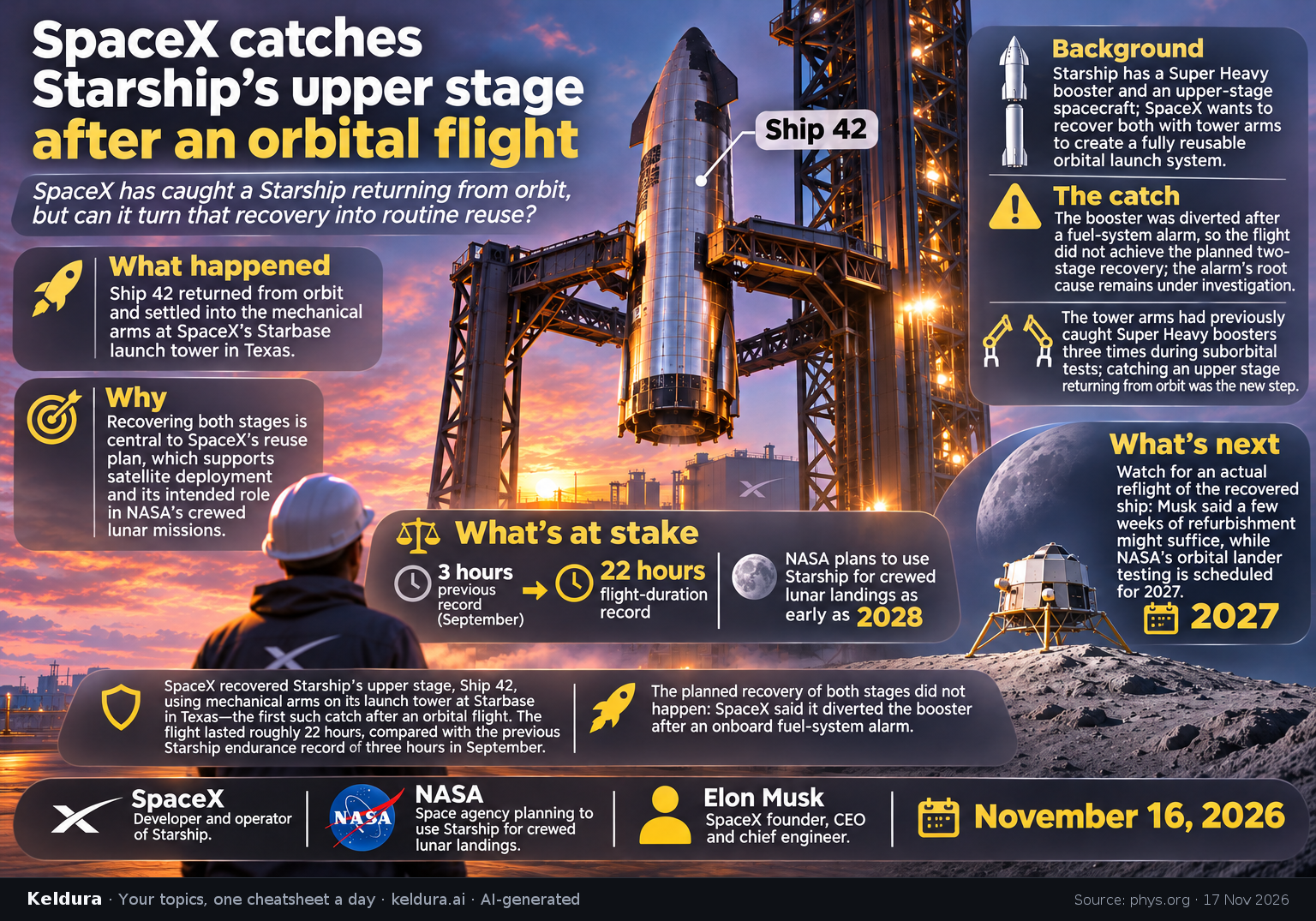
SpaceX recovered Starship’s upper stage, Ship 42, using mechanical arms on its launch tower at Starbase in Texas—the first such catch after an orbital flight. [2][4][8] The flight lasted roughly 22 hours, compared with the previous Starship endurance record of three hours in September. [2][4] The planned recovery of both stages did not happen: SpaceX said it diverted the booster after an onboard fuel-system alarm. [2][8]
Why it matters: NASA plans to use Starship as a lunar landing system for crewed missions starting as early as 2028, so its progress matters beyond SpaceX’s satellite business. Recovering the upper stage advances the company’s fully reusable launch-system plan, but this flight did not demonstrate recovery of both stages or a subsequent reflight. [2][8]
Key insights: The tower arms had previously caught Super Heavy boosters three times during suborbital tests; catching an upper stage returning from orbit was the new step. [2] | Elon Musk said the recovered heat shield looked good and the ship could probably fly again after a few weeks of refurbishment; that is his assessment, not a demonstrated turnaround time. [4] | Starship and Blue Origin’s Blue Moon landing system are scheduled for low-Earth-orbit testing during NASA’s Artemis III mission in 2027. [2]
Cheatsheet facts: What happened: Ship 42 returned from orbit and settled into the mechanical arms at SpaceX’s Starbase launch tower in Texas. [2][8] | Background: Starship has a Super Heavy booster and an upper-stage spacecraft; SpaceX wants to recover both with tower arms to create a fully reusable orbital launch system. [2] | Why: Recovering both stages is central to SpaceX’s reuse plan, which supports satellite deployment and its intended role in NASA’s crewed lunar missions. [2][8] | The catch: The booster was diverted after a fuel-system alarm, so the flight did not achieve the planned two-stage recovery; the alarm’s root cause remains under investigation. [2][8] | What's next: Watch for an actual reflight of the recovered ship: Musk said a few weeks of refurbishment might suffice, while NASA’s orbital lander testing is scheduled for 2027. [2][4]