Hera begins inspecting the asteroid NASA deliberately struck
DART changed an asteroid moonlet’s orbit, but what can Hera reveal about making that technique dependable?
ESA’s Hera spacecraft reached the Didymos asteroid system on November 4 and began a close-up investigation of NASA’s 2022 impact, which shortened Dimorphos’s orbit by 33 minutes.
ESA’s Hera spacecraft has begun examining the Didymos–Dimorphos asteroid system after arriving on November 4. It will measure the aftermath of NASA’s 2022 DART impact, which shortened the smaller asteroid’s orbit around its companion by 33 minutes. [8]
Open original · [8] Europe's Hera Spacecraft Has Begun Its Close-Up Investigation of the Asteroid System NASA Intentionally Hit in 2022 — smithsonianmag.com
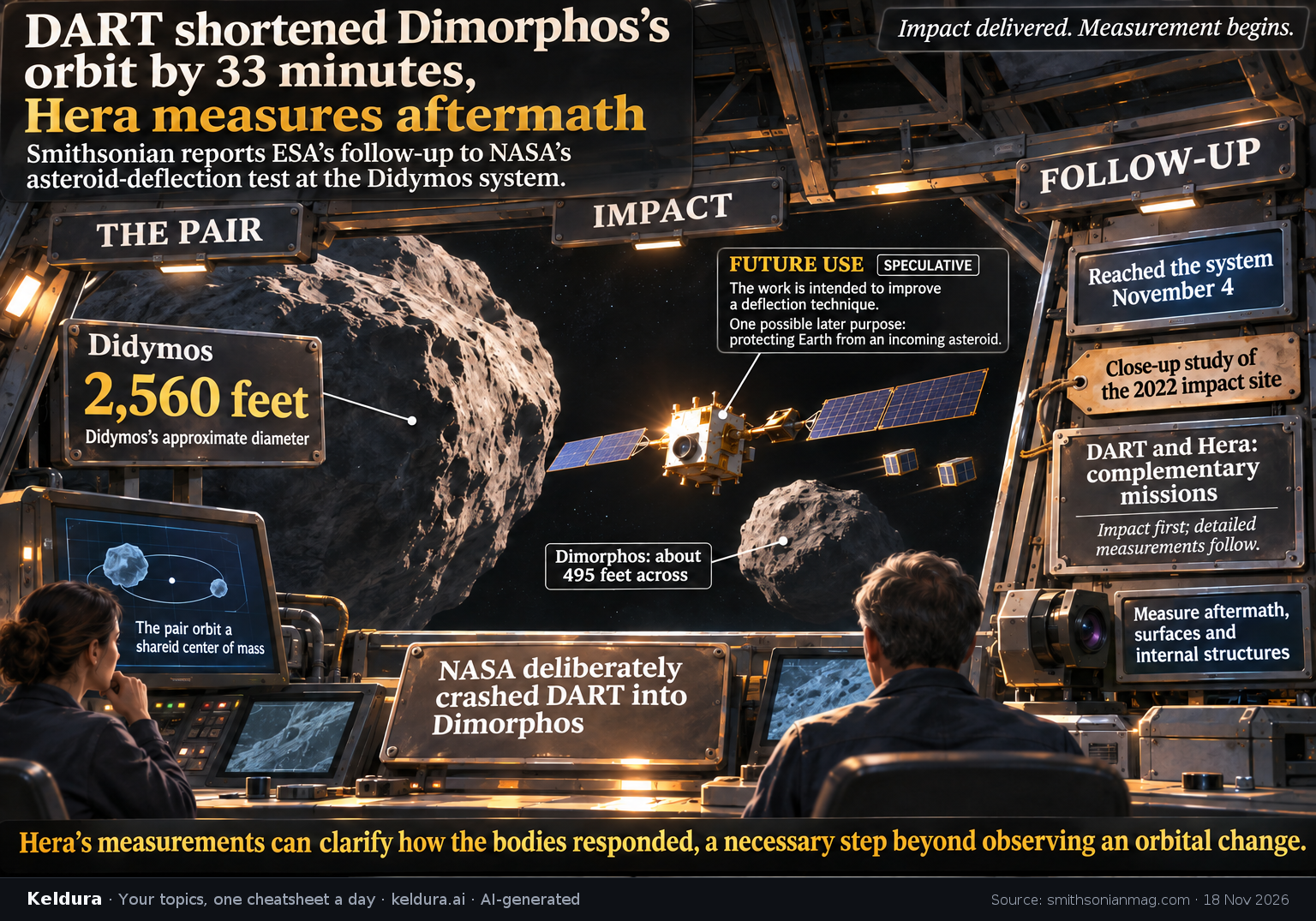
ESA’s Hera spacecraft has begun examining the Didymos–Dimorphos asteroid system after arriving on November 4. It will measure the aftermath of NASA’s 2022 DART impact, which shortened the smaller asteroid’s orbit around its companion by 33 minutes. [8]
Why it matters: DART demonstrated that a spacecraft impact could change an asteroid’s motion; Hera is collecting the detailed follow-up measurements needed to better understand that result. The work is intended to improve a technique that could one day help protect Earth from an incoming asteroid, while also revealing the bodies’ surfaces and internal structures. [8]
Key insights: Didymos is roughly 2,560 feet across, while its moonlet Dimorphos is about 495 feet across; the pair orbit a shared center of mass. [8] | DART and Hera were designed as complementary missions: one delivered the impact, and the other measures its outcome. [8] | Hera is scheduled to deploy two shoebox-size CubeSats early next year, including Juventas, which will attempt to land on Dimorphos. [8]
Cheatsheet facts: What happened: Hera reached the Didymos system on November 4 and began its close-up investigation of the 2022 impact site. [8] | Background: NASA deliberately crashed DART into Dimorphos, the smaller member of an asteroid pair, shortening its orbit around Didymos by 33 minutes. [8] | Why: Hera will measure the impact’s aftermath to help scientists understand asteroid deflection and the bodies’ physical properties. [8] | The catch: Changing Dimorphos’s orbit demonstrated deflection, but the paired missions were designed to add precise follow-up measurements before drawing a fuller picture of the outcome. [8] | What's next: Hera is due to move closer in December and deploy two CubeSats early in 2027; Juventas will attempt a landing on Dimorphos. [8]