Why softer inflation has not ended the US rate debate
Second-quarter GDP growth was revised up by 0.7 percentage points to an annualised 2.2%, with consumer spending, investment and exports.
Second-quarter GDP growth was revised up by 0.7 percentage points to an annualised 2.2%, with consumer spending, investment and exports contributing to the expansion [3]. August PCE inflation was 3.4% year-on-year and core PCE was 3.0%, while consumer spending jumped 0.9% on the month, or 0.6% afte…
Second-quarter GDP growth was revised up by 0.7 percentage points to an annualised 2.2%, with consumer spending, investment and exports contributing to the expansion [3]. August PCE inflation was 3.4% year-on-year and core PCE was 3.0%, while consumer spending jumped 0.9% on the month, or 0.6% after adjusting for inflation [3][9]. Market-implied odds of an October rate increase consequently fell to roughly 35%-37%, down from about 51% before the inflation data [4][9].
Why it matters: The combination leaves the Fed facing a two-sided problem: inflation remains above its 2% target, but softer monthly price growth reduces the urgency to raise rates immediately [3][9]. Strong spending and AI-related business investment are supporting economic growth, yet higher energy prices and borrowing costs could renew price pressure or eventually weaken household demand [4][9].
Key insights: The GDP revision was broad enough to include consumer spending, investment and exports, with real estate, information, durable-goods manufacturing, finance and insurance among the leading industry contributors [3]. | Consumers are sustaining growth partly by saving less: the saving rate fell to 4.1% in August from 4.6% in July, while inflation-adjusted disposable income was flat [9]. | Private payrolls increased by 90,000 in September after a downwardly revised 36,000 gain in August, putting the next government payroll report at the centre of the rate outlook [4]. | The market response was uneven: the Nasdaq gained 0.24%, the S&P 500 lost 0.25% and nine of the S&P’s 11 main sectors declined, even as major technology shares advanced [4].
Cheatsheet facts: What changed: Q2 GDP was revised to 2.2%, August PCE inflation came in at 3.4% year-on-year, and October rate-hike odds dropped to about 35%-37% [3][4][9]. | Why now: Inflation rose less than expected while consumer spending surged 0.9%, producing a mix of softer price momentum and resilient demand [9]. | Watch next: The Oct. 2 government payroll report and subsequent Fed commentary will provide observable evidence on labour-market strength and policymakers’ assessment of inflation [2][4].
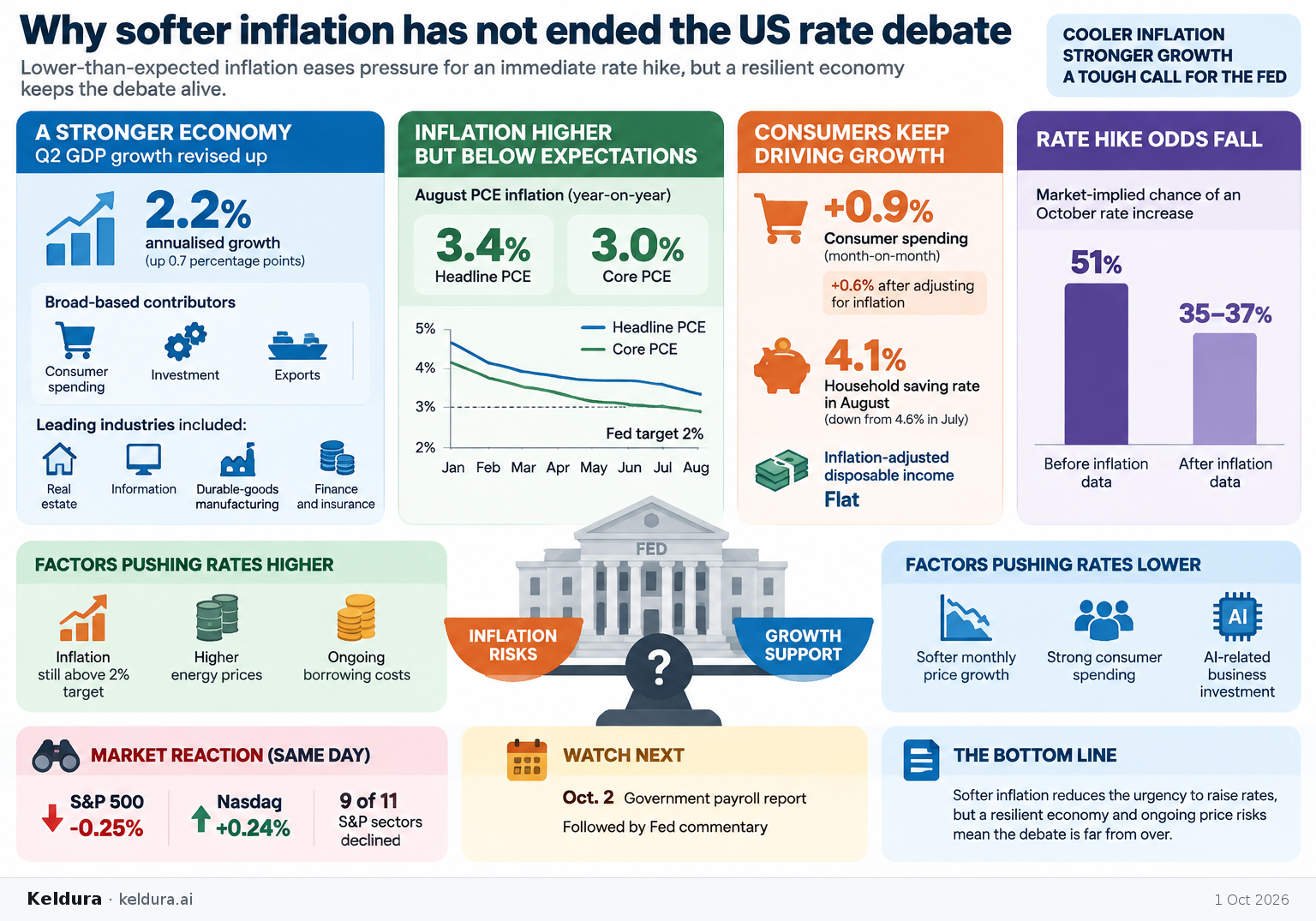
Second-quarter GDP growth was revised up by 0.7 percentage points to an annualised 2.2%, with consumer spending, investment and exports contributing to the expansion [3]. August PCE inflation was 3.4% year-on-year and core PCE was 3.0%, while consumer spending jumped 0.9% on the month, or 0.6% after adjusting for inflation [3][9]. Market-implied odds of an October rate increase consequently fell to roughly 35%-37%, down from about 51% before the inflation data [4][9].
Why it matters: The combination leaves the Fed facing a two-sided problem: inflation remains above its 2% target, but softer monthly price growth reduces the urgency to raise rates immediately [3][9]. Strong spending and AI-related business investment are supporting economic growth, yet higher energy prices and borrowing costs could renew price pressure or eventually weaken household demand [4][9].
Key insights: The GDP revision was broad enough to include consumer spending, investment and exports, with real estate, information, durable-goods manufacturing, finance and insurance among the leading industry contributors [3]. | Consumers are sustaining growth partly by saving less: the saving rate fell to 4.1% in August from 4.6% in July, while inflation-adjusted disposable income was flat [9]. | Private payrolls increased by 90,000 in September after a downwardly revised 36,000 gain in August, putting the next government payroll report at the centre of the rate outlook [4]. | The market response was uneven: the Nasdaq gained 0.24%, the S&P 500 lost 0.25% and nine of the S&P’s 11 main sectors declined, even as major technology shares advanced [4].
Cheatsheet facts: What changed: Q2 GDP was revised to 2.2%, August PCE inflation came in at 3.4% year-on-year, and October rate-hike odds dropped to about 35%-37% [3][4][9]. | Why now: Inflation rose less than expected while consumer spending surged 0.9%, producing a mix of softer price momentum and resilient demand [9]. | Watch next: The Oct. 2 government payroll report and subsequent Fed commentary will provide observable evidence on labour-market strength and policymakers’ assessment of inflation [2][4].
X copy pack
[3] US strongly revises up Q2 GDP growth, inflation stable - RTHK — news.rthk.hk[9] US inflation rises below expectations in August; consumer spending robust - The Korea Times — koreatimes.co.kr[4] S&P 500 dips, Nasdaq higher after data shows moderate inflation rise | The Straits Times — straitstimes.com[2] Trading Day: Shrugging off a volatile September, markets shuffle into Q4 - CNA — channelnewsasia.comRead in BriefingsPost to X