Gaza families get electricity from turbines built with salvaged debris
Scrap-built turbines can power lights and phones in Gaza, but how much can they replace a shattered electricity grid?
By November 5, Kamal Al-Dabary was building wind turbines from salvaged debris in a Khan Yunis displacement camp to power lights, phones and small appliances.
In a Khan Yunis displacement camp, former engineering student Kamal Al-Dabary is making wind turbines from scooter motors and old water tanks. The devices turn sea breezes into electricity stored in batteries, providing power for phones, lights, fans and electric razors where families lack direct g…
Open original · [1] Gaza turns rubble into power with homemade wind turbines | AFP.com — afp.com
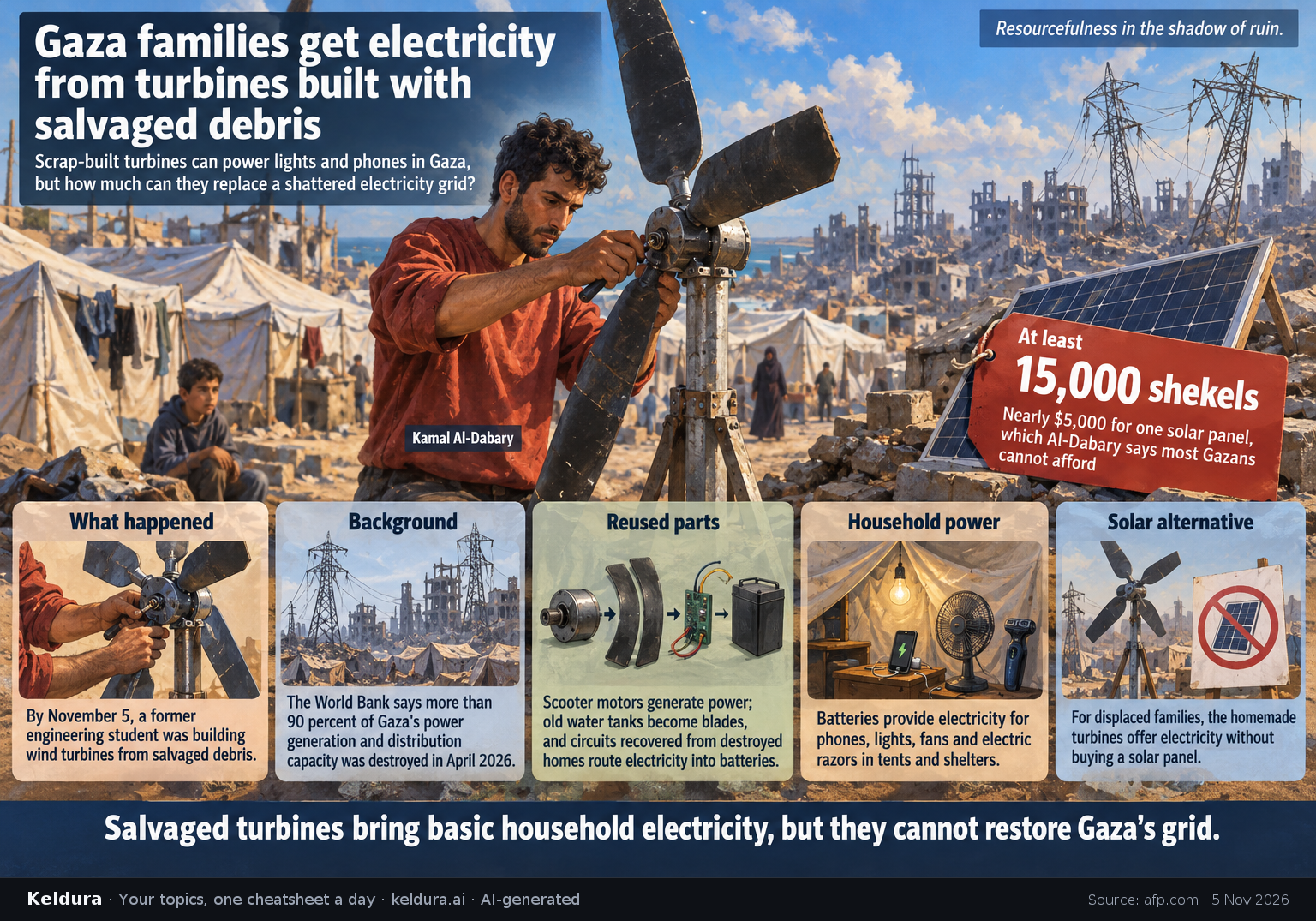
In a Khan Yunis displacement camp, former engineering student Kamal Al-Dabary is making wind turbines from scooter motors and old water tanks. The devices turn sea breezes into electricity stored in batteries, providing power for phones, lights, fans and electric razors where families lack direct grid access. [1]
Why it matters: For families living in tents and shelters, the turbines provide usable electricity without buying a solar panel that Al-Dabary says now costs at least 15,000 shekels, nearly $5,000. This is a small-scale alternative in a territory where the World Bank says more than 90 percent of power generation and distribution capacity was destroyed in April 2026. [1]
Key insights: The turbines reuse scooter motors as generators and old water tanks as blades, turning recovered materials into a working energy system. [1] | Electricity passes through circuits assembled from parts recovered from destroyed homes before reaching batteries. [1] | The documented uses are small loads—lighting, phone charging, fans and razors—not restoration of the territory's electricity network. [1]
Cheatsheet facts: What happened: Kamal Al-Dabary is building wind turbines for displaced families in southern Khan Yunis using scrap metal and salvaged debris. [1] | Why: Most Gazans lack direct access to the shattered grid, and Al-Dabary puts the price of a single solar panel at at least 15,000 shekels. [1] | Who pays: Salvaged scooter motors, water-tank blades and recovered electrical parts provide an alternative to buying a nearly $5,000 solar panel. [1] | The catch: The reported output supports phones, lights, fans and razors; it supplies small comforts rather than replacing Gaza's destroyed grid. [1]