Singapore strengthens penalties for companies linked to cross-border haze
Singapore can now arrest haze-law suspects and restrict companies, but can it overcome the overseas evidence problem?
On November 4, Singapore's parliament strengthened its anti-haze law, increasing daily fines tenfold to nearly US$800,000 and adding arrest powers.
Singapore's parliament passed stronger anti-haze legislation without dissent after weeks of air pollution from fires in Indonesia. The changes add arrest powers, trials in defendants' absence, company-funded investigations and potential restrictions on financial services. [11]
Open original · [11] Singapore toughens haze law with arrest powers, bigger fines | AFP.com — afp.com
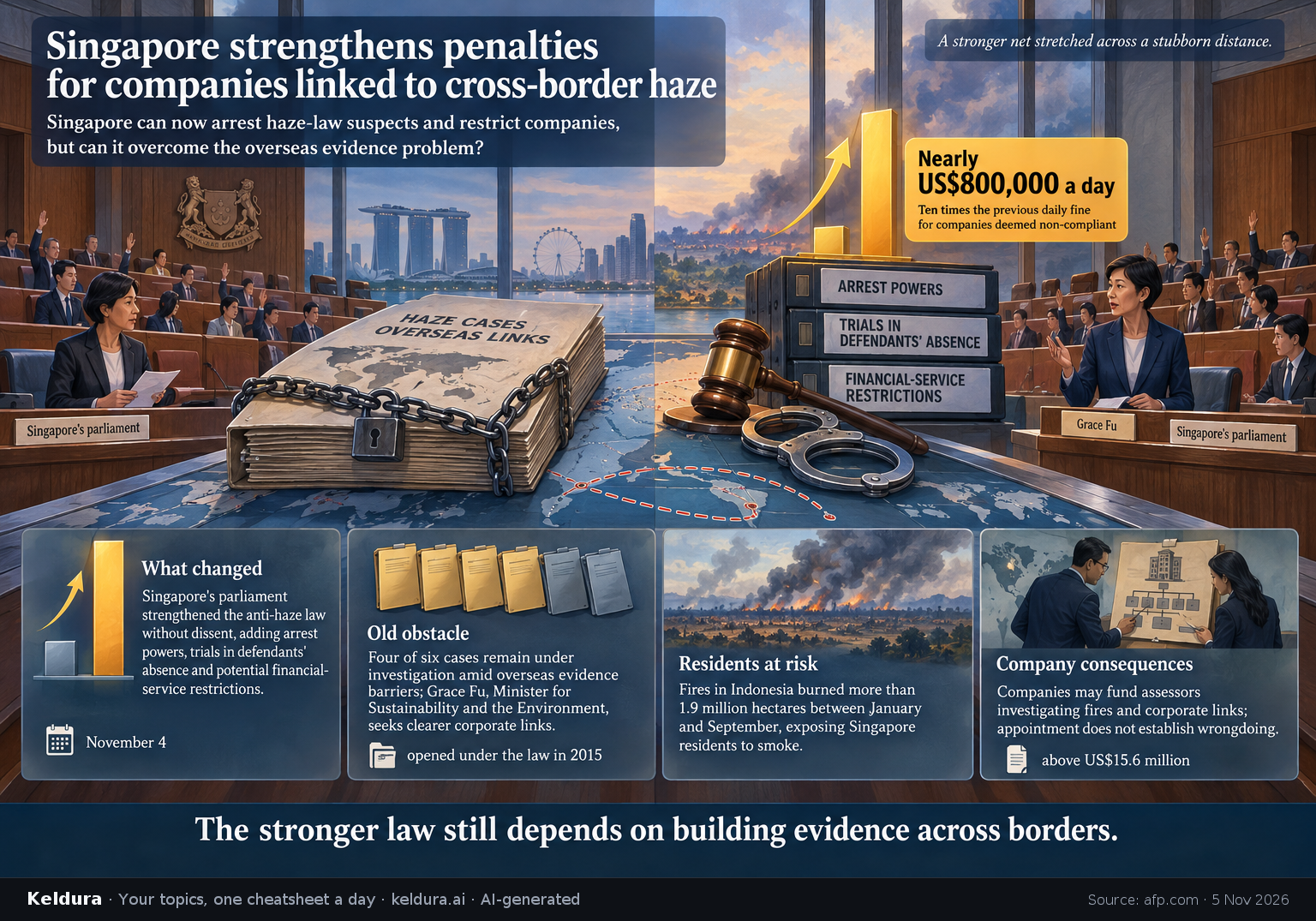
Singapore's parliament passed stronger anti-haze legislation without dissent after weeks of air pollution from fires in Indonesia. The changes add arrest powers, trials in defendants' absence, company-funded investigations and potential restrictions on financial services. [11]
Why it matters: Residents exposed to smoke could benefit if stronger enforcement changes companies' behavior: fires burned more than 1.9 million hectares in Indonesia between January and September. Companies deemed non-compliant now face daily fines nearly ten times the previous level, with a total ceiling above US$15.6 million. [11]
Key insights: The enforcement problem predates this year's smoke: four of six cases opened under the law in 2015 remain under investigation. [11] | Government-approved independent assessors can investigate fires, business operations and corporate relationships at companies' expense; their appointment does not imply wrongdoing. [11] | Experts attribute the fires partly to El Niño-linked drought, alongside longstanding deforestation and peatland drying. [11]
Cheatsheet facts: What happened: Parliament added arrest powers, larger fines and restrictions on designated companies to Singapore's anti-haze law on November 4. [11] | Why: The 2014 law has been difficult to enforce because evidence and defendants can be overseas; four investigations opened in 2015 remain unresolved. [11] | Who pays: Non-compliant companies face nearly US$800,000 in daily fines, while authorities can require companies to fund independent assessors. [11] | The catch: The new powers target an existing cross-border evidence problem; appointing an assessor establishes a way to investigate possible links, not proof of wrongdoing. [11]