Puerto Rico taps household batteries to support its power grid
Nearly 115,000 households help support Puerto Rico's grid, but how much can home batteries offset aging power plants?
On nearly 20 days in October, a utility drew energy from Hector Ríos' home battery in Cabo Rojo as part of Puerto Rico's nearly 115,000-household virtual power plant.
Puerto Rico is using batteries from nearly 115,000 households as a “virtual power plant” to bolster its electricity grid when aging power plants cannot meet demand. Hector Ríos, a 75-year-old participant in Cabo Rojo, had energy drawn from his home battery on nearly 20 days in October. [3]
Open original · [3] As outages persist, Puerto Rico finds a way to help keep the lights on with 'virtual power plant' — apnews.com
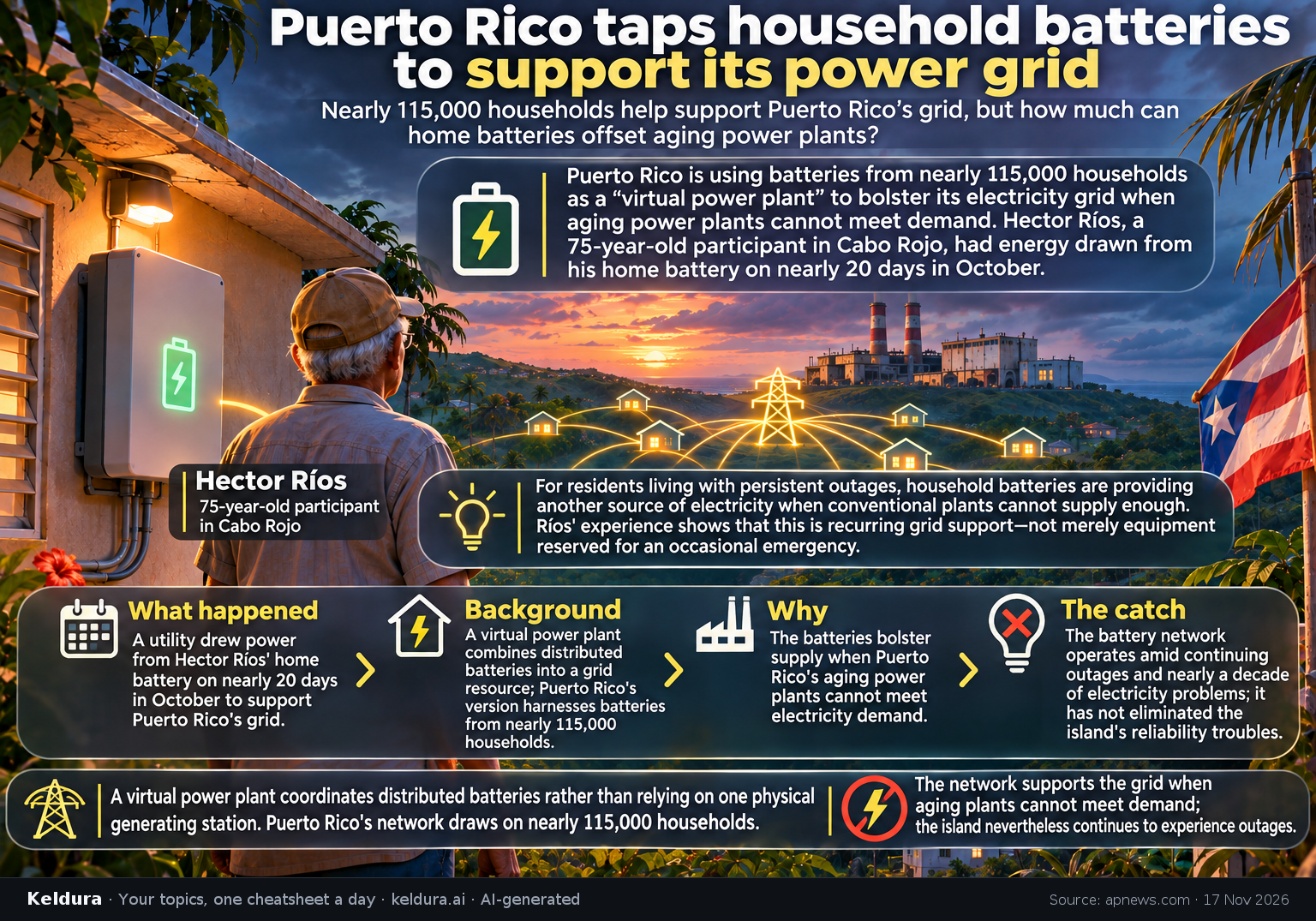
Puerto Rico is using batteries from nearly 115,000 households as a “virtual power plant” to bolster its electricity grid when aging power plants cannot meet demand. Hector Ríos, a 75-year-old participant in Cabo Rojo, had energy drawn from his home battery on nearly 20 days in October. [3]
Why it matters: For residents living with persistent outages, household batteries are providing another source of electricity when conventional plants cannot supply enough. Ríos' experience shows that this is recurring grid support—not merely equipment reserved for an occasional emergency. [3]
Key insights: A virtual power plant coordinates distributed batteries rather than relying on one physical generating station. Puerto Rico's network draws on nearly 115,000 households. [3] | Ríos' battery supplied the utility on nearly 20 days in a single month, illustrating how frequently one participating home was called upon. [3] | The network supports the grid when aging plants cannot meet demand; the island nevertheless continues to experience outages. [3]
Cheatsheet facts: What happened: A utility drew power from Hector Ríos' home battery on nearly 20 days in October to support Puerto Rico's grid. [3] | Background: A virtual power plant combines distributed batteries into a grid resource; Puerto Rico's version harnesses batteries from nearly 115,000 households. [3] | Why: The batteries bolster supply when Puerto Rico's aging power plants cannot meet electricity demand. [3] | The catch: The battery network operates amid continuing outages and nearly a decade of electricity problems; it has not eliminated the island's reliability troubles. [3]