Latin America pushes to turn mineral wealth into jobs and development
A regional dialogue in Santiago focused on how Latin America can turn copper and lithium wealth into employment, industrialization, infrastructure, and local development.[1] The World Bank said much of the value from mining is created beyond extraction, especially through supplier industries, proce…
A regional dialogue in Santiago focused on how Latin America can turn copper and lithium wealth into employment, industrialization, infrastructure, and local development.[1] The World Bank said much of the value from mining is created beyond extraction, especially through supplier industries, processing, logistics, workforce development, and infrastructure, and regional participants stressed collaboration across governments, companies, academia, and communities.[1]
Why it matters: This matters because Latin America sits at the center of the global energy transition, but the economic payoff from critical minerals will depend on whether countries can build local ecosystems that capture value beyond the mine.[1] The story also shows that policy credibility, environmental and social standards, and responsible private investment are being framed as conditions for turning mineral endowments into long-term development.[1]
Key insights: Chile’s economy and mining minister said the key is formal, high-quality employment and a broader productive ecosystem of SMEs, services, and innovation around mining operations.[1] | The World Bank’s Namrata Thapar said the biggest gains will come from supplier industries, processing, infrastructure, logistics, and workforce development rather than extraction alone.[1] | Participants identified four priorities for capturing more value: quality employment, industrialization, strategic infrastructure, and territorial development.[1] | The World Bank Group said it will support Chile’s efforts to increase the development impact of its mineral resources.[1]
Cheatsheet facts: What changed: A Santiago dialogue brought governments, miners, multilateral institutions, and experts together around a regional push to convert mineral wealth into jobs and development.[1] | Why now: Demand for critical minerals is rising as Latin America’s copper and lithium reserves gain strategic importance in the global energy transition.[1] | Watch next: Evidence of new policies, partnerships, or investments that expand local supply chains, processing, infrastructure, or workforce development in mining regions.[1]
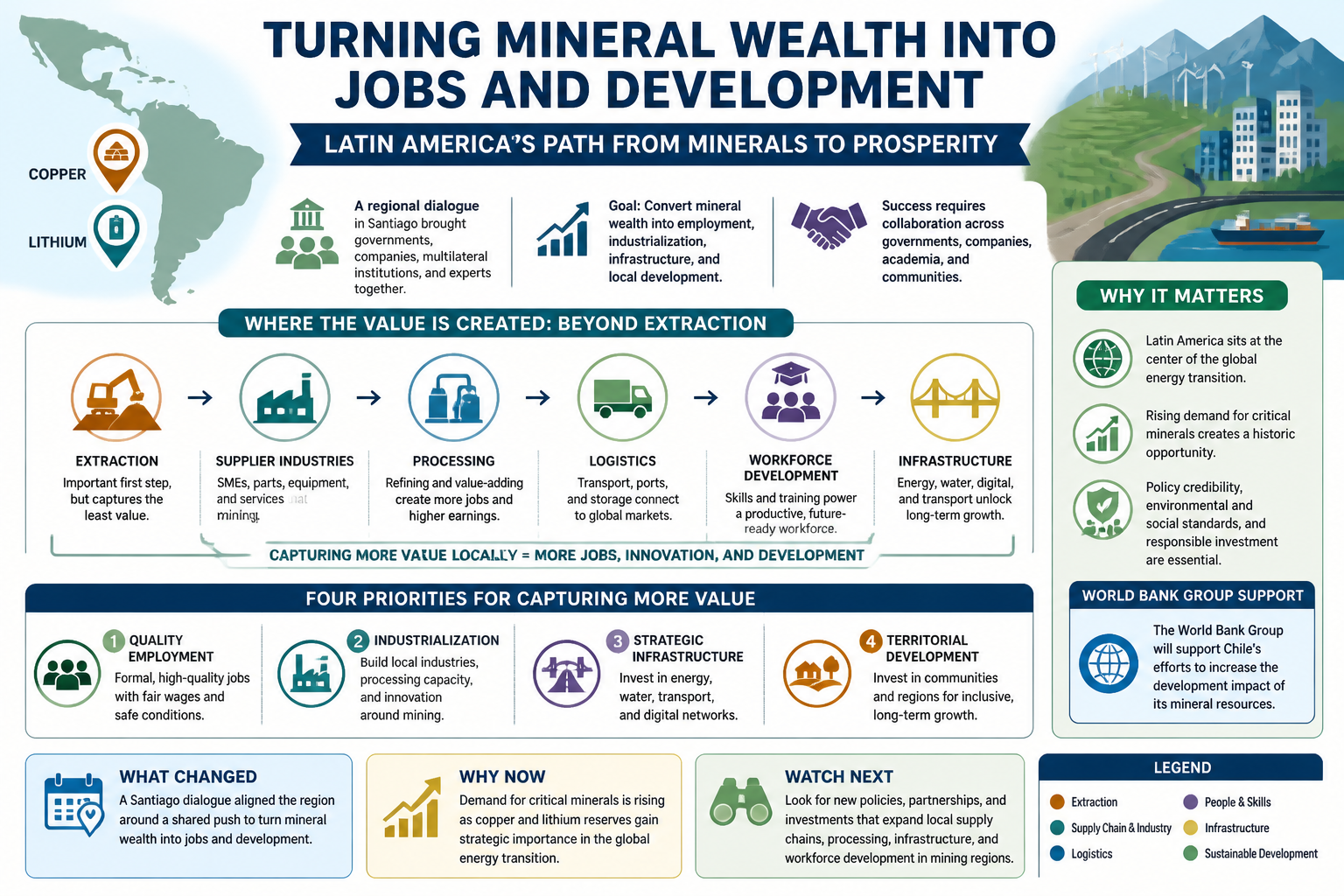
A regional dialogue in Santiago focused on how Latin America can turn copper and lithium wealth into employment, industrialization, infrastructure, and local development.[1] The World Bank said much of the value from mining is created beyond extraction, especially through supplier industries, processing, logistics, workforce development, and infrastructure, and regional participants stressed collaboration across governments, companies, academia, and communities.[1]
Why it matters: This matters because Latin America sits at the center of the global energy transition, but the economic payoff from critical minerals will depend on whether countries can build local ecosystems that capture value beyond the mine.[1] The story also shows that policy credibility, environmental and social standards, and responsible private investment are being framed as conditions for turning mineral endowments into long-term development.[1]
Key insights: Chile’s economy and mining minister said the key is formal, high-quality employment and a broader productive ecosystem of SMEs, services, and innovation around mining operations.[1] | The World Bank’s Namrata Thapar said the biggest gains will come from supplier industries, processing, infrastructure, logistics, and workforce development rather than extraction alone.[1] | Participants identified four priorities for capturing more value: quality employment, industrialization, strategic infrastructure, and territorial development.[1] | The World Bank Group said it will support Chile’s efforts to increase the development impact of its mineral resources.[1]
Cheatsheet facts: What changed: A Santiago dialogue brought governments, miners, multilateral institutions, and experts together around a regional push to convert mineral wealth into jobs and development.[1] | Why now: Demand for critical minerals is rising as Latin America’s copper and lithium reserves gain strategic importance in the global energy transition.[1] | Watch next: Evidence of new policies, partnerships, or investments that expand local supply chains, processing, infrastructure, or workforce development in mining regions.[1]