Higher rates undermine Trump’s economic-boom message
President Donald Trump responded to the positive August jobs report by criticizing inflation, interest rates, financial markets and U.S. trade partners rather than presenting the hiring gain as confirmation of an economic boom. [3][4] The economy has grown at roughly a 2% annual rate during his sec…
President Donald Trump responded to the positive August jobs report by criticizing inflation, interest rates, financial markets and U.S. trade partners rather than presenting the hiring gain as confirmation of an economic boom. [3][4] The economy has grown at roughly a 2% annual rate during his second term, while the national debt has crossed $40 trillion and the 10-year Treasury yield reached about 4.79% on Friday. [3][4]
Why it matters: Higher government borrowing costs constrain growth and make Trump’s promises of stronger expansion harder to reconcile with persistent inflation, tariffs and large deficits. [3][4] Reducing deficits could ease pressure on rates, but the spending cuts or tax increases involved would carry political costs. [3][4]
Key insights: Trump rejected the view that the surprise addition of 162,000 jobs could increase inflationary pressure. [3][4] | The administration argues that artificial intelligence, tariffs and tax cuts will raise productivity, factory employment and business investment. [4] | The annual federal budget deficit is roughly $2 trillion and is projected to exceed $3 trillion a decade from now. [3][4] | RSM US chief economist Joe Brusuelas said restoring market confidence would require slower government-spending growth, outright spending reductions and tax increases. [3][4]
Cheatsheet facts: What changed: A favorable employment headline intensified concern about inflation and rates, prompting Trump to focus on borrowing costs and economic grievances. [3][4] | Why now: The administration is defending its economic record two months before Election Day as growth remains near 2%, debt exceeds $40 trillion and long-term Treasury yields remain elevated. [3][4] | Watch next: Watch the 10-year Treasury yield from its roughly 4.79% Friday level and any concrete administration or congressional measures addressing the approximately $2 trillion annual deficit. [3][4]
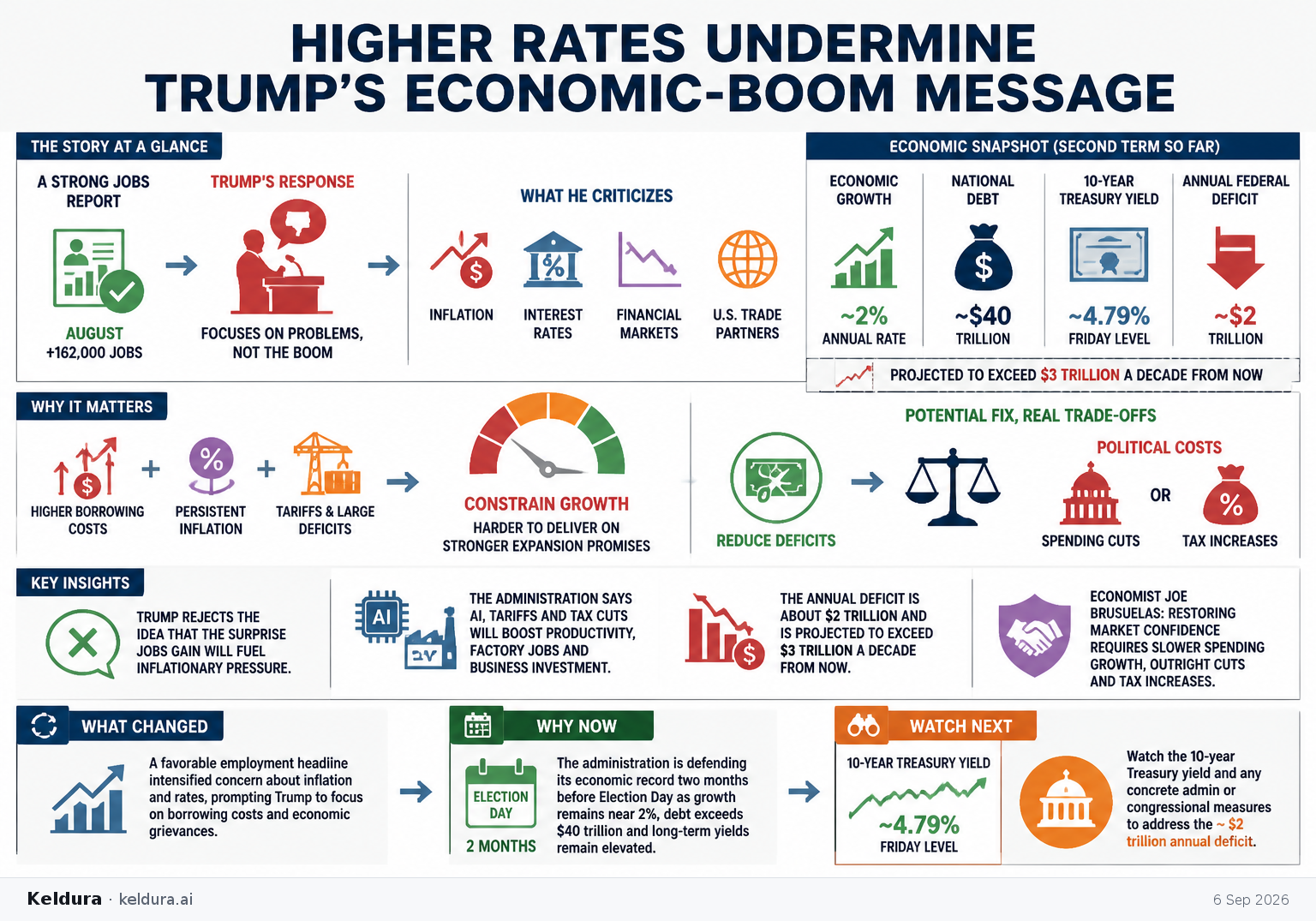
President Donald Trump responded to the positive August jobs report by criticizing inflation, interest rates, financial markets and U.S. trade partners rather than presenting the hiring gain as confirmation of an economic boom. [3][4] The economy has grown at roughly a 2% annual rate during his second term, while the national debt has crossed $40 trillion and the 10-year Treasury yield reached about 4.79% on Friday. [3][4]
Why it matters: Higher government borrowing costs constrain growth and make Trump’s promises of stronger expansion harder to reconcile with persistent inflation, tariffs and large deficits. [3][4] Reducing deficits could ease pressure on rates, but the spending cuts or tax increases involved would carry political costs. [3][4]
Key insights: Trump rejected the view that the surprise addition of 162,000 jobs could increase inflationary pressure. [3][4] | The administration argues that artificial intelligence, tariffs and tax cuts will raise productivity, factory employment and business investment. [4] | The annual federal budget deficit is roughly $2 trillion and is projected to exceed $3 trillion a decade from now. [3][4] | RSM US chief economist Joe Brusuelas said restoring market confidence would require slower government-spending growth, outright spending reductions and tax increases. [3][4]
Cheatsheet facts: What changed: A favorable employment headline intensified concern about inflation and rates, prompting Trump to focus on borrowing costs and economic grievances. [3][4] | Why now: The administration is defending its economic record two months before Election Day as growth remains near 2%, debt exceeds $40 trillion and long-term Treasury yields remain elevated. [3][4] | Watch next: Watch the 10-year Treasury yield from its roughly 4.79% Friday level and any concrete administration or congressional measures addressing the approximately $2 trillion annual deficit. [3][4]