Yen Rally Forces a Carry-Trade Retreat
The yen strengthened to 152.89 per dollar, its highest level since February, after trading near 160 less than a week earlier.[1] Expectations of a Bank of Japan rate increase, early signs of capital repatriation and intervention risk are prompting traders to unwind positions financed with low-cost…
The yen strengthened to 152.89 per dollar, its highest level since February, after trading near 160 less than a week earlier.[1] Expectations of a Bank of Japan rate increase, early signs of capital repatriation and intervention risk are prompting traders to unwind positions financed with low-cost yen borrowing.[1]
Why it matters: A stronger yen raises the cost and risk of a strategy widely used to finance investments in higher-yielding currencies and assets, potentially transmitting Japanese policy shifts across global markets.[1]
Key insights: The rally follows the yen’s slide to 40-year lows in July and a joint U.S.-Japan intervention.[1] | Investors are reluctant to rebuild short-yen positions because another intervention remains a risk.[1] | The yen also strengthened as broader markets absorbed higher oil prices and rising bond yields, reaching 154.76 per dollar during the cited session.[3]
Cheatsheet facts: What changed: The yen rapidly moved from around 160 to 152.89 per dollar, its strongest level since February.[1] | Why now: Markets are pricing faster Bank of Japan tightening while accounting for capital repatriation and official intervention risk.[1] | Watch next: The observable tests are next week’s central-bank meetings in Japan and the U.S., alongside whether traders resume or continue unwinding yen-funded positions.[1]
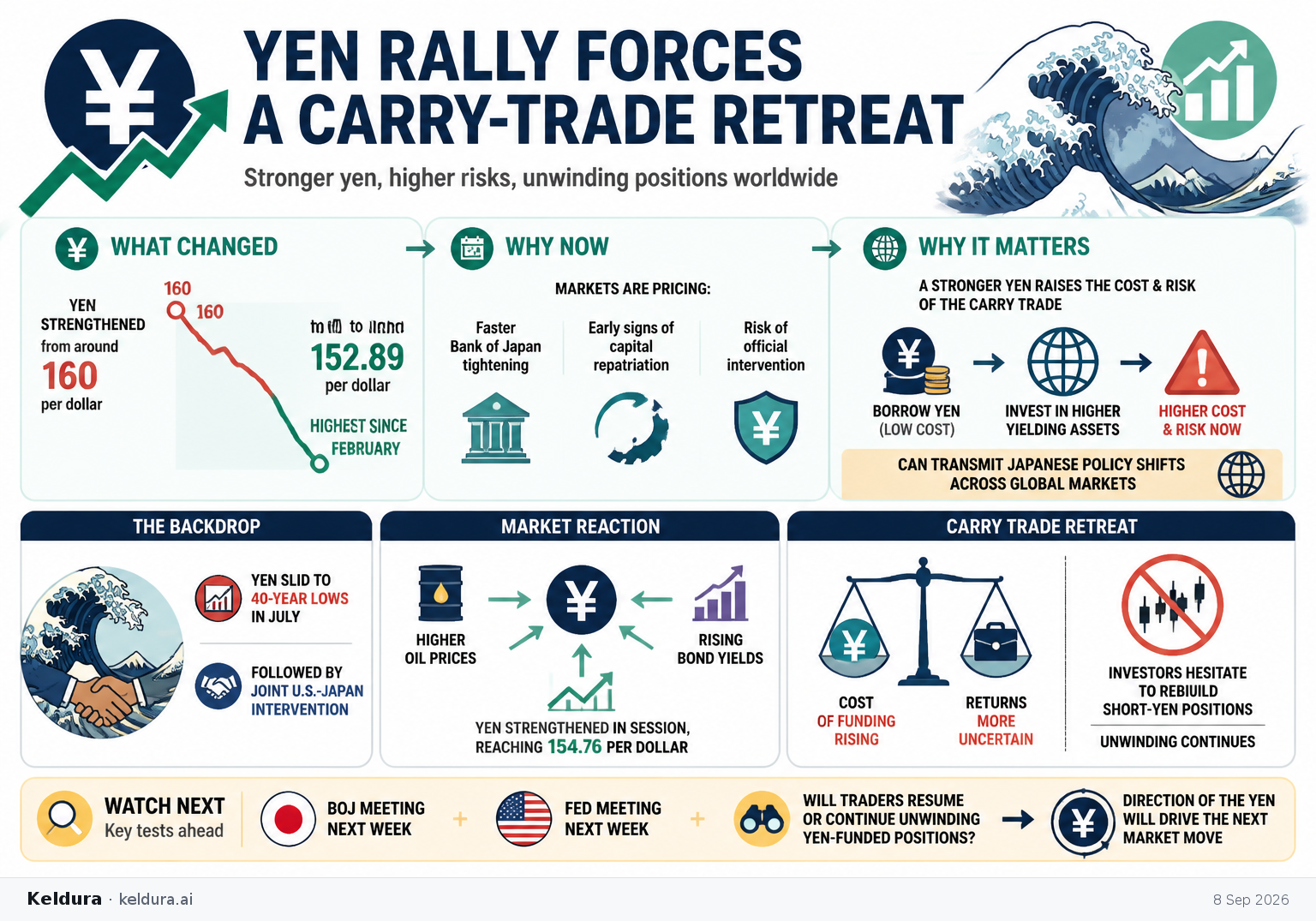
The yen strengthened to 152.89 per dollar, its highest level since February, after trading near 160 less than a week earlier.[1] Expectations of a Bank of Japan rate increase, early signs of capital repatriation and intervention risk are prompting traders to unwind positions financed with low-cost yen borrowing.[1]
Why it matters: A stronger yen raises the cost and risk of a strategy widely used to finance investments in higher-yielding currencies and assets, potentially transmitting Japanese policy shifts across global markets.[1]
Key insights: The rally follows the yen’s slide to 40-year lows in July and a joint U.S.-Japan intervention.[1] | Investors are reluctant to rebuild short-yen positions because another intervention remains a risk.[1] | The yen also strengthened as broader markets absorbed higher oil prices and rising bond yields, reaching 154.76 per dollar during the cited session.[3]
Cheatsheet facts: What changed: The yen rapidly moved from around 160 to 152.89 per dollar, its strongest level since February.[1] | Why now: Markets are pricing faster Bank of Japan tightening while accounting for capital repatriation and official intervention risk.[1] | Watch next: The observable tests are next week’s central-bank meetings in Japan and the U.S., alongside whether traders resume or continue unwinding yen-funded positions.[1]