How Iran diplomacy moved oil, bonds, currencies and gold
Oil prices fell on Wednesday after Donald Trump described US-Iran talks at the United Nations as productive.
Brent and West Texas Intermediate dipped to $98.91 and $89.93 per barrel in early Asian trade as markets assessed US-Iran diplomacy and the restart of Saudi Arabia’s East-West Pipeline.[8] Lower energy prices helped euro-zone bond yields retreat, but expectations of further rate increases kept the…
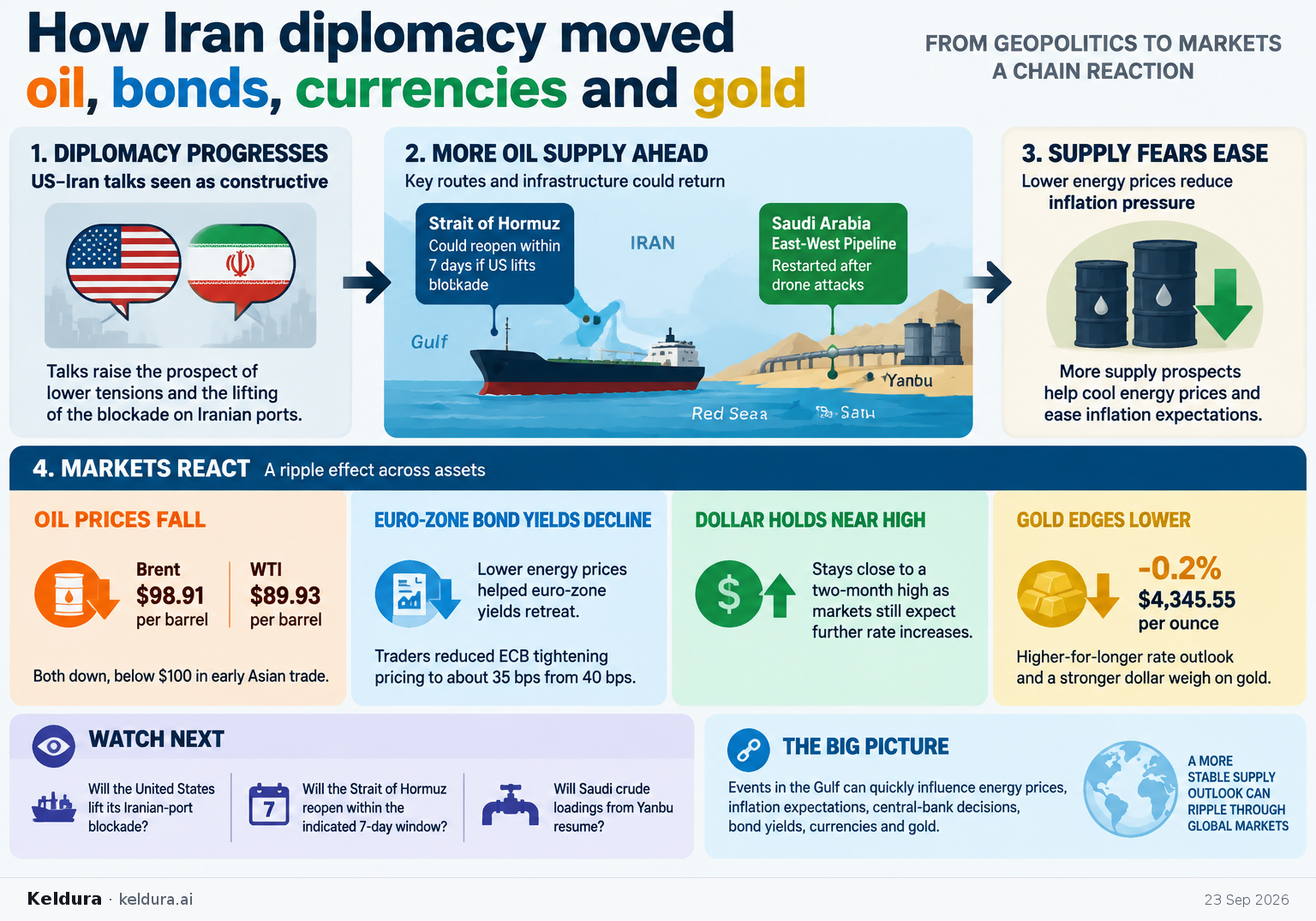
Brent and West Texas Intermediate dipped to $98.91 and $89.93 per barrel in early Asian trade as markets assessed US-Iran diplomacy and the restart of Saudi Arabia’s East-West Pipeline.[8] Lower energy prices helped euro-zone bond yields retreat, but expectations of further rate increases kept the dollar near a two-month high and contributed to a 0.2% fall in spot gold to $4,345.55 an ounce.[3][5][8]
Why it matters: The moves illustrate the transmission chain from the Strait of Hormuz and Gulf oil infrastructure to inflation expectations, central-bank pricing, bond yields and dollar-sensitive assets such as gold.[5][8]
Key insights: Iran said the Strait of Hormuz, which carried about one-fifth of global energy supplies before the war, could reopen within seven days if the United States lifts its blockade of Iranian ports.[8] | Saudi Arabia restarted its East-West Pipeline after drone attacks had halted crude loadings at Yanbu, improving the prospect of exports through the Red Sea.[8] | Traders reduced their pricing for additional European Central Bank tightening this year to about 35 basis points from 40 basis points on Friday as energy prices retreated.[8] | A stronger dollar raises the local-currency cost of dollar-priced bullion for overseas buyers, reinforcing the pressure that elevated interest rates place on gold.[5]
Cheatsheet facts: What changed: Brent and WTI fell below $100 in early Asian trade, while euro-zone yields declined and spot gold eased 0.2%.[5][8] | Why now: US-Iran talks, the possible reopening of the Strait of Hormuz and resumed operations on Saudi Arabia’s East-West Pipeline reduced immediate supply fears.[8] | Watch next: Track whether the United States lifts its Iranian-port blockade, whether the Strait reopens within the indicated seven-day window and whether Saudi crude loadings from Yanbu resume.[8]
Brent and West Texas Intermediate dipped to $98.91 and $89.93 per barrel in early Asian trade as markets assessed US-Iran diplomacy and the restart of Saudi Arabia’s East-West Pipeline.[8] Lower energy prices helped euro-zone bond yields retreat, but expectations of further rate increases kept the dollar near a two-month high and contributed to a 0.2% fall in spot gold to $4,345.55 an ounce.[3][5][8]
Why it matters: The moves illustrate the transmission chain from the Strait of Hormuz and Gulf oil infrastructure to inflation expectations, central-bank pricing, bond yields and dollar-sensitive assets such as gold.[5][8]
Key insights: Iran said the Strait of Hormuz, which carried about one-fifth of global energy supplies before the war, could reopen within seven days if the United States lifts its blockade of Iranian ports.[8] | Saudi Arabia restarted its East-West Pipeline after drone attacks had halted crude loadings at Yanbu, improving the prospect of exports through the Red Sea.[8] | Traders reduced their pricing for additional European Central Bank tightening this year to about 35 basis points from 40 basis points on Friday as energy prices retreated.[8] | A stronger dollar raises the local-currency cost of dollar-priced bullion for overseas buyers, reinforcing the pressure that elevated interest rates place on gold.[5]
Cheatsheet facts: What changed: Brent and WTI fell below $100 in early Asian trade, while euro-zone yields declined and spot gold eased 0.2%.[5][8] | Why now: US-Iran talks, the possible reopening of the Strait of Hormuz and resumed operations on Saudi Arabia’s East-West Pipeline reduced immediate supply fears.[8] | Watch next: Track whether the United States lifts its Iranian-port blockade, whether the Strait reopens within the indicated seven-day window and whether Saudi crude loadings from Yanbu resume.[8]
X copy pack
[8] Oil Prices Fall after Trump Hails 'Good' Talks with Iran — english.aawsat.com[3] Dollar holds near 2-month high as markets weigh rate hikes, Iran diplomacy | Reuters — reuters.com[5] Gold lacklustre as higher-for-longer rate outlook weighs on sentiment | Reuters — reuters.comRead in BriefingsPost to X