Democratic gains send tech shares lower and lift Treasuries
Investors are pricing in tighter AI rules, but how much can Democrats change while Donald Trump retains a veto?
On November 4, 2026, investors sold Asian technology shares and U.S. stock futures after Democratic election gains, with Nasdaq 100 futures falling as much as 2.1%.
Asian shares and U.S. stock futures fell as Democratic gains in the midterm elections prompted investors to reassess technology-sector regulation and AI infrastructure spending. [1][2][6][10] The dollar weakened and U.S. Treasury prices rose, with traders also reducing expectations for interest-rat…
Open original (5 sources):
- [1] Asian markets decline as AI stocks slump | AP News — apnews.com
- [2] Asian equities and US stocks futures slump amid blue sweep in US polls | The National — thenationalnews.com
- [6] Global stocks plunge after U.S. Democrats’ landslide, amid fears AI investment could be curbed [U.S. midterm elections] - First-Class Business Newspaper Financial News — en.fnnews.com
- [10] Morning Bid: Markets fret blue wave will drown data centres — streetinsider.com
- [4] Dollar dips with U.S. midterm results in focus — cnbc.com
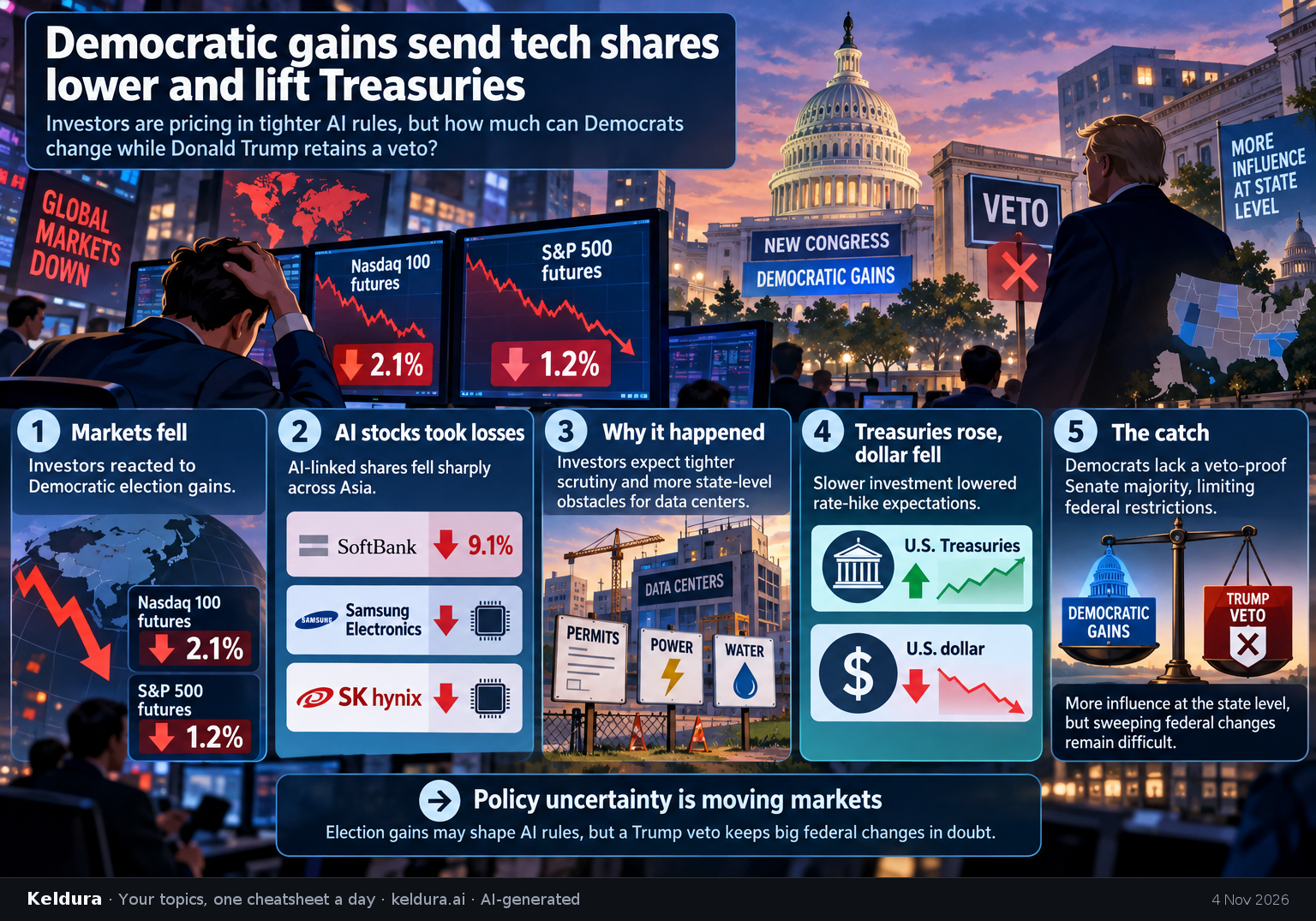
Asian shares and U.S. stock futures fell as Democratic gains in the midterm elections prompted investors to reassess technology-sector regulation and AI infrastructure spending. [1][2][6][10] The dollar weakened and U.S. Treasury prices rose, with traders also reducing expectations for interest-rate increases next year. [4][10] Reuters reported that Democrats had taken both congressional chambers, but analysts cautioned that President Donald Trump's veto would make new federal regulation difficult to enact. [10]
Why it matters: The repricing reached beyond American technology stocks: Japan's Nikkei fell as much as 4.5% intraday, while South Korea's KOSPI fell 3.4% in a later trading snapshot. Investors holding Asian chipmakers and AI-linked companies therefore faced losses tied to U.S. policy expectations, before any new restrictions had been enacted. [6][10]
Key insights: The immediate concern was construction rather than just AI software: investors anticipated more obstacles to data-center projects through state-level permitting and water and power requirements. [6][10] | Federal and state power differ: Trump can veto congressional legislation, but Democratic gains in governorships could give the party more influence over local construction rules. [10] | The bond market reflected a different consequence of slower investment: interest-rate futures removed about six basis points of expected increases next year, while two-year Treasury yields fell almost eight basis points. [10] | The dollar's decline accompanied lower yields; an early snapshot put the dollar index down 0.2% at 101.7, with the euro up 0.2% to $1.1212. [4]
Cheatsheet facts: What happened: Nasdaq 100 futures fell 2.1% and S&P 500 futures fell 1.2% in a later November 4 snapshot as investors reacted to Democratic election gains. [6] | Background: Data centers are the physical infrastructure behind AI computing, and their construction has become a major driver of U.S. growth; projects also face political disputes over power and water requirements. [6][10] | Why: Investors anticipated tighter scrutiny of AI companies and more state-level obstacles to building data centers. [2][6][10] | Who pays: AI-linked shares bore substantial losses: SoftBank fell as much as 9.1%, while Samsung Electronics and SK hynix also traded lower. [6] | The catch: Analysts said Democrats lacked a veto-proof Senate majority, limiting their ability to enact federal restrictions over Trump's opposition. [10]