WHO launches a global research agenda on climate change, migration, and displacement
WHO says climate change is increasingly contributing to migration and displacement, with disproportionate effects on people already in vulnerable situations and with limited adaptive capacity [2]. To address evidence gaps, WHO launched the Global Research Prioritization Exercise on Health, Migratio…
WHO says climate change is increasingly contributing to migration and displacement, with disproportionate effects on people already in vulnerable situations and with limited adaptive capacity [2]. To address evidence gaps, WHO launched the Global Research Prioritization Exercise on Health, Migration, and Displacement in the Context of Climate Change, and will hold a global virtual webinar to present prioritized evidence gaps and a roadmap for research and action [2].
Why it matters: The announcement signals a move from describing the climate-migration-health problem to organizing a formal research agenda around it. That matters because WHO is trying to translate evidence gaps into policy and practice for migrant and displaced populations, not just academic discussion [2].
Key insights: WHO says the health consequences of the climate–migration–health nexus remain under-researched and poorly understood [2]. | The GRPE report was informed by evidence reviews, global technical consultations, and a prioritization process spanning all six WHO regions [2]. | WHO presents the roadmap as a way to support an inclusive and responsive research agenda that can inform equitable policy and practice [2]. | The launch webinar is explicitly designed to share prioritized evidence gaps and support translation of research into action [2].
Cheatsheet facts: What changed: WHO launched the GRPE report and scheduled a webinar to launch its findings [2]. | Why now: Climate change is increasingly shaping migration and displacement, but the health effects remain under-studied [2]. | Watch next: Track the webinar outputs and any follow-on WHO roadmap or policy actions tied to the identified research gaps [2].
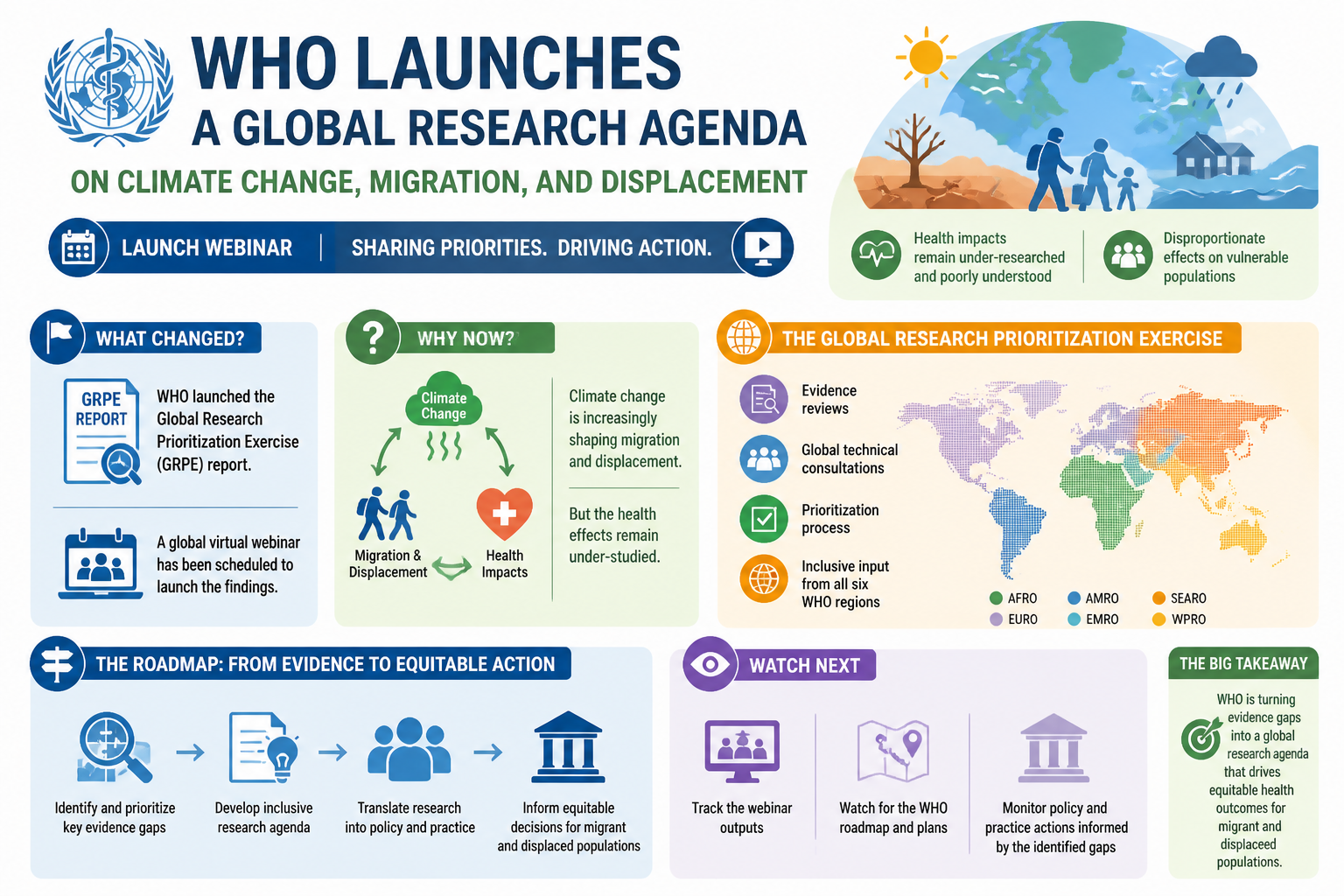
WHO says climate change is increasingly contributing to migration and displacement, with disproportionate effects on people already in vulnerable situations and with limited adaptive capacity [2]. To address evidence gaps, WHO launched the Global Research Prioritization Exercise on Health, Migration, and Displacement in the Context of Climate Change, and will hold a global virtual webinar to present prioritized evidence gaps and a roadmap for research and action [2].
Why it matters: The announcement signals a move from describing the climate-migration-health problem to organizing a formal research agenda around it. That matters because WHO is trying to translate evidence gaps into policy and practice for migrant and displaced populations, not just academic discussion [2].
Key insights: WHO says the health consequences of the climate–migration–health nexus remain under-researched and poorly understood [2]. | The GRPE report was informed by evidence reviews, global technical consultations, and a prioritization process spanning all six WHO regions [2]. | WHO presents the roadmap as a way to support an inclusive and responsive research agenda that can inform equitable policy and practice [2]. | The launch webinar is explicitly designed to share prioritized evidence gaps and support translation of research into action [2].
Cheatsheet facts: What changed: WHO launched the GRPE report and scheduled a webinar to launch its findings [2]. | Why now: Climate change is increasingly shaping migration and displacement, but the health effects remain under-studied [2]. | Watch next: Track the webinar outputs and any follow-on WHO roadmap or policy actions tied to the identified research gaps [2].