WHO pairs oral health guidance with antibiotic stewardship to curb AMR
WHO says oral diseases affect an estimated 960 million people in the Western Pacific Region and that access to essential oral health services remains limited [1]. It also says the oral health sector accounts for a significant share of human antibiotic use, much of it unnecessary or inappropriate, a…
WHO says oral diseases affect an estimated 960 million people in the Western Pacific Region and that access to essential oral health services remains limited [1]. It also says the oral health sector accounts for a significant share of human antibiotic use, much of it unnecessary or inappropriate, and points to a new guideline on minimally invasive oral health care plus the WHO AWaRe Antibiotic Book as tools to reduce unnecessary antibiotic use and mitigate antimicrobial resistance [1].
Why it matters: This links routine dental care to one of the biggest global health threats: antimicrobial resistance [1]. If countries adopt prevention-focused, minimally invasive approaches earlier, they may reduce both oral disease burden and avoidable antibiotic exposure [1].
Key insights: WHO frames early caries prevention and minimally invasive care as an AMR intervention, not just a dental practice change [1]. | The guideline is paired with the AWaRe Antibiotic Book’s oral and dental infections section, signaling implementation through prescribing guidance [1]. | WHO highlights vulnerable populations and limited access to essential services, so the burden is both clinical and equity-related [1]. | Country experiences and implementation of WHO guidelines are explicitly part of the agenda, indicating the next phase is uptake rather than new evidence generation [1].
Cheatsheet facts: What changed: WHO released a guideline on environmentally friendly, less invasive oral health care and promoted the AWaRe Antibiotic Book’s oral-health section [1]. | Why now: Oral diseases remain widespread while unnecessary antibiotic use in dentistry contributes to AMR [1]. | Watch next: Look for country reports or implementation examples shared alongside WHO guideline dissemination and AMR action [1].
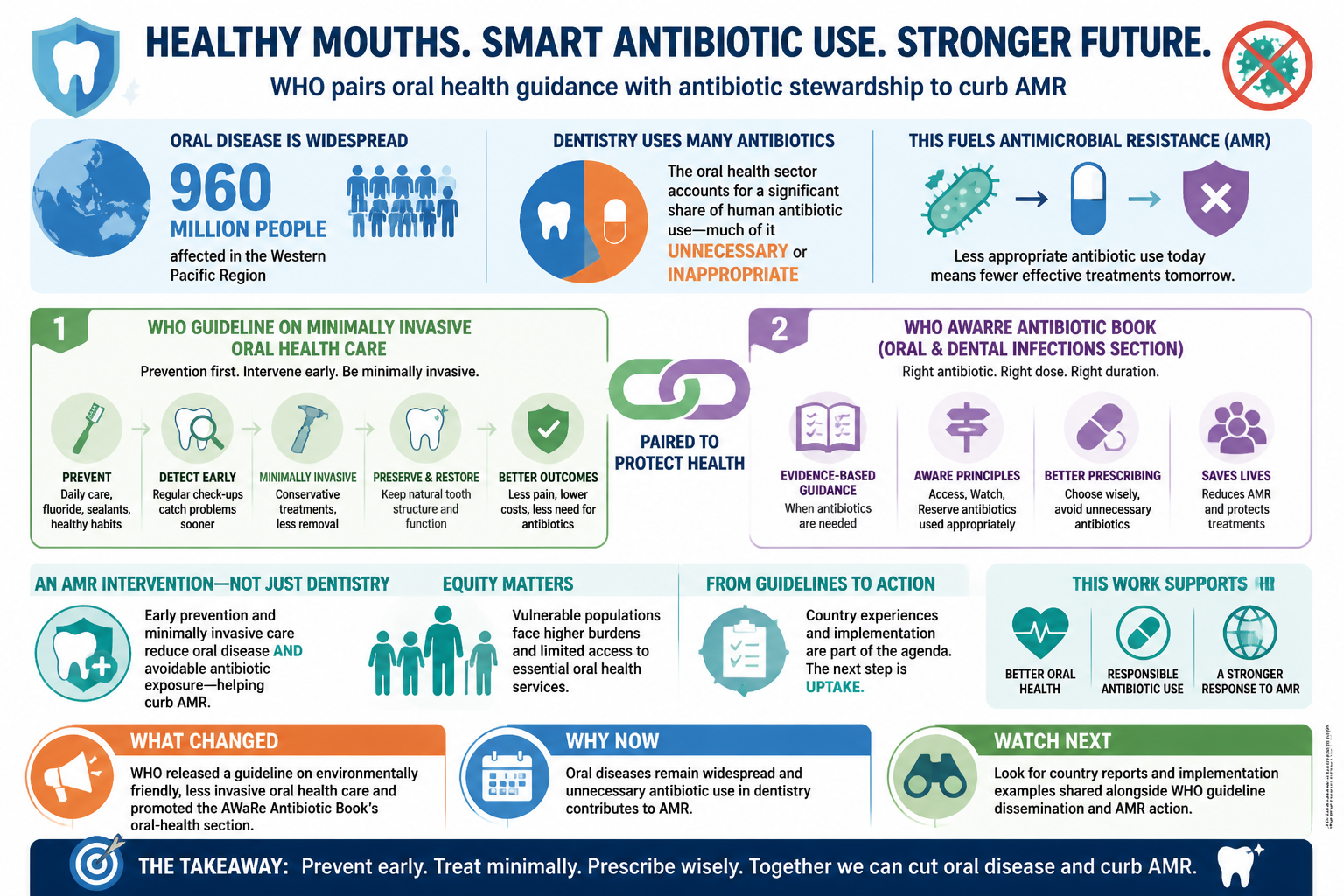
WHO says oral diseases affect an estimated 960 million people in the Western Pacific Region and that access to essential oral health services remains limited [1]. It also says the oral health sector accounts for a significant share of human antibiotic use, much of it unnecessary or inappropriate, and points to a new guideline on minimally invasive oral health care plus the WHO AWaRe Antibiotic Book as tools to reduce unnecessary antibiotic use and mitigate antimicrobial resistance [1].
Why it matters: This links routine dental care to one of the biggest global health threats: antimicrobial resistance [1]. If countries adopt prevention-focused, minimally invasive approaches earlier, they may reduce both oral disease burden and avoidable antibiotic exposure [1].
Key insights: WHO frames early caries prevention and minimally invasive care as an AMR intervention, not just a dental practice change [1]. | The guideline is paired with the AWaRe Antibiotic Book’s oral and dental infections section, signaling implementation through prescribing guidance [1]. | WHO highlights vulnerable populations and limited access to essential services, so the burden is both clinical and equity-related [1]. | Country experiences and implementation of WHO guidelines are explicitly part of the agenda, indicating the next phase is uptake rather than new evidence generation [1].
Cheatsheet facts: What changed: WHO released a guideline on environmentally friendly, less invasive oral health care and promoted the AWaRe Antibiotic Book’s oral-health section [1]. | Why now: Oral diseases remain widespread while unnecessary antibiotic use in dentistry contributes to AMR [1]. | Watch next: Look for country reports or implementation examples shared alongside WHO guideline dissemination and AMR action [1].