WHO pushes two linked system agendas: lead mitigation and smarter health financing
WHO has published a draft Global Action Plan on lead mitigation, developed in response to World Health Assembly resolution WHA78.27, with four focus areas: reducing lead exposure, strengthening knowledge and evidence, improving health-system capacity, and enhancing leadership and coordination [8].…
WHO has published a draft Global Action Plan on lead mitigation, developed in response to World Health Assembly resolution WHA78.27, with four focus areas: reducing lead exposure, strengthening knowledge and evidence, improving health-system capacity, and enhancing leadership and coordination [8]. In parallel, the Observatory Venice Summer School 2026 will focus on paying for health care under intensifying fiscal constraints, aiming to teach evidence-informed decisions on how to generate adequate revenues and spend better [1].
Why it matters: These are not separate technical exercises; they both target the policy levers that determine whether health systems can prevent harm and sustain services under pressure. Lead poisoning is framed as a preventable public health crisis affecting hundreds of millions of children, while the financing agenda addresses how governments can protect health systems when budgets are tight [8][1].
Key insights: The lead plan is explicitly a draft for consultation, so Member States still have a chance to shape revisions before it is finalized [8]. | The plan is designed to bring together health, government, industry, civil society, and international partners, signaling that lead exposure is being treated as a cross-sector problem rather than a narrow clinical one [8]. | The summer school is framed around real-world policy dilemmas and trade-offs, underscoring that financing choices have long-term consequences for health systems [1]. | WHO Europe’s Observatory partnership and the WHO Barcelona Office are emphasizing evidence-informed policy-making and knowledge brokering, not just academic training [1].
Cheatsheet facts: What changed: WHO issued a draft global lead mitigation plan, and the Venice Summer School announced a 2026 program on financing health care under fiscal constraints [8][1]. | Why now: Lead poisoning remains a major preventable burden, while health systems face intensifying fiscal constraints that force harder spending choices [8][1]. | Watch next: Consultation feedback on the lead plan and the 2026 Summer School agenda or participant materials showing how the financing framework is being operationalized [8][1].
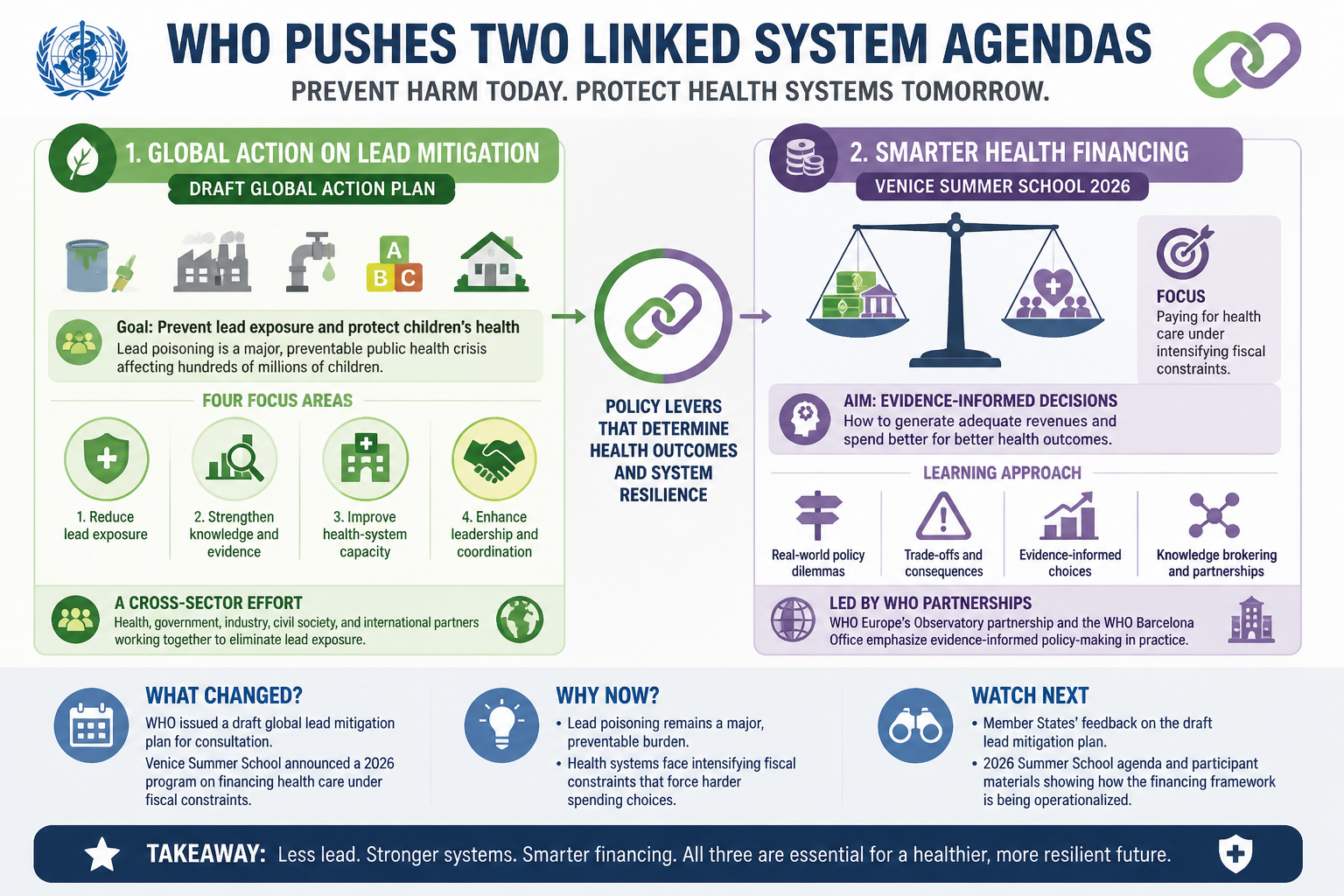
WHO has published a draft Global Action Plan on lead mitigation, developed in response to World Health Assembly resolution WHA78.27, with four focus areas: reducing lead exposure, strengthening knowledge and evidence, improving health-system capacity, and enhancing leadership and coordination [8]. In parallel, the Observatory Venice Summer School 2026 will focus on paying for health care under intensifying fiscal constraints, aiming to teach evidence-informed decisions on how to generate adequate revenues and spend better [1].
Why it matters: These are not separate technical exercises; they both target the policy levers that determine whether health systems can prevent harm and sustain services under pressure. Lead poisoning is framed as a preventable public health crisis affecting hundreds of millions of children, while the financing agenda addresses how governments can protect health systems when budgets are tight [8][1].
Key insights: The lead plan is explicitly a draft for consultation, so Member States still have a chance to shape revisions before it is finalized [8]. | The plan is designed to bring together health, government, industry, civil society, and international partners, signaling that lead exposure is being treated as a cross-sector problem rather than a narrow clinical one [8]. | The summer school is framed around real-world policy dilemmas and trade-offs, underscoring that financing choices have long-term consequences for health systems [1]. | WHO Europe’s Observatory partnership and the WHO Barcelona Office are emphasizing evidence-informed policy-making and knowledge brokering, not just academic training [1].
Cheatsheet facts: What changed: WHO issued a draft global lead mitigation plan, and the Venice Summer School announced a 2026 program on financing health care under fiscal constraints [8][1]. | Why now: Lead poisoning remains a major preventable burden, while health systems face intensifying fiscal constraints that force harder spending choices [8][1]. | Watch next: Consultation feedback on the lead plan and the 2026 Summer School agenda or participant materials showing how the financing framework is being operationalized [8][1].