WHO urges a more equity-focused push to reach missed children with vaccines in South-East Asia
WHO said nearly 1.2 million children in the South-East Asia Region did not receive their first routine vaccine in 2025, while 600,000 remained partially vaccinated, even as routine coverage stayed high. The region’s DTP3 coverage held at 94%, MCV1 rose to 96%, and MCV2 to 93%, but WHO said zero-dos…
WHO said nearly 1.2 million children in the South-East Asia Region did not receive their first routine vaccine in 2025, while 600,000 remained partially vaccinated, even as routine coverage stayed high. The region’s DTP3 coverage held at 94%, MCV1 rose to 96%, and MCV2 to 93%, but WHO said zero-dose and partially vaccinated children remain concentrated in underserved, remote, conflict-affected, and marginalized communities.[2]
Why it matters: WHO says the remaining immunity gaps are driving new outbreaks of vaccine-preventable diseases, and it specifically linked recent measles outbreaks, including in Bangladesh, to those gaps.[2] The message is that high average coverage can mask localized vulnerability, so equity-targeted immunization work is now as important as headline coverage rates.[2]
Key insights: The region is still the highest-performing of WHO’s six regions on routine childhood immunization, but progress in reducing zero-dose children has slowed sharply, with only about 23,000 fewer zero-dose children than in 2024.[2] | WHO is pushing a primary-care and data-driven strategy: local data, community engagement, and integration of immunization with other health services.[2] | The campaign is broadening beyond infancy, with WHO also highlighting Td vaccination in pregnancy and HPV vaccination as part of a life-course immunization approach.[2] | WHO framed the goal as advancing Immunization Agenda 2030 while ensuring no child is left behind.[2]
Cheatsheet facts: What changed: WHO renewed its call to reach every child after 2025 estimates showed 1.2 million zero-dose children and 600,000 partially vaccinated children in South-East Asia.[2] | Why now: Measles outbreaks and persistent immunity gaps show that strong regional averages are not enough to prevent resurgence.[2] | Watch next: Look for country plans that use local data, primary care, and community outreach to reduce zero-dose and partially vaccinated counts.[2]
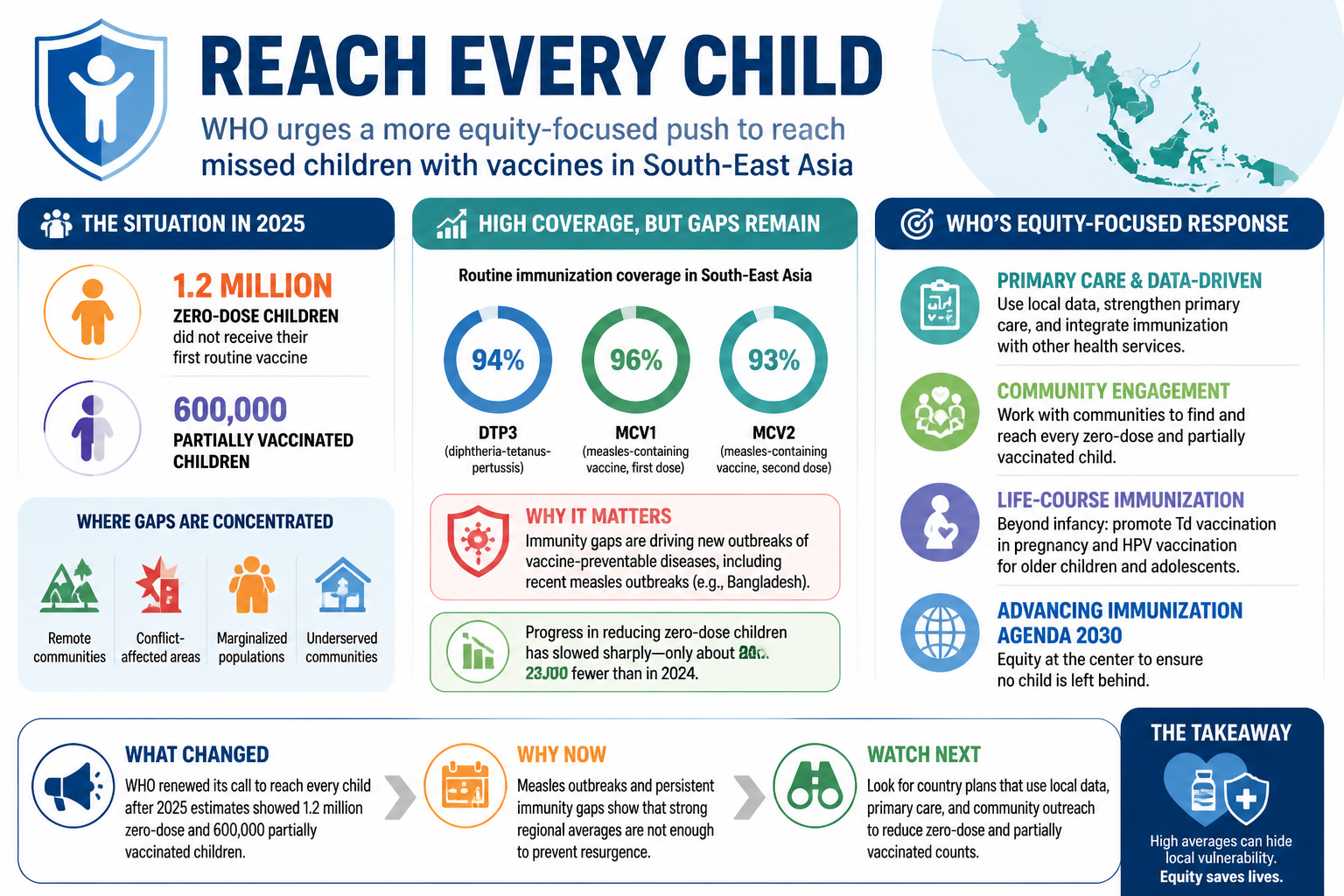
WHO said nearly 1.2 million children in the South-East Asia Region did not receive their first routine vaccine in 2025, while 600,000 remained partially vaccinated, even as routine coverage stayed high. The region’s DTP3 coverage held at 94%, MCV1 rose to 96%, and MCV2 to 93%, but WHO said zero-dose and partially vaccinated children remain concentrated in underserved, remote, conflict-affected, and marginalized communities.[2]
Why it matters: WHO says the remaining immunity gaps are driving new outbreaks of vaccine-preventable diseases, and it specifically linked recent measles outbreaks, including in Bangladesh, to those gaps.[2] The message is that high average coverage can mask localized vulnerability, so equity-targeted immunization work is now as important as headline coverage rates.[2]
Key insights: The region is still the highest-performing of WHO’s six regions on routine childhood immunization, but progress in reducing zero-dose children has slowed sharply, with only about 23,000 fewer zero-dose children than in 2024.[2] | WHO is pushing a primary-care and data-driven strategy: local data, community engagement, and integration of immunization with other health services.[2] | The campaign is broadening beyond infancy, with WHO also highlighting Td vaccination in pregnancy and HPV vaccination as part of a life-course immunization approach.[2] | WHO framed the goal as advancing Immunization Agenda 2030 while ensuring no child is left behind.[2]
Cheatsheet facts: What changed: WHO renewed its call to reach every child after 2025 estimates showed 1.2 million zero-dose children and 600,000 partially vaccinated children in South-East Asia.[2] | Why now: Measles outbreaks and persistent immunity gaps show that strong regional averages are not enough to prevent resurgence.[2] | Watch next: Look for country plans that use local data, primary care, and community outreach to reduce zero-dose and partially vaccinated counts.[2]