Ebola Care Capacity Expands as Facilities Face Uneven Pressure
The Democratic Republic of the Congo expanded its Ebola response from one nine-bed treatment centre on 19 May 2026 to 59 identified facilities with 1,346 beds across affected provinces, while deploying more than 4,000 additional health professionals.[7] Ituri had 25 care facilities and 974 beds as…
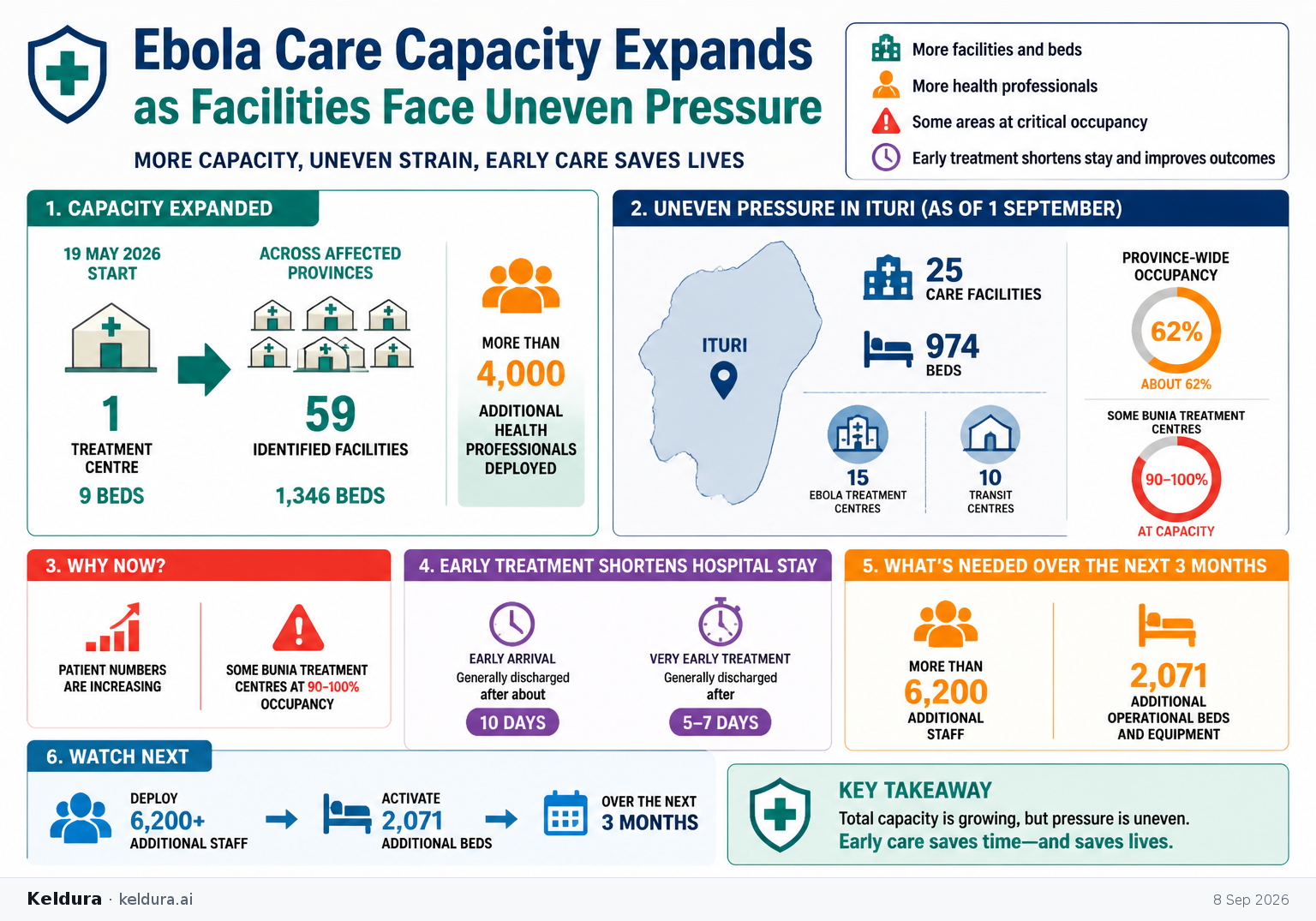
The Democratic Republic of the Congo expanded its Ebola response from one nine-bed treatment centre on 19 May 2026 to 59 identified facilities with 1,346 beds across affected provinces, while deploying more than 4,000 additional health professionals.[7] Ituri had 25 care facilities and 974 beds as of 1 September, but some treatment centres in Bunia were operating at 90–100% occupancy despite a province-wide occupancy rate of about 62%.[7]
Why it matters: The uneven strain means aggregate bed availability can obscure severe local bottlenecks, while early treatment can shorten hospitalization and improve patients’ chances of recovery.[7]
Key insights: The response includes 15 Ebola treatment centres and 10 transit centres across 19 health zones in Ituri.[7] | Planners say more than 6,200 additional staff and equipment for 2,071 additional operational beds will be needed over the next three months.[7] | Confirmed patients who arrive early can generally be discharged after about 10 days, or after 5–7 days when treatment begins at a very early stage.[7]
Cheatsheet facts: What changed: Ebola care capacity grew from one nine-bed centre to 59 identified facilities offering 1,346 beds across affected provinces.[7] | Why now: Patient numbers are increasing, and some Bunia treatment centres have reached 90–100% occupancy.[7] | Watch next: Track the deployment of the requested 6,200-plus staff and the activation of 2,071 additional operational beds over the next three months.[7]
The Democratic Republic of the Congo expanded its Ebola response from one nine-bed treatment centre on 19 May 2026 to 59 identified facilities with 1,346 beds across affected provinces, while deploying more than 4,000 additional health professionals.[7] Ituri had 25 care facilities and 974 beds as of 1 September, but some treatment centres in Bunia were operating at 90–100% occupancy despite a province-wide occupancy rate of about 62%.[7]
Why it matters: The uneven strain means aggregate bed availability can obscure severe local bottlenecks, while early treatment can shorten hospitalization and improve patients’ chances of recovery.[7]
Key insights: The response includes 15 Ebola treatment centres and 10 transit centres across 19 health zones in Ituri.[7] | Planners say more than 6,200 additional staff and equipment for 2,071 additional operational beds will be needed over the next three months.[7] | Confirmed patients who arrive early can generally be discharged after about 10 days, or after 5–7 days when treatment begins at a very early stage.[7]
Cheatsheet facts: What changed: Ebola care capacity grew from one nine-bed centre to 59 identified facilities offering 1,346 beds across affected provinces.[7] | Why now: Patient numbers are increasing, and some Bunia treatment centres have reached 90–100% occupancy.[7] | Watch next: Track the deployment of the requested 6,200-plus staff and the activation of 2,071 additional operational beds over the next three months.[7]