Timor-Leste eliminates trachoma as a regional public-health problem
WHO validated Timor-Leste’s elimination of trachoma as a public-health problem on 3 September 2026, making it the final country with suspected endemic trachoma in the WHO South-East Asia Region to reach that milestone.[1] The country was also recognized for putting more than 86,900 people with hype…
WHO validated Timor-Leste’s elimination of trachoma as a public-health problem on 3 September 2026, making it the final country with suspected endemic trachoma in the WHO South-East Asia Region to reach that milestone.[1] The country was also recognized for putting more than 86,900 people with hypertension and diabetes on protocol-based management—above its target of 50,000—and for sustaining maternal and neonatal tetanus elimination for a decade.[1]
Why it matters: Because trachoma is the world’s leading infectious cause of blindness, Timor-Leste’s validation means the disease is now eliminated as a public-health problem throughout the WHO South-East Asia Region.[1] WHO attributes the region’s broader gains to sustained national commitment, health systems, surveillance, quality services, community engagement and collaboration.[5]
Key insights: The trachoma award was presented during the Seventy-ninth Session of the WHO Regional Committee for South-East Asia in Dili.[1] | Timor-Leste exceeded its national hypertension and diabetes management target by more than 36,900 people.[1] | Bhutan was recognized for eliminating dog-mediated human rabies as a public-health problem, while Thailand became the region’s seventh country verified as having eliminated rubella.[1]
Cheatsheet facts: What changed: Timor-Leste received WHO validation that trachoma is no longer a public-health problem in the country.[1] | Why now: The validation followed on 3 September 2026 and was recognized during WHO’s regional committee meeting in Dili.[1] | Watch next: Continued surveillance and quality health services are observable safeguards for sustaining disease-elimination gains across the region.[1][5]
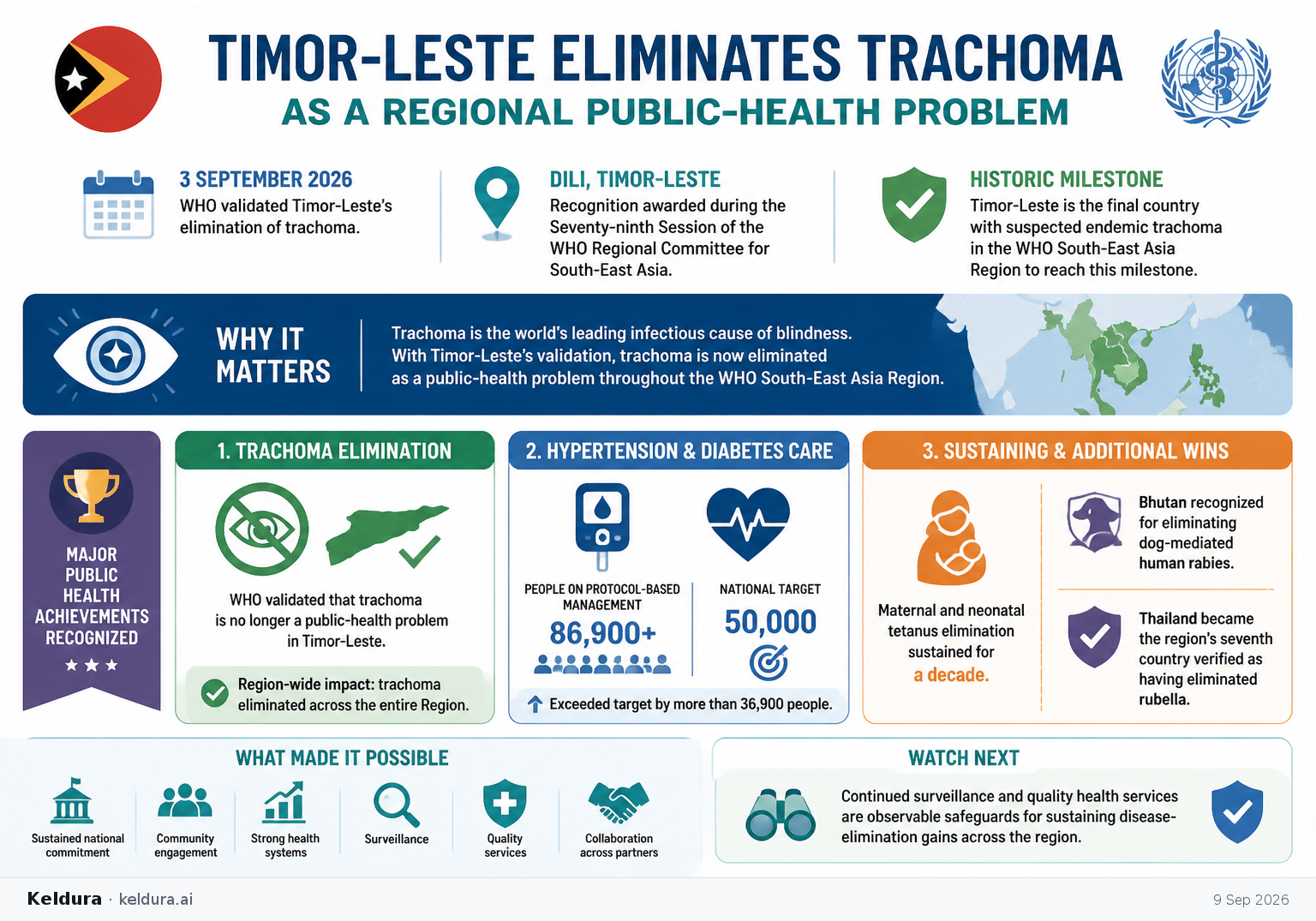
WHO validated Timor-Leste’s elimination of trachoma as a public-health problem on 3 September 2026, making it the final country with suspected endemic trachoma in the WHO South-East Asia Region to reach that milestone.[1] The country was also recognized for putting more than 86,900 people with hypertension and diabetes on protocol-based management—above its target of 50,000—and for sustaining maternal and neonatal tetanus elimination for a decade.[1]
Why it matters: Because trachoma is the world’s leading infectious cause of blindness, Timor-Leste’s validation means the disease is now eliminated as a public-health problem throughout the WHO South-East Asia Region.[1] WHO attributes the region’s broader gains to sustained national commitment, health systems, surveillance, quality services, community engagement and collaboration.[5]
Key insights: The trachoma award was presented during the Seventy-ninth Session of the WHO Regional Committee for South-East Asia in Dili.[1] | Timor-Leste exceeded its national hypertension and diabetes management target by more than 36,900 people.[1] | Bhutan was recognized for eliminating dog-mediated human rabies as a public-health problem, while Thailand became the region’s seventh country verified as having eliminated rubella.[1]
Cheatsheet facts: What changed: Timor-Leste received WHO validation that trachoma is no longer a public-health problem in the country.[1] | Why now: The validation followed on 3 September 2026 and was recognized during WHO’s regional committee meeting in Dili.[1] | Watch next: Continued surveillance and quality health services are observable safeguards for sustaining disease-elimination gains across the region.[1][5]