Targeted nanoparticles improve cancer immunotherapy responses in mice
Removing scar-associated cells helped cancer immunotherapy work in mice, but can the treatment do the same in people?
In a study published September 24 in Science, researchers used targeted nanoparticles to reduce fibrosis and improve immunotherapy responses in mice with tumors in scarred tissue.
Researchers led by Scott Lowe, Daniel Heller, and Aveline Filliol developed drug-carrying nanoparticles that targeted a small population of senescent immune cells in fibrotic tissue. [7] In mice, the treatment reduced scarring, increased the presence of immune cells and helped immunotherapy work be…
Open original · [7] Senescence-targeting nanoparticles may enhance immunotherapy | National Institutes of Health (NIH) — nih.gov
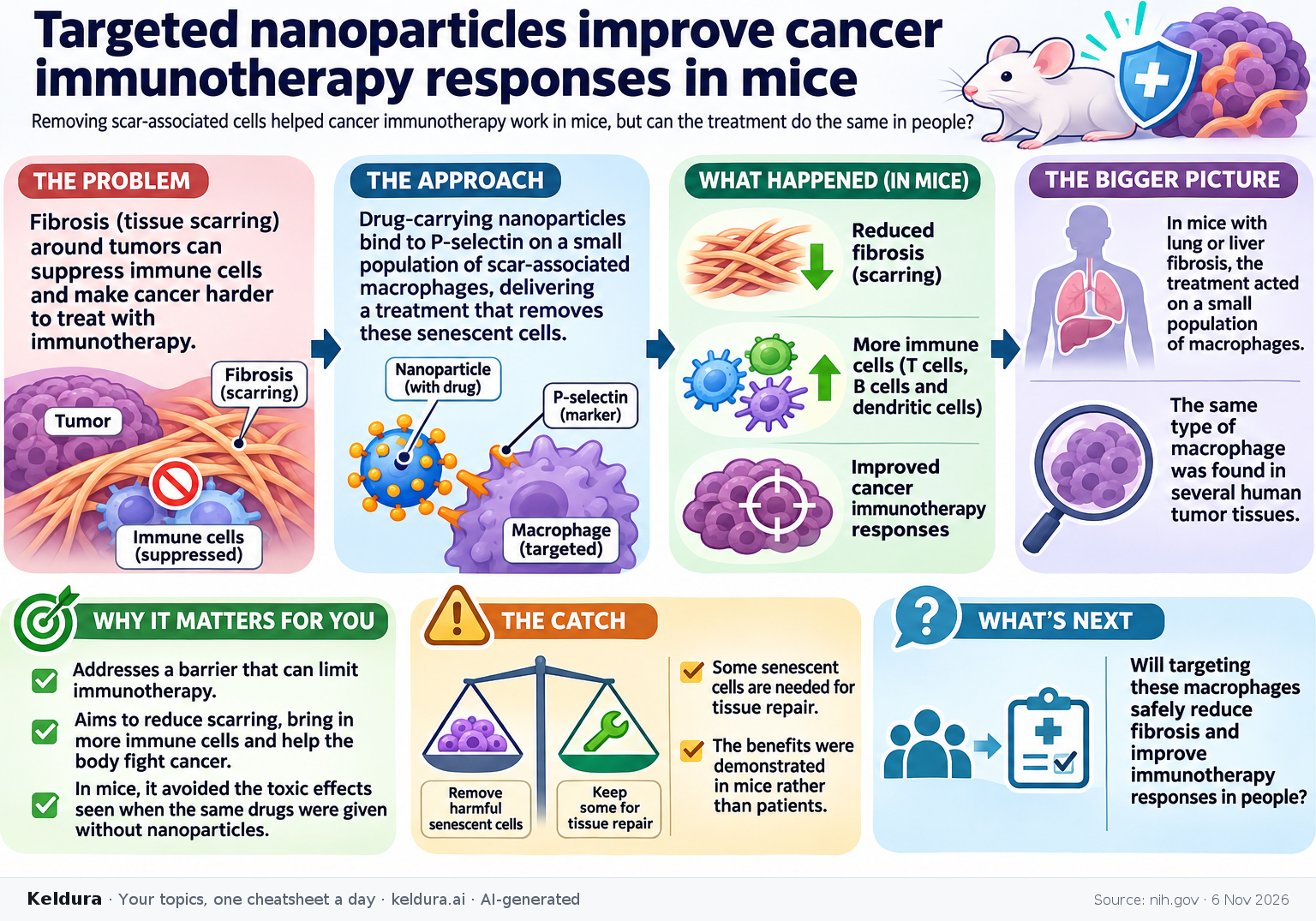
Researchers led by Scott Lowe, Daniel Heller, and Aveline Filliol developed drug-carrying nanoparticles that targeted a small population of senescent immune cells in fibrotic tissue. [7] In mice, the treatment reduced scarring, increased the presence of immune cells and helped immunotherapy work better against tumors growing in those tissues. [7] Researchers also identified the targeted macrophage type in human tumor tissue, but the reported treatment results were in mice. [7]
Why it matters: Scarring around tumors can suppress nearby immune cells and make cancer harder to treat with immunotherapy. This approach addresses that barrier while, in mice, avoiding the toxic effects seen when the same drugs were given without the nanoparticles. [7]
Key insights: Senescent cells stop dividing but can persist, driving inflammation and fibrosis; some also support tissue repair, making selective removal important. [7] | The nanoparticles bound to P-selectin, a protein marker found at high levels on the targeted cells in scarred tissue. [7] | In mice with lung or liver fibrosis, the treatment acted on a small population of macrophages and increased T cells, B cells and dendritic cells in affected tissue. [7] | Finding the same macrophage type in several human tumor tissues gives researchers a human target to investigate, not proof of a working human therapy. [7]
Cheatsheet facts: What happened: Drug-carrying nanoparticles reduced fibrosis and improved cancer immunotherapy responses in mouse experiments. [7] | Background: Fibrosis is tissue scarring; senescent cells within it can sustain inflammation and inhibit immune cells that would otherwise help attack tumors. [7] | Why: Binding to the P-selectin marker directed the nanoparticles toward a small population of scar-associated macrophages. [7] | The catch: Some senescent cells are needed for tissue repair, and the treatment's benefits were demonstrated in mice rather than patients. [7] | What we don't know: Will targeting these macrophages safely reduce fibrosis and improve immunotherapy responses in people? [7]