Hera returns its first close-up of the Didymos asteroids
Hera can now inspect the asteroids altered by NASA’s DART impact, but what did the collision change beyond the smaller body’s orbit?
On November 5, 2026, ESA published Hera’s first close-up of the Didymos asteroid system, taken from 60 kilometers away.
ESA’s Hera spacecraft photographed the Didymos binary asteroid system from 60 kilometers away, showing a side of the larger asteroid that NASA’s DART camera did not see before impact. Hera is preparing to investigate the aftermath of DART’s September 2022 collision with the smaller asteroid, Dimorp…
Open original · [7] Hera’s first close-up view of Didymos asteroids — ESA News
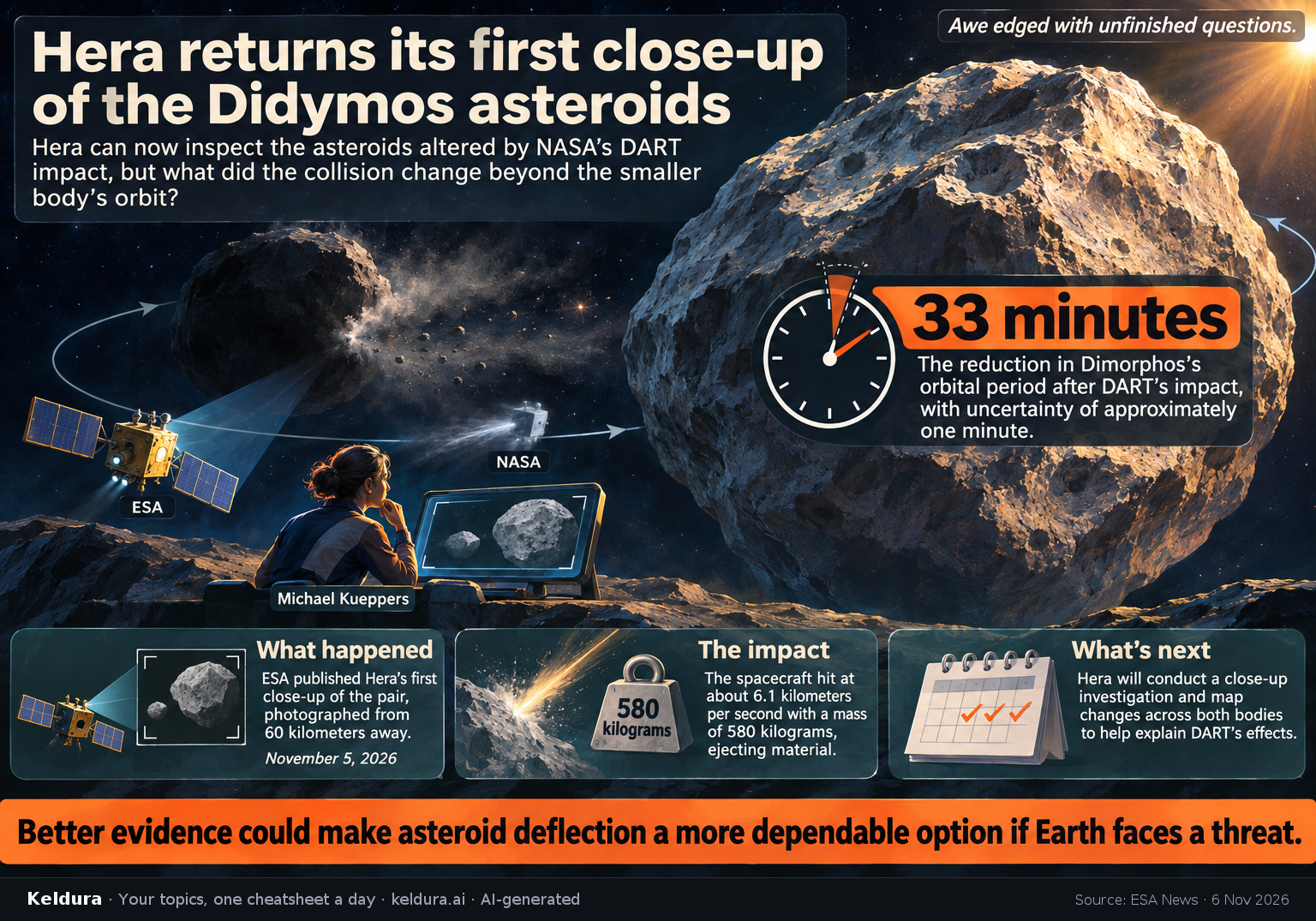
ESA’s Hera spacecraft photographed the Didymos binary asteroid system from 60 kilometers away, showing a side of the larger asteroid that NASA’s DART camera did not see before impact. Hera is preparing to investigate the aftermath of DART’s September 2022 collision with the smaller asteroid, Dimorphos, which shortened its orbit by approximately 33 minutes. [7]
Why it matters: DART demonstrated that a spacecraft impact could change an asteroid’s orbit; Hera is investigating the result so that the technique can become better understood and potentially repeatable if Earth ever faces an asteroid threat. Its observations will also test whether debris from Dimorphos crossed approximately one kilometer to reach Didymos. [7]
Key insights: The two bodies differ substantially in size: Didymos is approximately 780 meters across, while Dimorphos measures approximately 151 meters. [7] | DART struck at about 6.1 kilometers per second with a mass of 580 kilograms, producing a larger orbital change than researchers had predicted. [7] | Most of Dimorphos is hidden in shadow in the new image, while the larger Didymos is clearly visible. [7] | Hera mission scientist Michael Kueppers says some visible characteristics could come from impact material transported between the two asteroids; mapping is needed to sort that out. [7]
Cheatsheet facts: What happened: Hera obtained its first close-up of the asteroid pair from 60 kilometers away, revealing a different side of Didymos from DART’s approach images. [7] | Background: Dimorphos orbits Didymos; NASA deliberately struck the smaller body with DART on September 26, 2022, to test asteroid deflection. [7] | Why: The impact shortened Dimorphos’s orbit by 33 minutes, give or minus one minute, making it the first Solar System object whose orbit humans measurably changed. [7] | The catch: ESA scientists expect debris to have crossed the roughly one-kilometer gap, but must determine which observed features came from that transport. [7] | What's next: Hera will conduct a close-up investigation and map changes across both bodies to help explain DART’s effects. [7]