Congo’s Ebola outbreak remains uncontrolled after six months
Ebola survivors are urging people to seek care, but how can treatment reach communities where families distrust it?
As of November 15, Congo had recorded more than 11,000 Ebola cases six months into an outbreak, with nearly half of those infected dying.
Congo’s Ebola outbreak remains uncontrolled six months into the response, with inadequate contact tracing and isolation, according to AP. Government figures show more than 11,000 cases, while the BBC reports 5,400 deaths and describes families’ distrust of treatment centres. [1][2] The outbreak inv…
Open original (2 sources):
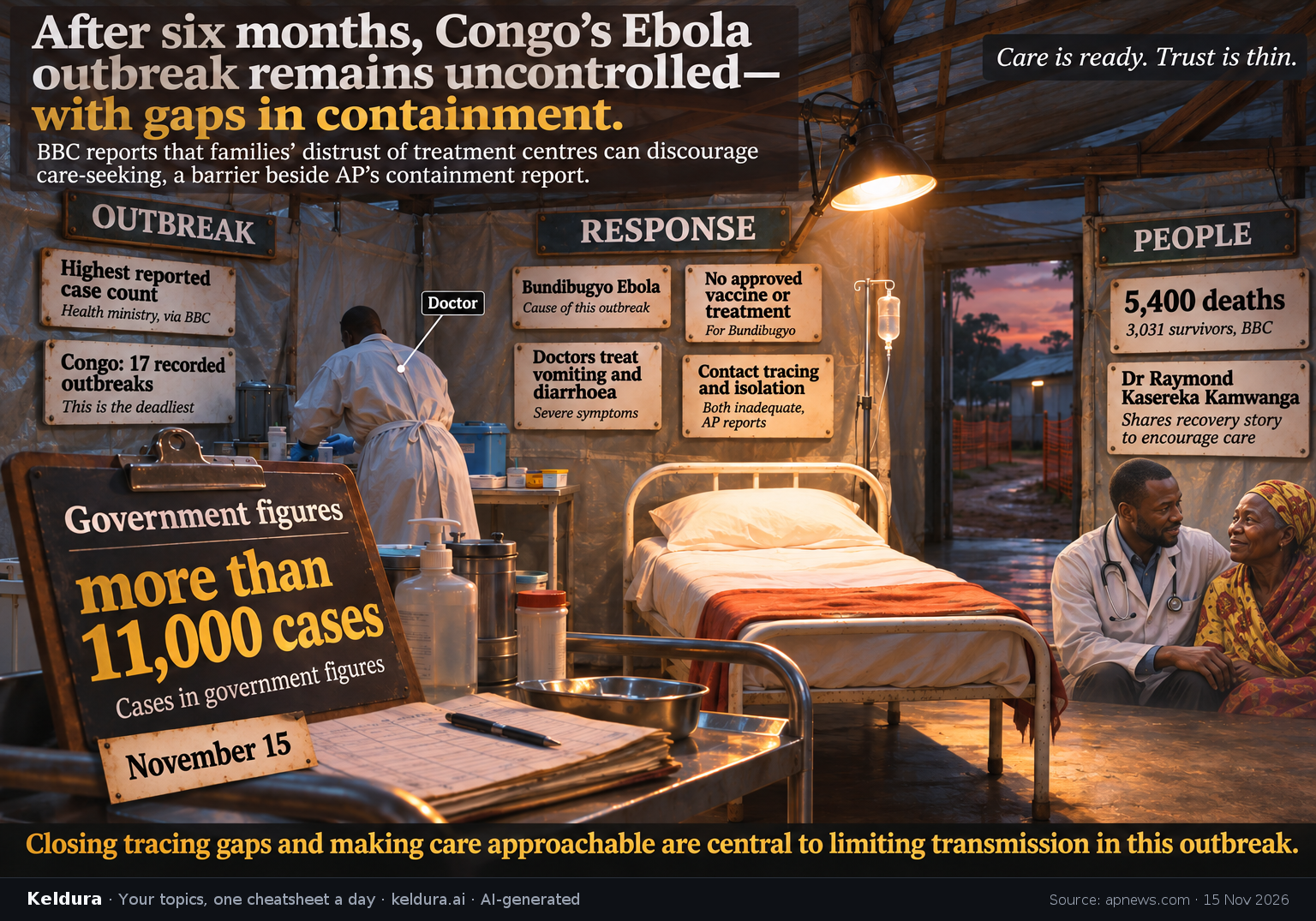
Congo’s Ebola outbreak remains uncontrolled six months into the response, with inadequate contact tracing and isolation, according to AP. Government figures show more than 11,000 cases, while the BBC reports 5,400 deaths and describes families’ distrust of treatment centres. [1][2] The outbreak involves the Bundibugyo species, for which there is no approved vaccine or treatment; doctors provide care for symptoms such as severe vomiting and diarrhoea. [2]
Why it matters: Families in affected communities face both a deadly infection and barriers to seeking care: nearly half of recorded patients have died, while inadequate isolation and contact tracing leave opportunities for further transmission. Treatment can still support recovery, as illustrated by doctor and survivor Dr Raymond Kasereka Kamwanga. [1][2]
Key insights: This is the deadliest of Congo’s 17 recorded Ebola outbreaks; the BBC describes it as the second-deadliest Ebola outbreak worldwide. [1][2] | Butembo, in North Kivu province, has the highest reported case count, according to the Congolese health ministry cited by the BBC. [2] | Dr Raymond Kasereka Kamwanga’s family regarded the treatment centre as a “death house”; he now shares his recovery story to encourage others to seek care. [2] | The absence of an approved vaccine or treatment applies to the Bundibugyo species causing this outbreak, rather than being a statement about every Ebola species. [2]
Cheatsheet facts: What happened: Six months into Congo’s response, more than 11,000 cases have been recorded and basic containment remains inadequate. [1] | Background: The outbreak is caused by the Bundibugyo species of Ebola, which has no approved vaccine or treatment; care addresses patients’ symptoms. [2] | Why: AP reports inadequate contact tracing and isolation, while the BBC documents distrust that can discourage people from entering treatment centres. [1][2] | Who pays: The BBC reports 5,400 deaths and 3,031 survivors; families and health workers are among those directly affected. [2] | The catch: Survival is possible, but Dr Raymond Kasereka Kamwanga says protective measures are not always adequate in the clinical setting where he believes he became infected. [2]
X copy pack
Edition complete
You've reached the end of this edition.