Hubble and Webb find Omega Centauri’s first stellar-mass black hole
Astronomers using more than 20 years of NASA Hubble Space Telescope archival data, plus recent James Webb Space Telescope observations, say they have identified the first stellar-mass black hole in Omega Centauri [13]. The object, dubbed oMEGACat BH-2, was found through astrometry rather than the u…
Astronomers using more than 20 years of NASA Hubble Space Telescope archival data, plus recent James Webb Space Telescope observations, say they have identified the first stellar-mass black hole in Omega Centauri [13]. The object, dubbed oMEGACat BH-2, was found through astrometry rather than the usual radio, X-ray, or radial-velocity methods, and the team says the binary has a 94-year orbit [13].
Why it matters: This is a notable step in resolving a long-standing gap in what scientists expected to find inside Omega Centauri, where models suggest thousands of stellar-mass black holes should exist [13]. The result may refine theories of black hole formation in metal-poor environments and improve understanding of how black holes form binaries in dense clusters [13].
Key insights: The discovery combines Hubble astrometry from 2002 to 2023 with Webb near-infrared data to constrain the companion’s mass more precisely [13]. | The team says the black hole’s mass is 4.46 solar masses, ruling out the earlier neutron-star interpretation [13]. | Researchers say the binary likely formed dynamically, meaning the star and black hole did not start out together [13]. | The system’s long orbital period makes it the longest-period black hole binary known to date [13].
Cheatsheet facts: What changed: A black hole candidate in Omega Centauri was confirmed as the cluster’s first detected stellar-mass black hole using Hubble and Webb data [13]. | Why now: A long archive of Hubble measurements plus newer Webb observations gave the precision needed to measure the object’s motion and mass [13]. | Watch next: Look for the paper’s reception in The Astrophysical Journal Letters and any follow-up modeling on black hole formation in metal-poor clusters [13].
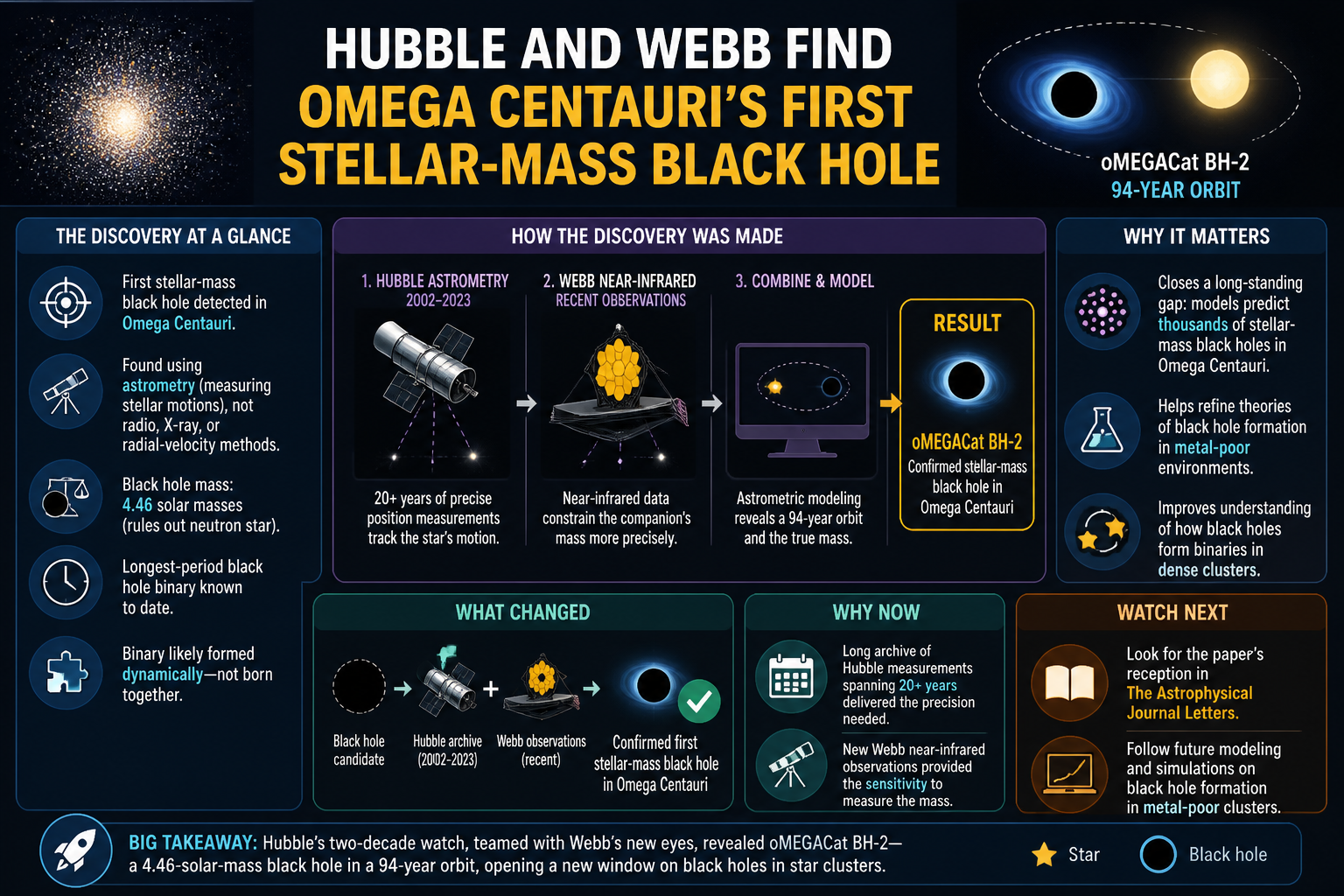
Astronomers using more than 20 years of NASA Hubble Space Telescope archival data, plus recent James Webb Space Telescope observations, say they have identified the first stellar-mass black hole in Omega Centauri [13]. The object, dubbed oMEGACat BH-2, was found through astrometry rather than the usual radio, X-ray, or radial-velocity methods, and the team says the binary has a 94-year orbit [13].
Why it matters: This is a notable step in resolving a long-standing gap in what scientists expected to find inside Omega Centauri, where models suggest thousands of stellar-mass black holes should exist [13]. The result may refine theories of black hole formation in metal-poor environments and improve understanding of how black holes form binaries in dense clusters [13].
Key insights: The discovery combines Hubble astrometry from 2002 to 2023 with Webb near-infrared data to constrain the companion’s mass more precisely [13]. | The team says the black hole’s mass is 4.46 solar masses, ruling out the earlier neutron-star interpretation [13]. | Researchers say the binary likely formed dynamically, meaning the star and black hole did not start out together [13]. | The system’s long orbital period makes it the longest-period black hole binary known to date [13].
Cheatsheet facts: What changed: A black hole candidate in Omega Centauri was confirmed as the cluster’s first detected stellar-mass black hole using Hubble and Webb data [13]. | Why now: A long archive of Hubble measurements plus newer Webb observations gave the precision needed to measure the object’s motion and mass [13]. | Watch next: Look for the paper’s reception in The Astrophysical Journal Letters and any follow-up modeling on black hole formation in metal-poor clusters [13].