NASA changes SunRISE’s launch vehicle to Falcon Heavy
NASA says its SunRISE mission will now launch on a SpaceX Falcon Heavy from Kennedy Space Center, replacing the originally planned United Launch Alliance Vulcan Centaur [7]. The mission’s six SmallSats will fly in formation as one large radio telescope above geosynchronous orbit to study solar radi…
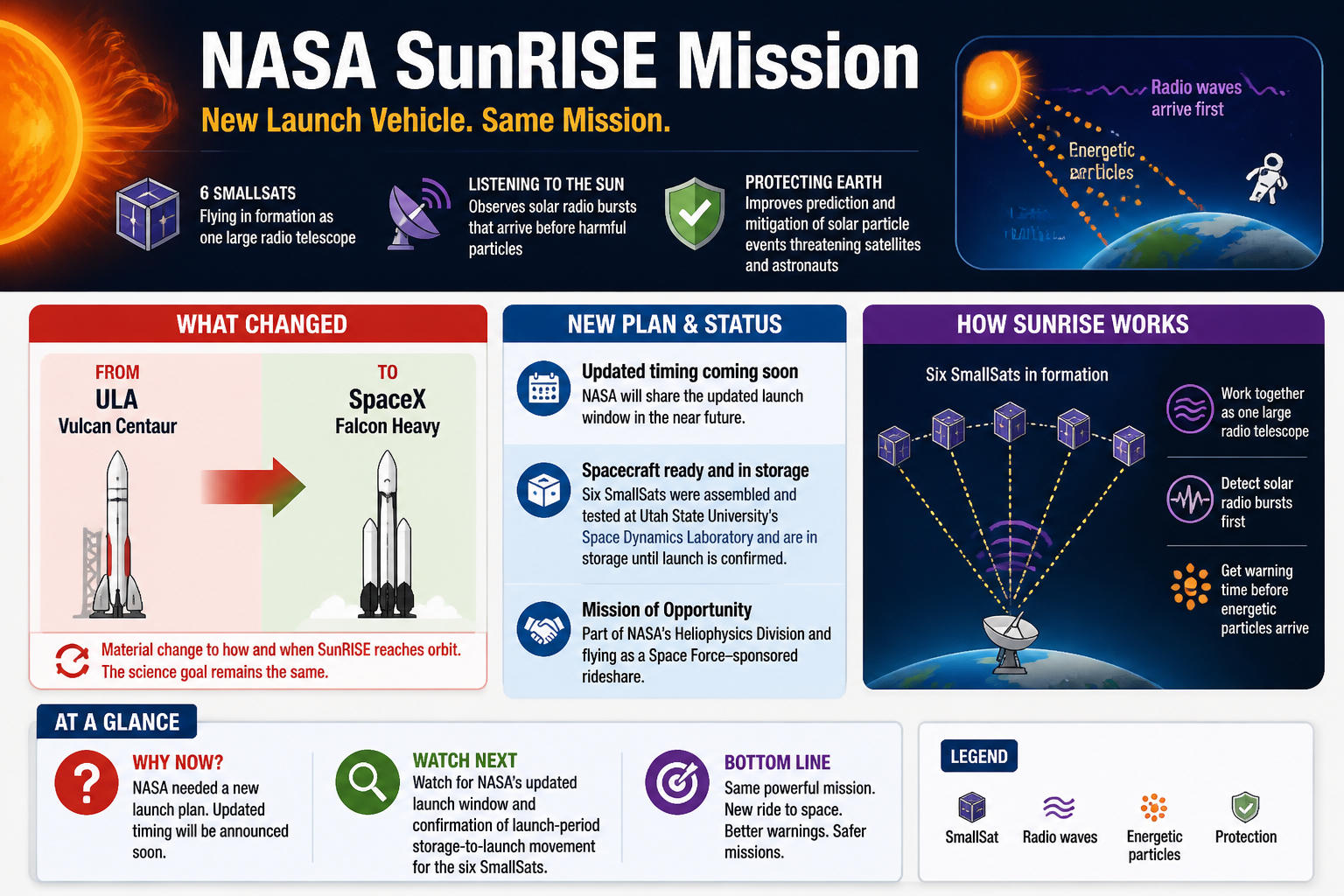
NASA says its SunRISE mission will now launch on a SpaceX Falcon Heavy from Kennedy Space Center, replacing the originally planned United Launch Alliance Vulcan Centaur [7]. The mission’s six SmallSats will fly in formation as one large radio telescope above geosynchronous orbit to study solar radio bursts and the energetic particles that can threaten satellites and astronauts [7].
Why it matters: The launch-vehicle switch is a material mission change because it affects how and when SunRISE reaches orbit, while leaving the science goal intact [7]. The mission is aimed at improving prediction and mitigation of solar particle events that can damage satellites and affect astronauts [7].
Key insights: NASA says it will share updated launch timing in the near future [7]. | The SmallSats were assembled and tested at Utah State University’s Space Dynamics Laboratory and are in storage until launch is confirmed [7]. | SunRISE is a Mission of Opportunity within NASA’s Heliophysics Division and rides as a Space Force-sponsored rideshare [7]. | The mission will observe radio waves that arrive at Earth before solar energetic particles, which could help with warning time [7].
Cheatsheet facts: What changed: SunRISE’s launch vehicle changed from ULA’s Vulcan Centaur to SpaceX Falcon Heavy [7]. | Why now: NASA needed a new launch plan and says updated timing will be announced soon [7]. | Watch next: Watch for NASA’s updated launch window and confirmation of launch-period storage-to-launch movement for the six SmallSats [7].
NASA says its SunRISE mission will now launch on a SpaceX Falcon Heavy from Kennedy Space Center, replacing the originally planned United Launch Alliance Vulcan Centaur [7]. The mission’s six SmallSats will fly in formation as one large radio telescope above geosynchronous orbit to study solar radio bursts and the energetic particles that can threaten satellites and astronauts [7].
Why it matters: The launch-vehicle switch is a material mission change because it affects how and when SunRISE reaches orbit, while leaving the science goal intact [7]. The mission is aimed at improving prediction and mitigation of solar particle events that can damage satellites and affect astronauts [7].
Key insights: NASA says it will share updated launch timing in the near future [7]. | The SmallSats were assembled and tested at Utah State University’s Space Dynamics Laboratory and are in storage until launch is confirmed [7]. | SunRISE is a Mission of Opportunity within NASA’s Heliophysics Division and rides as a Space Force-sponsored rideshare [7]. | The mission will observe radio waves that arrive at Earth before solar energetic particles, which could help with warning time [7].
Cheatsheet facts: What changed: SunRISE’s launch vehicle changed from ULA’s Vulcan Centaur to SpaceX Falcon Heavy [7]. | Why now: NASA needed a new launch plan and says updated timing will be announced soon [7]. | Watch next: Watch for NASA’s updated launch window and confirmation of launch-period storage-to-launch movement for the six SmallSats [7].