SpaceX seeks approval for a million-satellite AI constellation
SpaceX has applied to the US Federal Communications Commission to launch one million satellites that would use near-constant solar power to provide processing capacity for artificial intelligence.[1] The proposal comes as the active satellite population has already risen from just over 1,000 a deca…
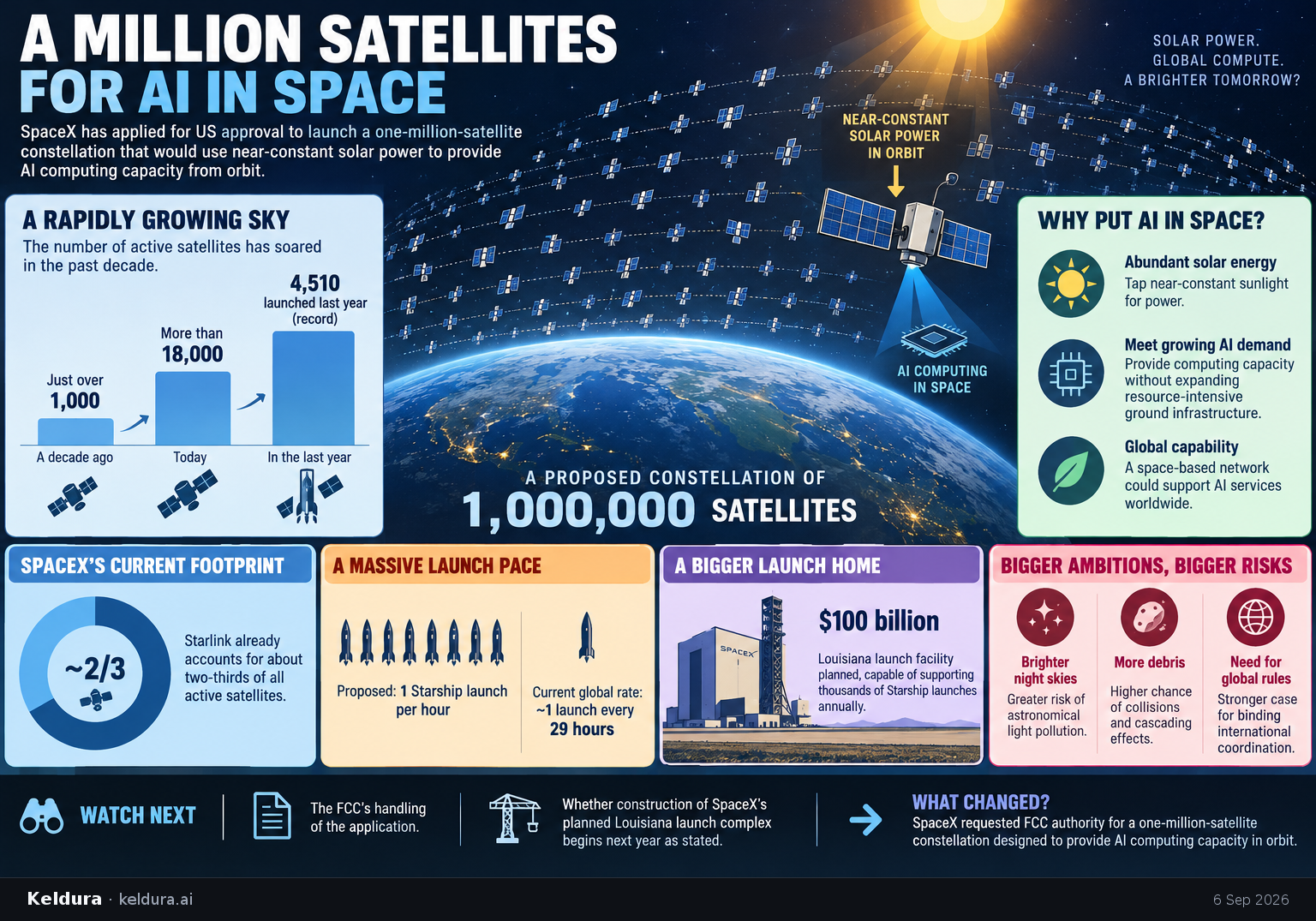
SpaceX has applied to the US Federal Communications Commission to launch one million satellites that would use near-constant solar power to provide processing capacity for artificial intelligence.[1] The proposal comes as the active satellite population has already risen from just over 1,000 a decade ago to more than 18,000, with a record 4,510 objects launched last year.[1]
Why it matters: A constellation on this scale would dramatically increase pressure on low Earth orbit, sharpening concerns about astronomical light pollution, debris and cascading collisions while strengthening the case for binding international coordination.[1]
Key insights: SpaceX’s Starlink network already accounts for about two-thirds of all active satellites.[1] | The filing targets a Starship launch cadence of one per hour, compared with a current global rate of roughly one rocket launch every 29 hours.[1] | SpaceX says orbital computing could meet AI’s growing electricity demand by drawing directly on abundant solar energy, rather than expanding resource-intensive terrestrial infrastructure.[1] | The company has unveiled plans for a $100 billion Louisiana launch facility capable of supporting thousands of Starship launches annually.[1]
Cheatsheet facts: What changed: SpaceX requested FCC authority for a one-million-satellite constellation designed to provide AI computing capacity in orbit.[1] | Why now: AI power demand is rising as satellite deployment is already at record levels, with 4,510 objects launched last year.[1] | Watch next: Watch the FCC’s handling of the application and whether construction of SpaceX’s planned Louisiana launch complex begins next year as stated.[1]