Perseverance finds extensive complex organic carbon in ancient Martian river rocks
Scientists have confirmed hundreds of detections of macromolecular carbon in two mudstones from the Bright Angel formation, an ancient river channel that once fed Jezero Crater’s lake.[2] Perseverance’s SHERLOC instrument found the complex carbon in both sedimentary minerals and later-forming carbo…
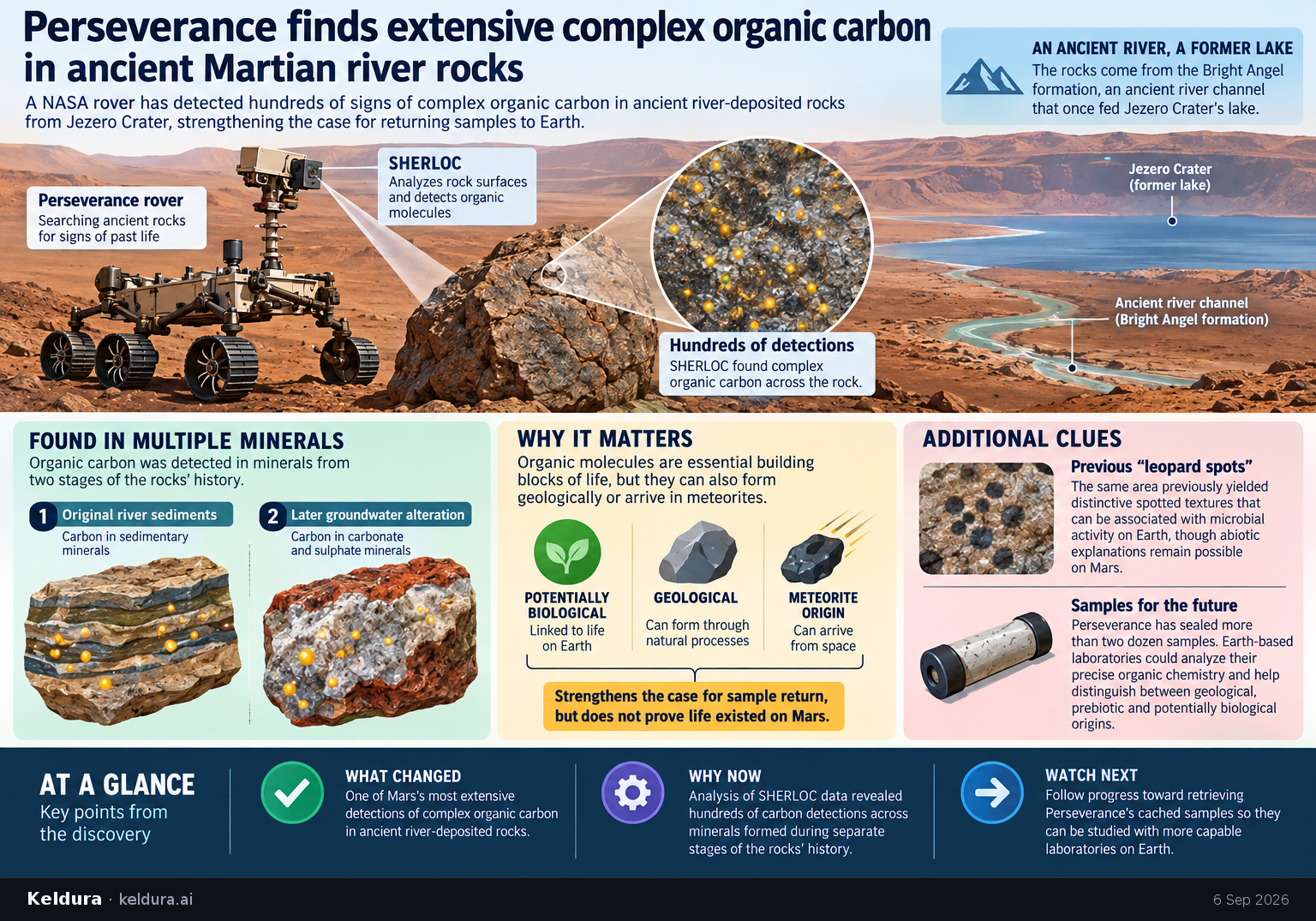
Scientists have confirmed hundreds of detections of macromolecular carbon in two mudstones from the Bright Angel formation, an ancient river channel that once fed Jezero Crater’s lake.[2] Perseverance’s SHERLOC instrument found the complex carbon in both sedimentary minerals and later-forming carbonate and sulphate minerals, indicating incorporation during at least two stages of the rocks’ history.[2]
Why it matters: Organic molecules are essential building blocks of life but can also form geologically or arrive in meteorites, so the result strengthens the case for returning Perseverance’s samples to Earth without establishing that Mars once hosted life.[2]
Key insights: The finding is thought to be the only detection of macromolecular carbon on a natural rock surface on Mars.[2] | Carbon associated with both original sediments and later groundwater alteration suggests that organic chemistry persisted through multiple environmental phases.[2] | The same area previously yielded distinctive “leopard spots” that can be associated with microbial activity on Earth, although abiotic explanations remain possible on Mars.[2] | Perseverance has sealed more than two dozen samples whose precise organic chemistry could be studied with more capable laboratories on Earth.[2]
Cheatsheet facts: What changed: Researchers confirmed one of Mars’s most extensive detections of complex organic carbon in ancient river-deposited rocks.[2] | Why now: Analysis of SHERLOC observations revealed hundreds of carbon detections distributed across minerals formed during separate stages of the rocks’ history.[2] | Watch next: Watch progress toward retrieving Perseverance’s cached samples, because Earth-based analysis could distinguish geological, prebiotic and potentially biological origins more precisely.[2]