Roman’s corrected optics beat its image-quality requirement
Roman’s main instrument now promises sharper survey images, but what calibration work remains?
On October 14, 2026, NASA reported that its Nancy Grace Roman Space Telescope team had corrected the observatory’s optics and prepared its main instrument for routine use.
NASA’s Roman team reduced the Wide Field Instrument’s optical error to 63 nanometers RMS, against an image-quality requirement of about 90 nanometers RMS. The team also corrected initially out-of-focus Coronagraph Instrument images, though that instrument still needs further calibration before its…
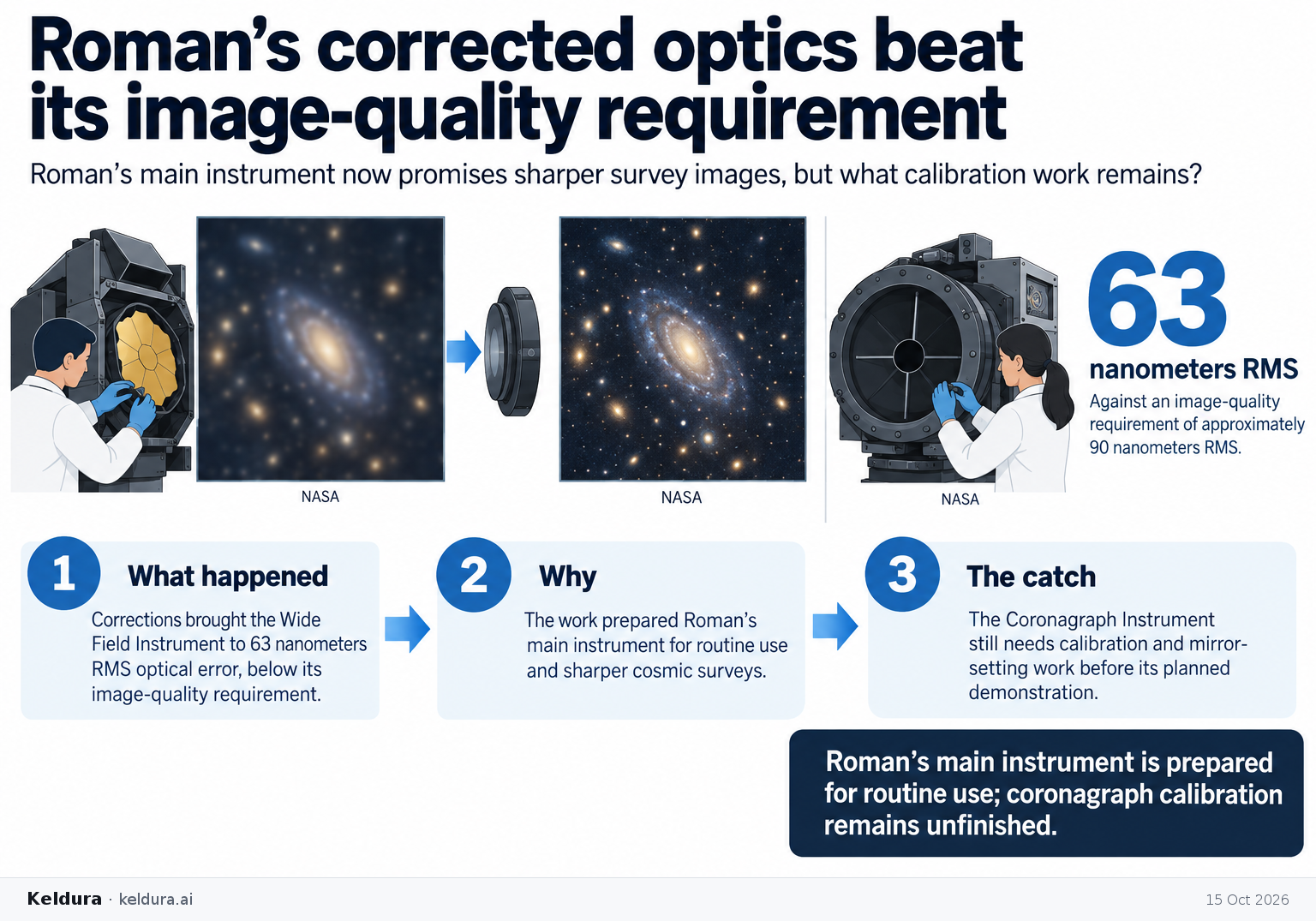
NASA’s Roman team reduced the Wide Field Instrument’s optical error to 63 nanometers RMS, against an image-quality requirement of about 90 nanometers RMS. The team also corrected initially out-of-focus Coronagraph Instrument images, though that instrument still needs further calibration before its light-suppression demonstration. [5]
Why it matters: Sharper images improve the raw material for Roman’s broad cosmic surveys, which are intended to investigate dark matter, dark energy, exoplanets, and distant galaxies. [5]
Key insights: The reported improvement is measurable: 63 nanometers RMS is 30% less optical error than the approximately 90-nanometer requirement. [5] | The two instruments are at different stages: the main instrument has completed this preparation, while the coronagraph team is still determining settings for its deformable mirrors. [5]
Cheatsheet facts: What happened: Corrections brought Roman’s Wide Field Instrument to 63 nanometers RMS optical error, below its approximately 90-nanometer requirement. [5] | Why: The work fine-tuned the observatory’s vision and prepared its primary instrument for routine use. [5] | The catch: The Coronagraph Instrument still needs calibration and mirror-setting work before its planned light-suppression demonstration in the coming weeks. [5]