Griffin-1 passes environmental tests ahead of planned lunar delivery
Griffin-1 has endured simulated launch and space conditions, but what remains before it can deliver cargo to the Moon?
On October 13, NASA reported that Voyager Technologies’ Griffin-1 lunar lander had passed environmental testing at the Jet Propulsion Laboratory.
Griffin-1 passed tests at NASA’s Jet Propulsion Laboratory that simulated launch vibration and noise, space vacuum, and extreme temperatures. The lander has returned to Voyager Lunar Systems for final assembly ahead of launch-readiness work and a planned launch later this year to deliver 10 science…
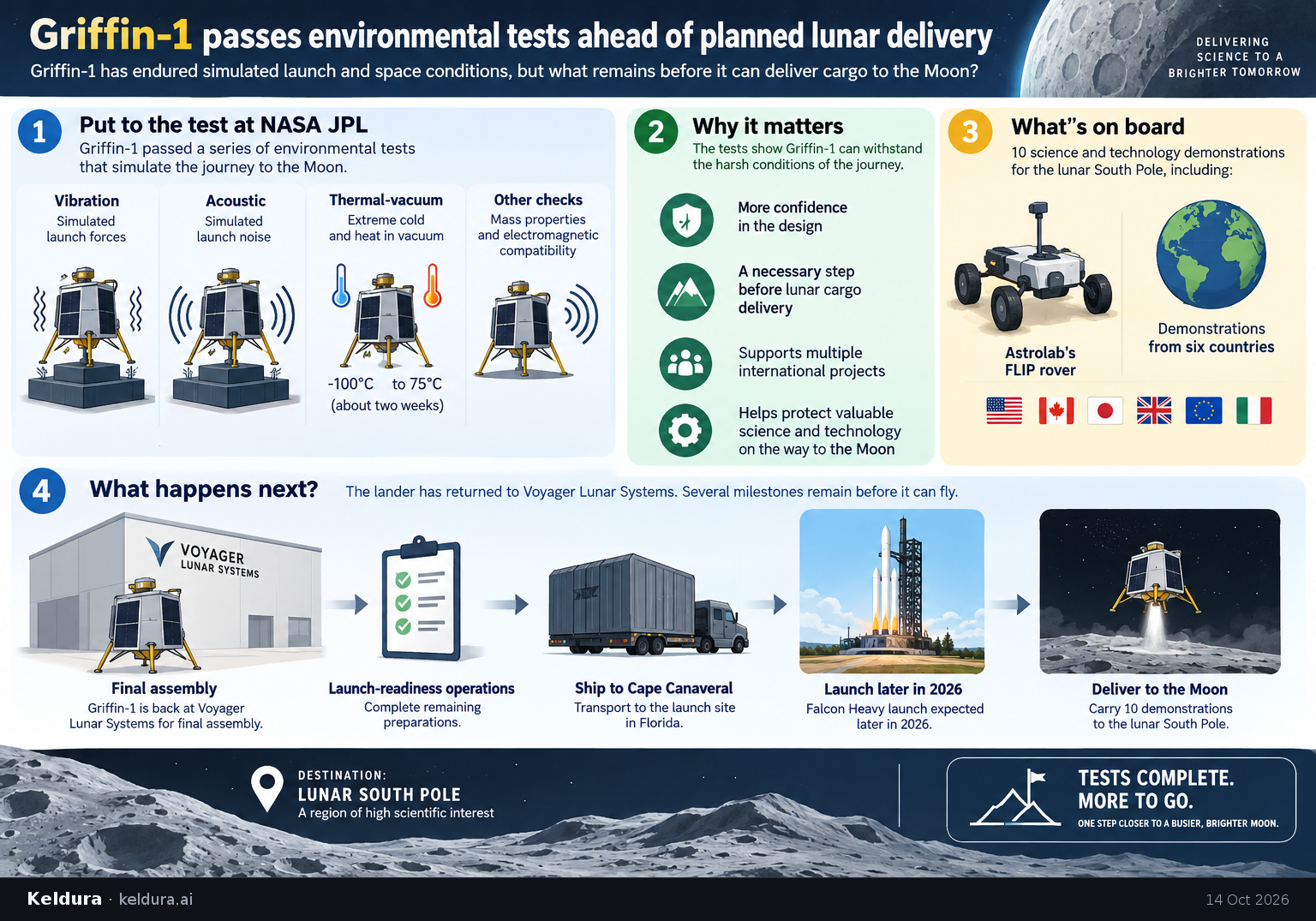
Griffin-1 passed tests at NASA’s Jet Propulsion Laboratory that simulated launch vibration and noise, space vacuum, and extreme temperatures. The lander has returned to Voyager Lunar Systems for final assembly ahead of launch-readiness work and a planned launch later this year to deliver 10 science and technology demonstrations near the lunar South Pole. [11]
Why it matters: The tests provide evidence that the spacecraft can withstand conditions on its journey, a necessary step before attempting lunar cargo delivery. Its planned payload includes Astrolab’s FLIP rover and demonstrations from six countries, making the remaining assembly and flight milestones relevant to multiple projects. [11]
Key insights: Thermal-vacuum testing exposed Griffin-1 to temperatures ranging from minus 100 degrees Celsius to 75 degrees Celsius over about two weeks. [11] | Separate tests checked mass properties and electromagnetic compatibility, addressing navigation behavior and whether onboard electronics interfere with one another. [11] | Passing environmental tests is not the end of preparation: final assembly, launch-readiness operations, and shipment to Cape Canaveral remain. [11]
Cheatsheet facts: What happened: Griffin-1 passed launch and space-environment tests at NASA’s Jet Propulsion Laboratory. [11] | Why: Engineers tested whether the lander could withstand vibration, acoustic loads, vacuum, and temperature extremes during its lunar mission. [11] | The catch: The spacecraft is back at Voyager Lunar Systems for final assembly; the successful tests do not mean it has launched or landed. [11] | What's next: NASA identifies launch-readiness operations and shipment to Cape Canaveral as the next steps, with a Falcon Heavy launch expected later in 2026. [11]