NASA opens $10 billion lunar delivery competition and student challenge
NASA announced a $10 billion framework for the second phase of Commercial Lunar Payload Services, with nine companies competing to deliver technology and infrastructure to the Moon over 10 years.
On November 7–8, NASA announced a $10 billion, 10-year lunar delivery framework and opened a $1 million Moon Base Student Challenge.
NASA announced a $10 billion framework for the second phase of Commercial Lunar Payload Services, with nine companies competing to deliver technology and infrastructure to the Moon over 10 years. At the same MAX POWER event, NASA opened a $1 million student challenge covering six Moon Base design c…
Open original (2 sources):
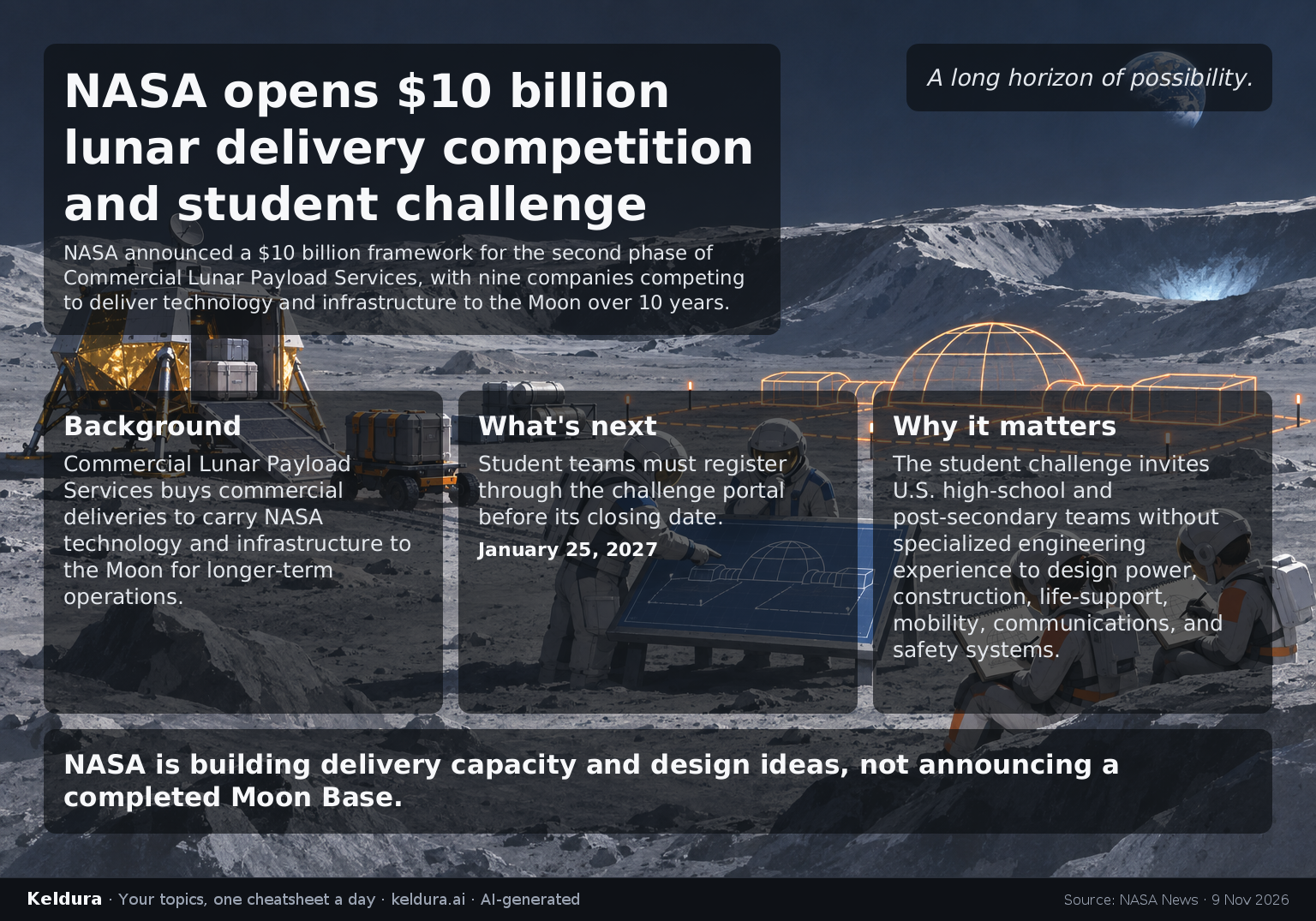
NASA announced a $10 billion framework for the second phase of Commercial Lunar Payload Services, with nine companies competing to deliver technology and infrastructure to the Moon over 10 years. At the same MAX POWER event, NASA opened a $1 million student challenge covering six Moon Base design categories, with registration closing January 25, 2027. [11][12]
Why it matters: A sustained lunar presence requires more than astronaut transport: NASA is seeking delivery services and designs for power, construction, life support, mobility, communications, and safety. U.S. high-school and post-secondary teams can enter the student challenge without prior specialized engineering experience. [11][12]
Key insights: The $10 billion figure describes a competitive, 10-year delivery framework—not an award of that amount to a single lander builder. SpaceX, Blue Origin, and Northrop Grumman Space Systems are among nine competing companies. [12] | Delivery providers are expected to manage, build, and operate landers carrying NASA technology and infrastructure to the Moon. [12] | The student challenge asks for work resembling industry deliverables, including trade studies, concept proposals, and stakeholder briefings. [11] | NASA places the planned Moon Base in the lunar South Pole region and describes sustained lunar operations as preparation for future crewed Mars missions. [11]
Cheatsheet facts: What happened: NASA announced a $10 billion lunar delivery framework and opened a separate $1 million Moon Base Student Challenge. [11][12] | Background: Commercial Lunar Payload Services buys delivery services to the Moon. Its second phase is intended to carry NASA technology and infrastructure needed for longer-term lunar operations. [12] | Why: NASA’s planned South Pole base needs power, construction, life support, mobility, communications, and astronaut safety systems—the student challenge’s six design categories. [11] | The catch: Nine companies are competing within the delivery framework; the announcement is not a completed lunar infrastructure network or a single-company $10 billion award. [12] | What's next: Student teams must register through NASA STEM Gateway by January 25, 2027. [11]
X copy pack
Edition complete
You've reached the end of this edition.