Perseverance collects its first Mars sample in over a year
Perseverance finally collected a hard-rock sample, but can scientists establish whether it is among the oldest in its collection?
On October 24, 2026, NASA’s Perseverance rover collected the Singita rock sample on Mars, its first sample in more than a year.
Perseverance collected Singita after moving about 100 meters from a rock that was too hard to core and selecting a flatter target and a less-worn drill bit. The drill penetrated about 3.1 centimeters into a gabbro whose textures suggest formation deep in Mars’s crust followed by excavation through…
Open original (2 sources):
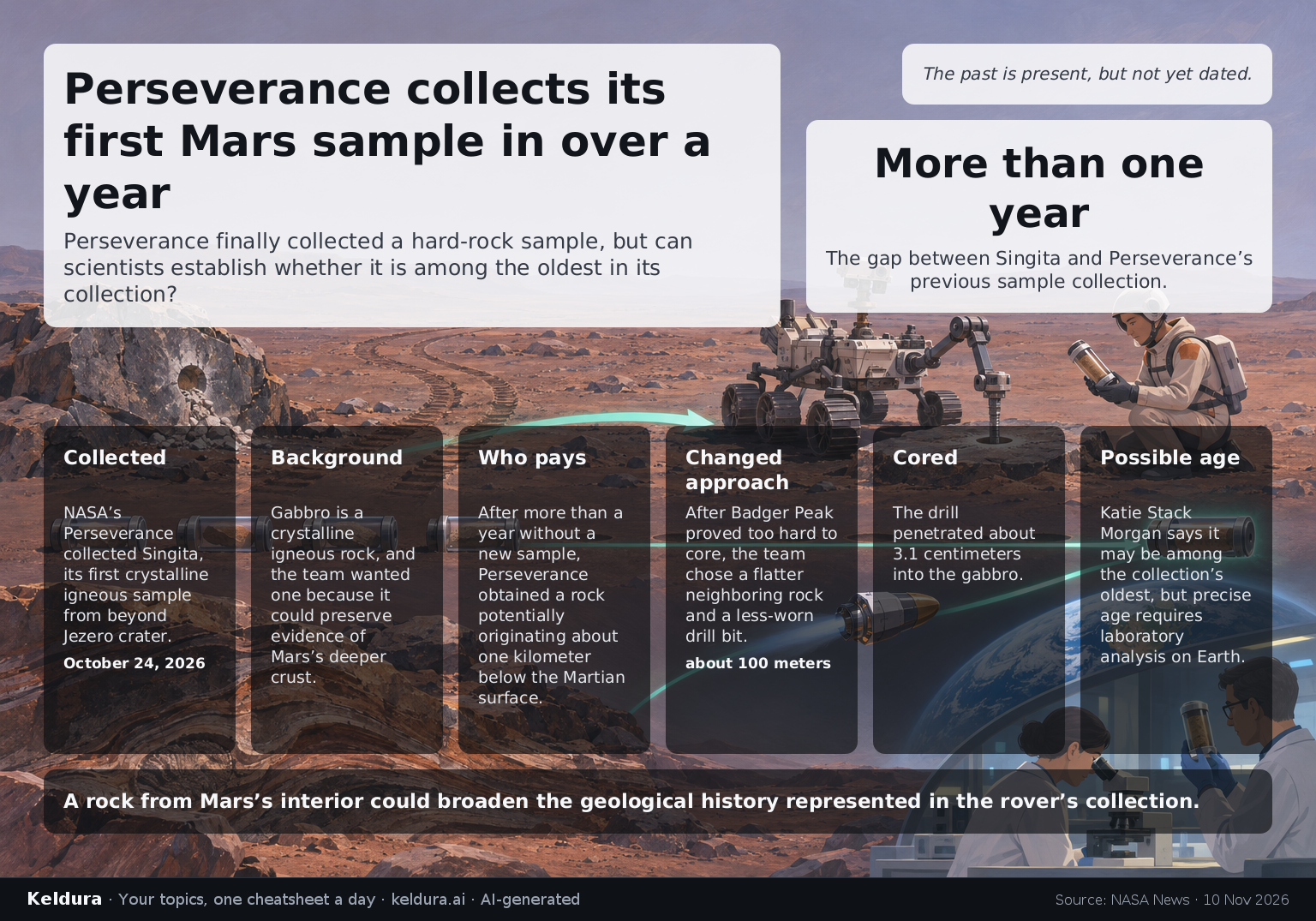
Perseverance collected Singita after moving about 100 meters from a rock that was too hard to core and selecting a flatter target and a less-worn drill bit. The drill penetrated about 3.1 centimeters into a gabbro whose textures suggest formation deep in Mars’s crust followed by excavation through one or more large impacts. [9] Singita may be exceptionally old, but determining its precise age requires returning it to Earth. [4]
Why it matters: Singita gives scientists a physical sample of material likely formed deep inside Mars, rather than only observations of its surface. It is Perseverance’s first crystalline igneous sample from beyond Jezero crater, potentially extending the geological history represented in the rover’s collection. [4][9]
Key insights: Gabbro is an igneous rock made mainly of calcium-rich plagioclase feldspar and pyroxene crystals; the team specifically wanted this rock type in its collection. [9] | The successful attempt changed both the drilling geometry and the tool condition: a flatter neighboring rock supported the drill stabilizers, while a less-worn bit improved the chances of coring. [9] | Project scientist Katie Stack Morgan said the rock likely originated about one kilometer below the surface before an impact excavated it. [4] | The suggestion that Singita is among the oldest rocks is not a measured age; precise dating awaits laboratory analysis on Earth. [4]
Cheatsheet facts: What happened: Perseverance collected Singita on October 24, ending a gap of more than a year between sample collections. [4][9] | Why: The team wanted a gabbro sample and moved about 100 meters after the earlier Badger Peak rock proved too hard to core. [9] | The catch: Textures suggest a deep-crustal origin and possibly great age, but scientists need the sample on Earth to determine its precise age. [4][9] | What we don't know: Did one large impact bring Singita to the surface, or did multiple impacts shape its history? NASA identifies both possibilities. [9]
X copy pack
Edition complete
You've reached the end of this edition.