Puncak Jaya’s remaining ice has fragmented beyond glacier flow
Only about 2% of Puncak Jaya’s 1988 ice area remained in 2025, but how long can the scattered patches survive?
On November 16, NASA described Puncak Jaya’s ice as patches too small to flow as glaciers, following a measured decline to 0.09 square kilometers by September 2025.
NASA’s account of Puncak Jaya describes the Indonesian mountain’s remaining ice as scattered patches too small to flow like glaciers. [3] Satellite and aerial measurements put the September 2025 area at about 0.09 square kilometers, roughly 2% of its 1988 extent, while a 2026 Landsat image shows ne…
Open original · [3] The Last Ice on Puncak Jaya - NASA Science — science.nasa.gov
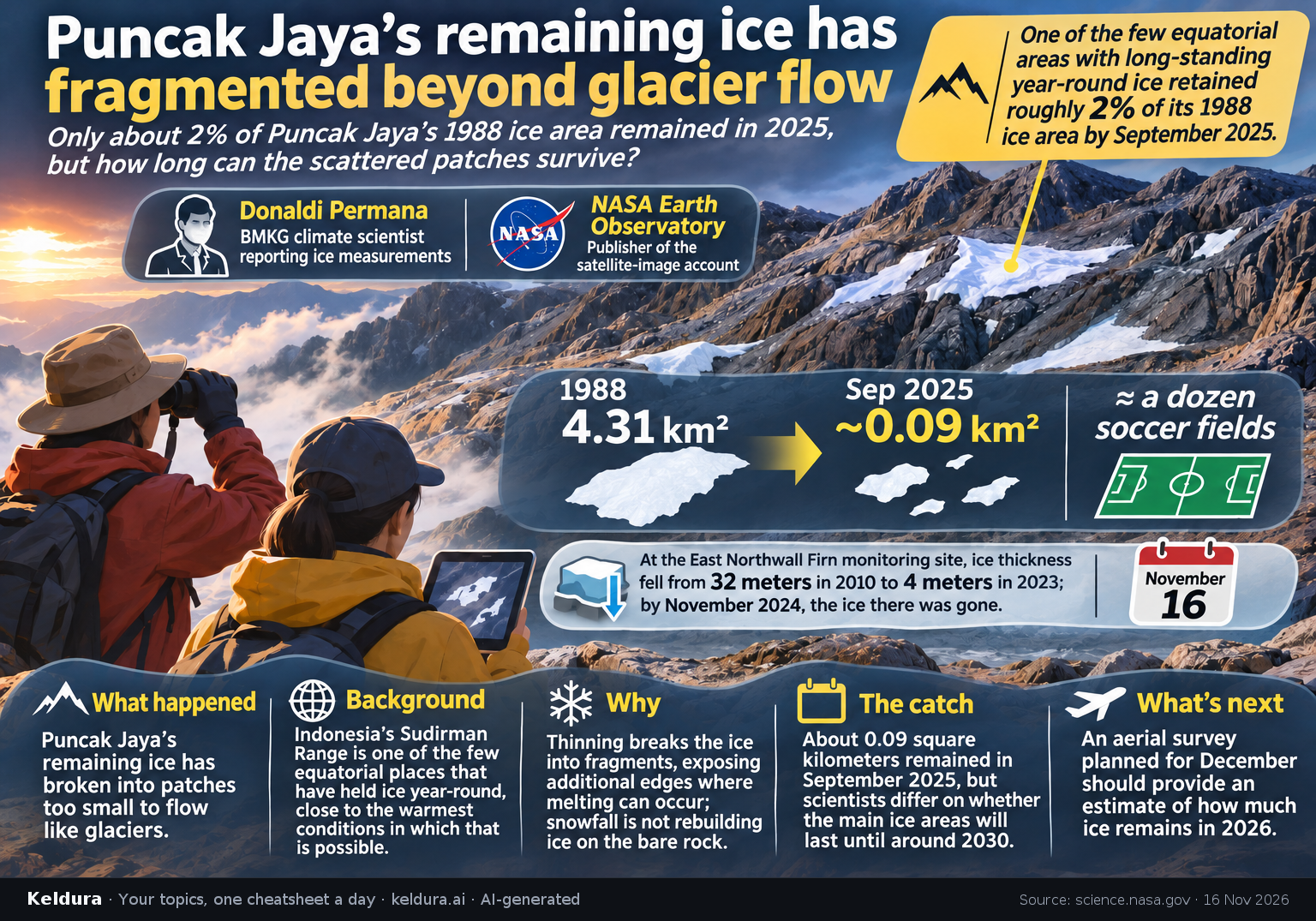
NASA’s account of Puncak Jaya describes the Indonesian mountain’s remaining ice as scattered patches too small to flow like glaciers. [3] Satellite and aerial measurements put the September 2025 area at about 0.09 square kilometers, roughly 2% of its 1988 extent, while a 2026 Landsat image shows newly exposed bedrock between remnants. [3]
Why it matters: Readers can see a concrete measure of change in a rare equatorial ice system: an area of 4.31 square kilometers in 1988 had contracted to roughly a dozen soccer fields by September 2025. Scientists use these tropical glaciers as indicators because they exist near the warmest conditions that allow year-round ice. [3]
Key insights: At the East Northwall Firn monitoring site, ice thickness fell from 32 meters in 2010 to 4 meters in 2023; by November 2024, the ice there was gone. [3] | Fragmentation exposes more ice edges to melting, adding a mechanism that compounds the loss as the ice shrinks. [3] | Snow still falls, but it does not remain on the exposed rock long enough to accumulate into new ice. [3] | Satellite studies suggest the main glacial ice areas could disappear around 2030; BMKG estimates allow an earlier disappearance, accelerated by the current El Niño. [3]
Cheatsheet facts: What happened: Puncak Jaya’s remaining ice has broken into patches too small to flow like glaciers. [3] | Background: Indonesia’s Sudirman Range is one of the few equatorial places that have held ice year-round, close to the warmest conditions in which that is possible. [3] | Why: Thinning breaks the ice into fragments, exposing additional edges where melting can occur; snowfall is not rebuilding ice on the bare rock. [3] | The catch: About 0.09 square kilometers remained in September 2025, but scientists differ on whether the main ice areas will last until around 2030. [3] | What's next: An aerial survey planned for December should provide an estimate of how much ice remains in 2026. [3]
X copy pack
Edition complete
You've reached the end of this edition.