Two of NASA’s four Mars missions pause science
NASA can still hear Perseverance, but what will it take to get the rover and the Odyssey orbiter back to science?
By November 24, NASA had paused science on its Perseverance rover and Odyssey orbiter after separate faults sidelined two of its four missions operating at Mars.
NASA paused Perseverance science after its primary relay radio stopped responding and its backup transmitted at about half its expected power. The Odyssey orbiter suspended science after losing a second steering wheel, leaving it dependent on fuel-burning thrusters to stay pointed. [4]
Open original · [4] Half of NASA's aging Mars fleet knocked offline by technical issues - Ars Technica — arstechnica.com
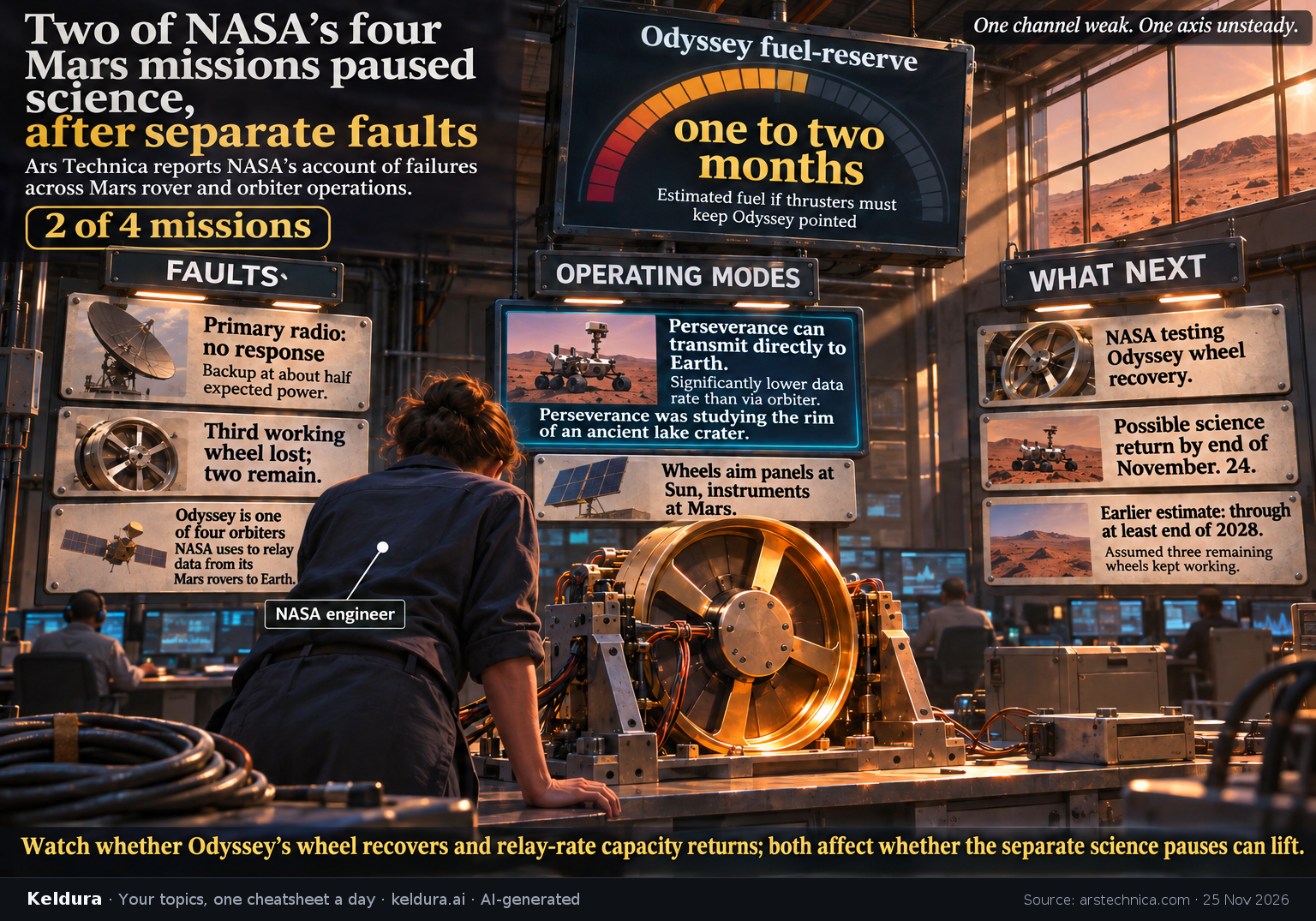
NASA paused Perseverance science after its primary relay radio stopped responding and its backup transmitted at about half its expected power. The Odyssey orbiter suspended science after losing a second steering wheel, leaving it dependent on fuel-burning thrusters to stay pointed. [4]
Why it matters: The outages interrupt two different kinds of work: Perseverance was studying the rim of an ancient lake crater, and Odyssey is one of four orbiters NASA uses to relay data from its Mars rovers to Earth. Engineers estimate Odyssey has only one to two months of fuel if it cannot recover its third working wheel. [4]
Key insights: Perseverance can still transmit directly to Earth, but at a significantly lower data rate than it gets by relaying through an orbiter. [4] | Odyssey arrived at Mars in 2001 and needs three working reaction wheels to orient itself without relying entirely on thrusters; it now has two. [4] | The earlier estimate that Odyssey could operate through at least the end of 2028 assumed its three remaining wheels would keep working. [4]
Cheatsheet facts: What happened: Perseverance and Odyssey paused science after separate hardware faults, affecting half of NASA’s four missions at Mars. [4] | Background: Mars orbiters relay rover data to Earth. Odyssey also uses spinning devices called reaction wheels to aim its solar panels at the Sun and its instruments at Mars. [4] | Why: Perseverance’s main relay radio did not respond and its backup was weak; Odyssey lost the third working wheel it needed to hold its orientation without relying entirely on thrusters. [4] | The catch: Perseverance has a slower link, while Odyssey has an estimated one to two months of fuel if it must keep using thrusters to stay pointed. [4] | What's next: NASA is testing whether Odyssey’s wheel can be recovered and says Perseverance could return to science by the end of November. [4]