NASA’s Leading Strawberry Keeps Its Spot in Space Crop Trials
A wild strawberry produced twice as much fruit in a trial, but is yield what matters most when every inch counts?
On November 25, 2026, NASA highlighted trials in which its Delizz strawberry stayed the leading candidate despite a wild variety producing twice as much fruit.
In simulated space-growing conditions, a wild strawberry grown from seed produced twice as many buds, flowers and fruit as Delizz, NASA's leading strawberry candidate, but sent out too many runners for tight spacecraft quarters. [9] Separate ground tests found that cucumbers kept producing edible f…
Open original · [9] NASA Science - Crop production systems for the Moon Base — NASA News
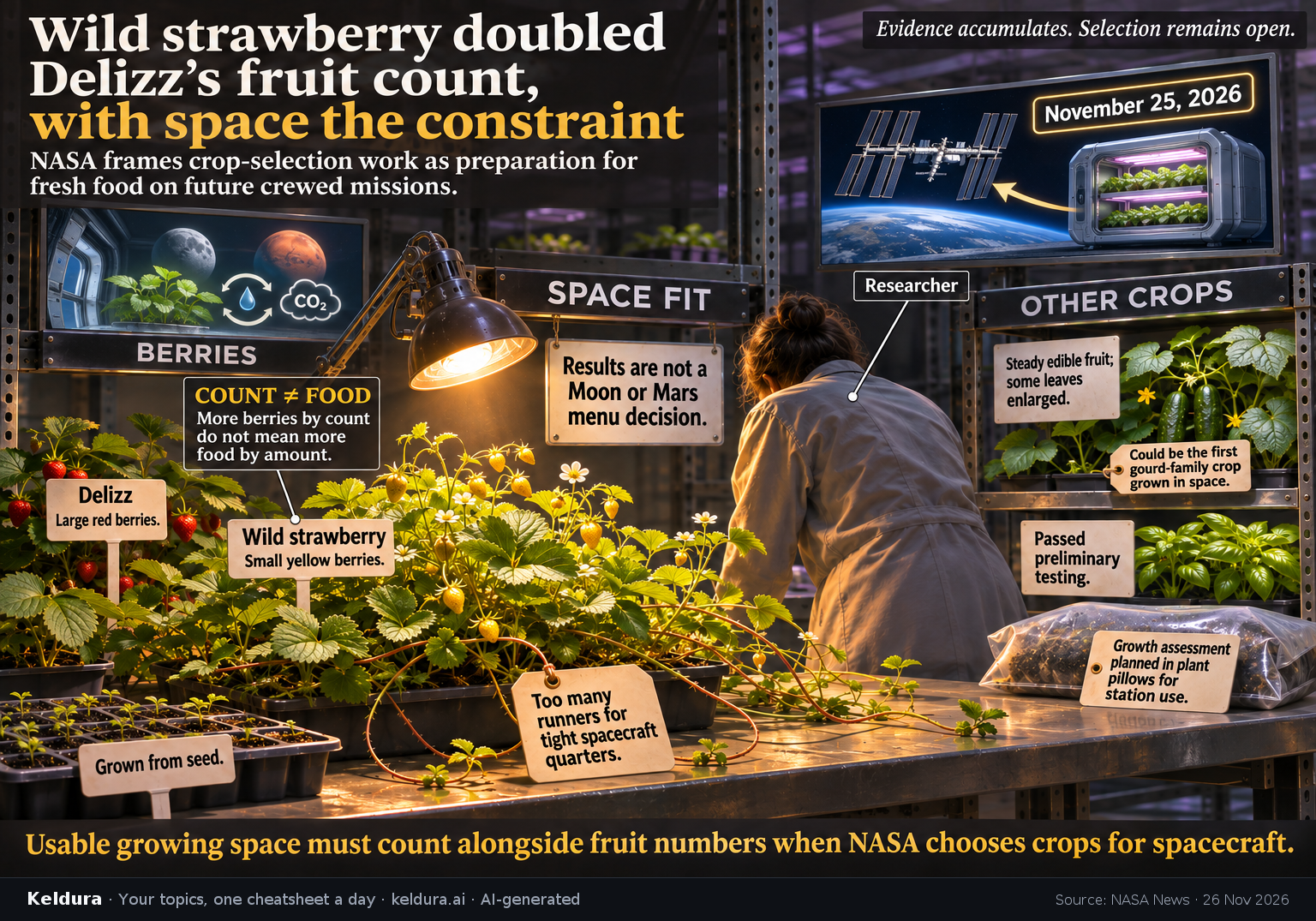
In simulated space-growing conditions, a wild strawberry grown from seed produced twice as many buds, flowers and fruit as Delizz, NASA's leading strawberry candidate, but sent out too many runners for tight spacecraft quarters. [9] Separate ground tests found that cucumbers kept producing edible fruit and that lemon basil passed preliminary testing. [9]
Why it matters: For crews heading to the Moon or Mars, plants could add fresh food to packaged meals while recycling water and taking up carbon dioxide. The strawberry trial shows why usable growing space matters alongside fruit count when choosing crops for a spacecraft. [9]
Key insights: Delizz produced large red berries, while the wild strawberry produced small yellow berries, so twice the fruit count does not mean twice the amount of food. [9] | Cucumbers produced a steady supply of edible fruit despite some enlarged leaves in ground tests; they could become the first gourd-family crop grown in space. [9] | Lemon basil passed preliminary tests, and researchers plan to assess how it grows in plant pillows designed to hold plants aboard the space station. [9]
Cheatsheet facts: What happened: A wild strawberry outproduced Delizz in fruit count, but Delizz remained NASA's leading strawberry candidate. [9] | Why: The wild plant made too many runners, stems that spread outward and would take up room aboard a spacecraft. [9] | The catch: The strawberry, cucumber and basil results come from work on Earth; they are not a menu decision for the Moon or Mars. [9] | What's next: NASA plans to send a prototype growing chamber to the International Space Station to inform crop systems for future Moon and Mars missions. [9]