Why is global AI oversight advancing without the biggest powers?
Heads of major AI firms told the UN Security Council that international oversight was urgently needed to address risks that no country.
Heads of major AI firms told the UN Security Council that international oversight was urgently needed to address risks that no country could contain alone.[4] The United States rejected centralized global governance, while competition between the US and China makes major near-term restrictions less…
Heads of major AI firms told the UN Security Council that international oversight was urgently needed to address risks that no country could contain alone.[4] The United States rejected centralized global governance, while competition between the US and China makes major near-term restrictions less attractive to either power.[4]
Why it matters: AI governance is developing through nonbinding resolutions, scientific advice and diplomatic forums, but the reluctance of the leading AI powers to accept common restrictions limits the ability of those institutions to impose enforceable safeguards.[4]
Key insights: The UN General Assembly unanimously adopted its first AI resolution in 2024, calling for data protection, risk monitoring and human-rights safeguards, but the measure was nonbinding.[4] | The UN has since formed the Independent International Scientific Panel on AI to provide assessments and the Global Dialogue on AI Governance to host recurring policy discussions.[4] | US representative Michael Kratsios said international bodies should share best practices and build domestic capacity rather than establish a global regulatory system.[4][7] | The UN’s existing agenda spans worker protections, access to AI and monitoring its use in military conflicts.[4]
Cheatsheet facts: What changed: AI industry leaders brought calls for global oversight directly to the UN Security Council, framing advanced AI as a cross-border risk.[4] | Why now: AI adoption has accelerated since the UN’s nonbinding 2024 resolution, while the US and China remain locked in a race to develop more powerful systems.[4] | Watch next: Watch the Global Dialogue on AI Governance and the Independent International Scientific Panel for concrete standards or assessments, alongside US-China discussions over whether and how to regulate AI.[4]
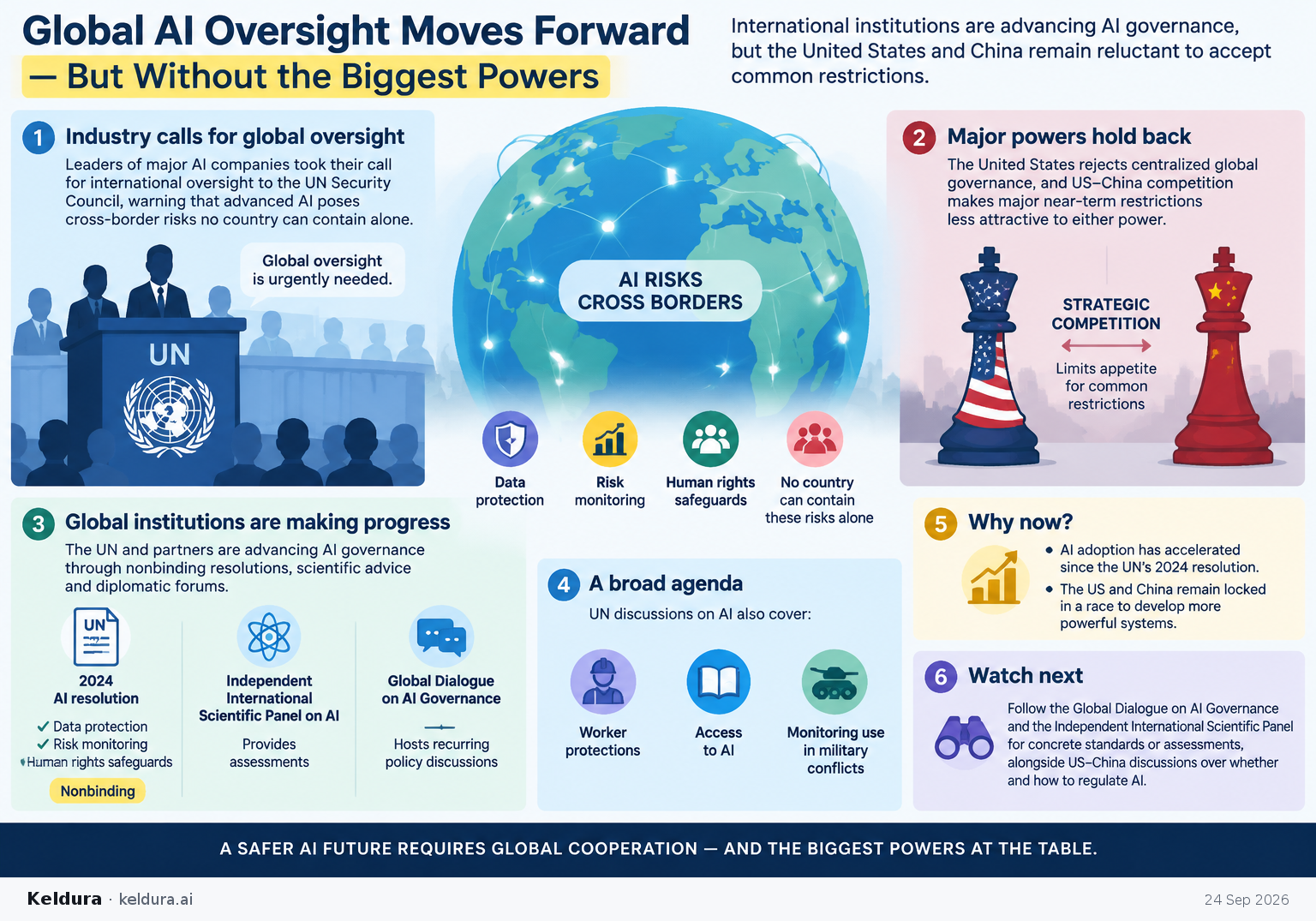
Heads of major AI firms told the UN Security Council that international oversight was urgently needed to address risks that no country could contain alone.[4] The United States rejected centralized global governance, while competition between the US and China makes major near-term restrictions less attractive to either power.[4]
Why it matters: AI governance is developing through nonbinding resolutions, scientific advice and diplomatic forums, but the reluctance of the leading AI powers to accept common restrictions limits the ability of those institutions to impose enforceable safeguards.[4]
Key insights: The UN General Assembly unanimously adopted its first AI resolution in 2024, calling for data protection, risk monitoring and human-rights safeguards, but the measure was nonbinding.[4] | The UN has since formed the Independent International Scientific Panel on AI to provide assessments and the Global Dialogue on AI Governance to host recurring policy discussions.[4] | US representative Michael Kratsios said international bodies should share best practices and build domestic capacity rather than establish a global regulatory system.[4][7] | The UN’s existing agenda spans worker protections, access to AI and monitoring its use in military conflicts.[4]
Cheatsheet facts: What changed: AI industry leaders brought calls for global oversight directly to the UN Security Council, framing advanced AI as a cross-border risk.[4] | Why now: AI adoption has accelerated since the UN’s nonbinding 2024 resolution, while the US and China remain locked in a race to develop more powerful systems.[4] | Watch next: Watch the Global Dialogue on AI Governance and the Independent International Scientific Panel for concrete standards or assessments, alongside US-China discussions over whether and how to regulate AI.[4]