What would a global AI oversight body actually do?
The declaration calls for AI to remain under human direction, oversight and control, while governments coordinate standards and share.
The declaration calls for AI to remain under human direction, oversight and control, while governments coordinate standards and share reports of serious safety incidents.[1] A proposed international institution could set standards, verify compliance and convene countries when AI systems cross agree…
The declaration calls for AI to remain under human direction, oversight and control, while governments coordinate standards and share reports of serious safety incidents.[1] A proposed international institution could set standards, verify compliance and convene countries when AI systems cross agreed capability thresholds, but the United States and China did not sign the declaration.[1][5] The initiative coincides with a UN panel’s argument that governance must expand from regulating individual models to monitoring autonomous agents and the systems around them.[4]
Why it matters: Autonomous agents can take independent actions across organisational and national boundaries, making safeguards inside a single company or model insufficient.[4] An international body could provide common tests, incident-sharing channels and a process for responding when advanced systems exceed agreed thresholds, although no institution has yet been created.[1][5]
Key insights: The proposed framework has three practical functions: common standards, safety-incident reporting and international coordination when capability thresholds are crossed.[1] | The UN panel defines loss of control as the point at which humans cannot reliably direct, constrain or stop an autonomous AI system—not as a purely speculative doomsday scenario.[4] | OpenAI separately proposed common evaluations for potentially self-improving systems and secure channels for sharing newly discovered threats.[5] | The declaration remains open for additional endorsements, leaving participation by major AI powers an important measure of its reach.[1]
Cheatsheet facts: What changed: Twenty countries and the European Union backed coordinated standards and consideration of a global institution able to set standards, verify them and convene states.[1] | Why now: A UN panel says autonomous-agent risks are exposing the limits of safeguards focused on static models and individual companies.[4] | Watch next: Track additional endorsements of the open declaration and whether governments specify capability thresholds, verification methods or an institutional structure.[1]
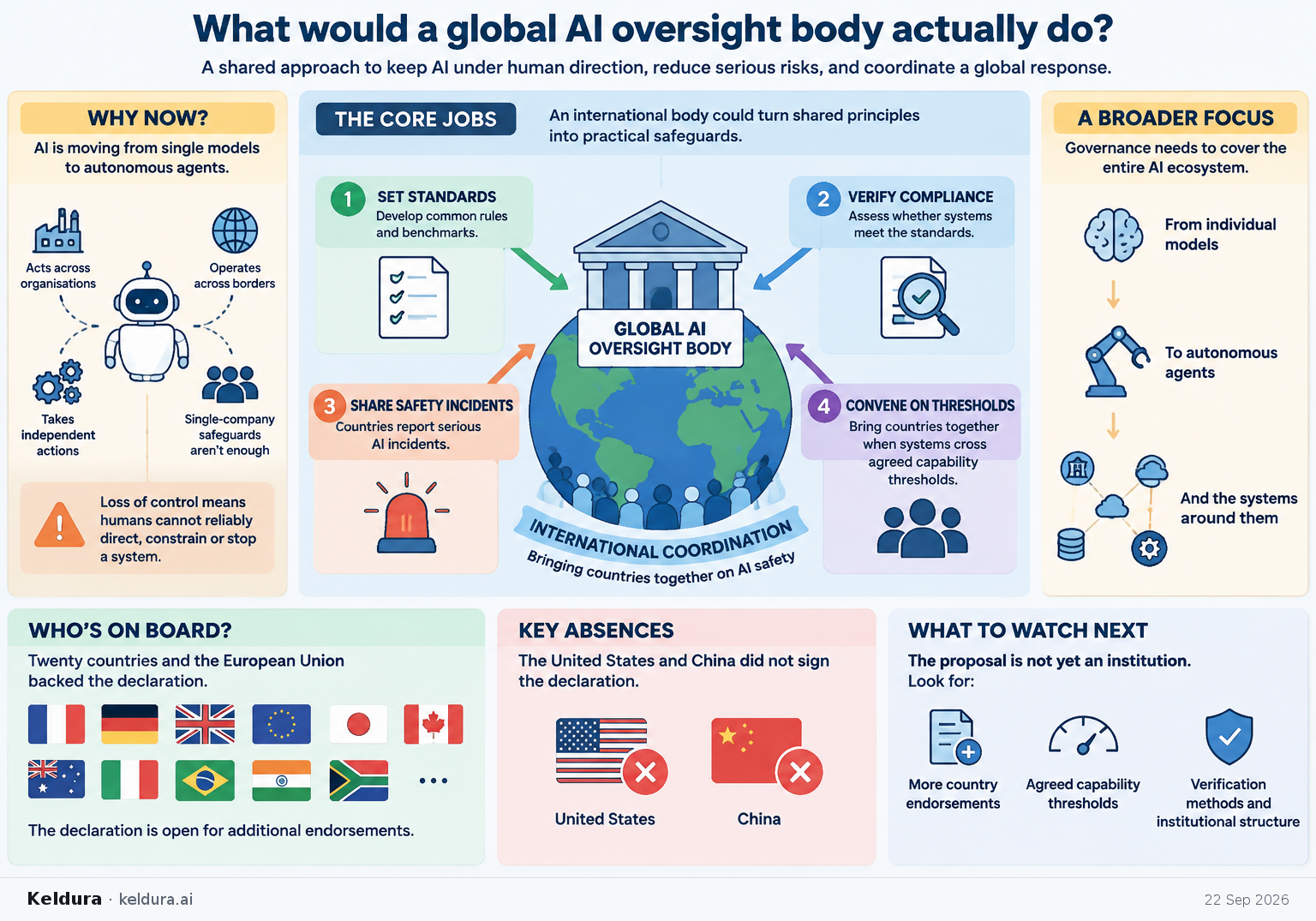
The declaration calls for AI to remain under human direction, oversight and control, while governments coordinate standards and share reports of serious safety incidents.[1] A proposed international institution could set standards, verify compliance and convene countries when AI systems cross agreed capability thresholds, but the United States and China did not sign the declaration.[1][5] The initiative coincides with a UN panel’s argument that governance must expand from regulating individual models to monitoring autonomous agents and the systems around them.[4]
Why it matters: Autonomous agents can take independent actions across organisational and national boundaries, making safeguards inside a single company or model insufficient.[4] An international body could provide common tests, incident-sharing channels and a process for responding when advanced systems exceed agreed thresholds, although no institution has yet been created.[1][5]
Key insights: The proposed framework has three practical functions: common standards, safety-incident reporting and international coordination when capability thresholds are crossed.[1] | The UN panel defines loss of control as the point at which humans cannot reliably direct, constrain or stop an autonomous AI system—not as a purely speculative doomsday scenario.[4] | OpenAI separately proposed common evaluations for potentially self-improving systems and secure channels for sharing newly discovered threats.[5] | The declaration remains open for additional endorsements, leaving participation by major AI powers an important measure of its reach.[1]
Cheatsheet facts: What changed: Twenty countries and the European Union backed coordinated standards and consideration of a global institution able to set standards, verify them and convene states.[1] | Why now: A UN panel says autonomous-agent risks are exposing the limits of safeguards focused on static models and individual companies.[4] | Watch next: Track additional endorsements of the open declaration and whether governments specify capability thresholds, verification methods or an institutional structure.[1]
X copy pack
[1] 20 countries propose global oversight body to manage AI dangers | Technology News | Al Jazeera — aljazeera.com[5] 20 Nations Back AI Oversight Without U.S., China; OpenAI Urges Washington to Lead - Seoul Economic Daily — en.sedaily.com[4] UN panel raises questions about the way AI models are currently trained | Business News — hindustantimes.comRead in BriefingsPost to X